How to Reach a 1500 Rating on Chess.com as an Adult
I have been working as an online chess coach for many years, and every time a new adult student comes to me, I ask him the same question in the first lesson: what ultimate goal would you like to set for our lessons? And the most frequent answer is to reach the 1500 level on Chess.com! The second question I ask after hearing this is: “Do you believe that you can do it?” And you may be surprised, but about 50% of students doubt their abilities and answer negatively.
To you, dear reader, I want to say what I usually say to my skeptical adult students. It does not matter who you are and how old you are. It does not matter how long you have been playing chess and how many attempts you have already made before. With the right (or at least half-right) approach, you will be able to do it easily and with pleasure. And I would like to repeat and emphasize these two words in particular: Easily and with pleasure. I decided to write this article to prove it to you. But first, let us examine the reasons for these misconceptions.
Why adult chess players doubt themselves
There are several reasons for this. And the main one is that they constantly compare themselves to children. You cannot imagine how many times during lessons I have heard something like: “I am too old, I cannot think and develop as fast as a kid.” Funny enough, most often I heard this phrase from students younger than 40. Indeed, statistically, children progress much faster. But believe me, they have many other obstacles. I explained in much more detail why kids and adults improve differently in chess in this article.
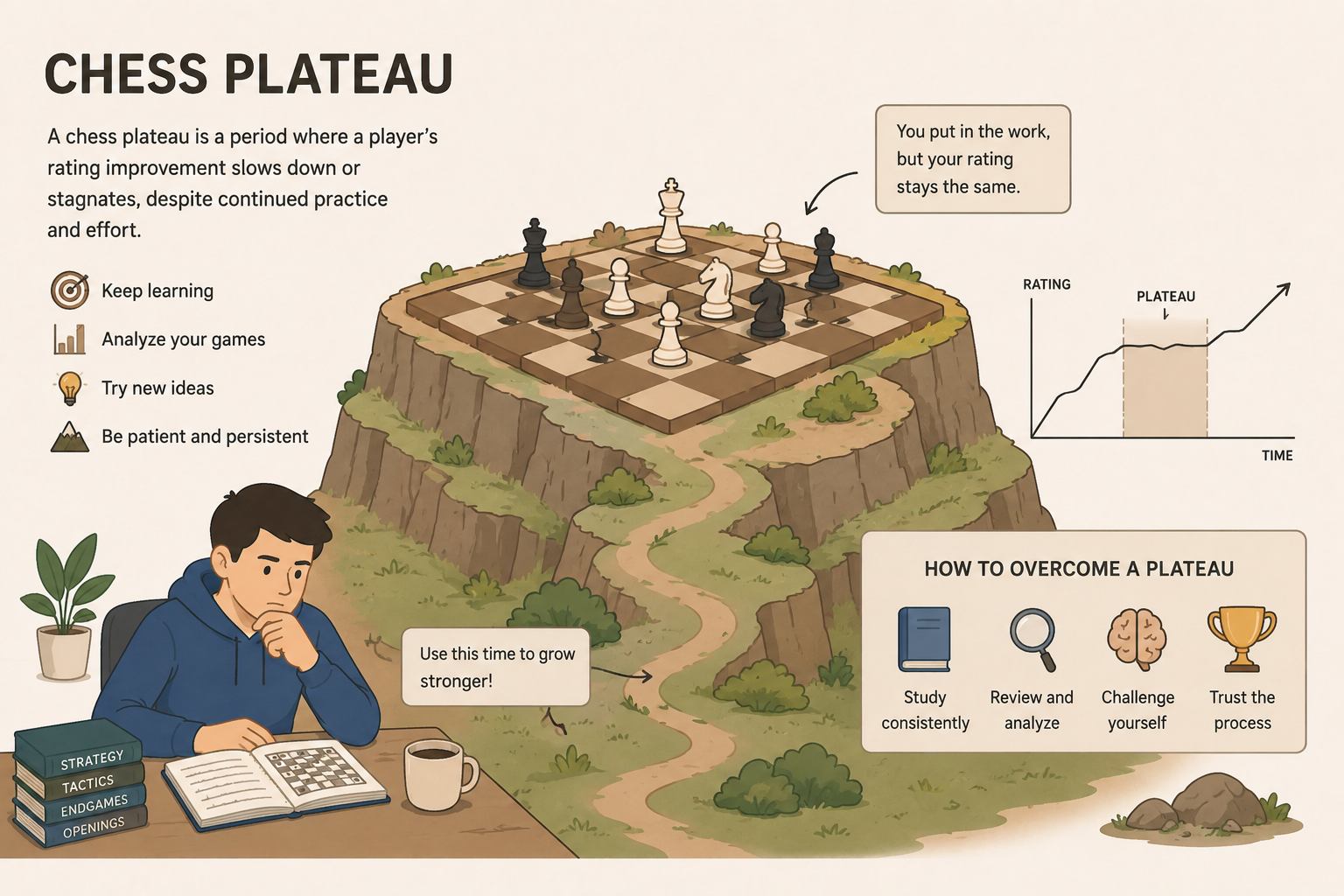
But if someone is able to absorb information faster than you, it does not mean that you are unable to absorb it at all! And here I want to give you my first and very important advice. Do not compare your progress to anyone else. Move at a pace comfortable for you and compare your level of play only to your “yesterday self.” Believe me, in my coaching practice I have seen many cases where a student’s rating stays in one place for half a year, while the student keeps studying and working hard. And then he changes some insignificant detail (for example, starts playing on chess.com in the morning instead of in the evening), and in the next few weeks his performance shoots into the sky by 200–300 points. If this happens to you, don’t panic. Hitting your first chess plateau is a completely normal part of improvement, and there are several proven ways to overcome it.
But if you constantly pressure yourself by comparing with others, in the end you will exhaust yourself and your brain will tell you: enough chess for me. And you will never be able to unlock your potential. It always makes me sad when this happens, but honestly, it happens from time to time even with my adult chess students.
The second reason that becomes a source of doubt is the idea that chess is some kind of elite game available only to geniuses, but not to ordinary players. Earlier this really was the case, but only because the chess community was very closed and there was only a small amount of educational material. Nowadays chess is starting to suffer more from an excess of information rather than from a lack of it. Ironically, having access to more information does not necessarily make you a stronger player. In many cases, the real problem is following the wrong study habits rather than a lack of educational resources.
I agree that not everyone can become a grandmaster. But we are talking about the bar of 1500 online rating! And this requires about 5% of the effort and skills needed on the path to the grandmaster title. Therefore, do not worry that you will have to become a recluse like Bobby Fischer, sacrifice your time, work, and family for this goal. Of course not! Now let us ask ourselves: who is a 1500 player anyway? What can he do and how much time does he spend on chess? I suggest making a portrait of the average 1500 adult chess player.
Who is a 1500 player?
Let us clarify a few details right away. This article is specifically about online rating and specifically about Chess.com. Not Lichess. If your goal is to reach 1500 on Lichess, then you can close this article right now and register an account on Lichess. The system will automatically give you the standard 1500 rating and the goal is achieved. With Chess.com, unfortunately, everything is more complicated.
I would also like to clarify that we are not interested at all in blitz and bullet rating. These are fun controls used exclusively for entertainment. There is very little chess there. You may not believe it, but once I got a request from an adult student: to learn how to play bullet better. To which I answered that it would be much more reasonable to buy an expensive computer mouse and maybe change the internet provider.
Let us return to the 1500 player. You may be surprised, but a 1500 chess player does not possess any secret opening knowledge. Moreover, at this level there are often players who do not know a single opening at all, or know only one setup as White, for example the London, and use only it.
And what about endgames? Surely a 1500 adult player knows how to checkmate with a knight and bishop or is familiar with the Philidor position in rook endgames? You will be surprised, but many at this level do not even know how to win the king and pawn versus king endgame (provided the position is winning, of course). And this, by the way, is the very first and basic rule of endgames.
Has a 1500 player studied the games of the greatest classics? Is he familiar with at least 5 strategic techniques from the legendary book 50 Strategic Techniques? My answer is definitely no.
But what a 1500 adult chess player will be good at, or relatively good at, is calculation skills.
👉 Tactical training is your main key to success on the road to 1500
And now we have finally come to the main key to success. And to the main distinguishing feature of a 1500 chess player. Almost all players at this level know how to calculate tactics well 2 moves ahead. And sometimes they even find 3-4 move combinations in games.
I will let you in on a secret: at levels up to 2000 online, 99% of games are won or lost because of a blunder. And it does not even matter who made more mistakes in the game, you or your opponent. The one whose mistake was critical loses.
That is exactly why, if you are at a level below 1500, I would not advise you to spend time on openings. There is almost no point in it, for the reasons I described here: “Link to article.” You may get a wonderful position out of the opening, but if you have problems with tactics, believe me, you will ruin absolutely any opening advantage.
Therefore, my great advice for you:
Try to train tactics every day. If you have an hour of free time – that is wonderful (I already envy you), if even half an hour – that is already good. The most important thing is consistency and regularity. Believe me, after 2 months of constant training you will not recognize yourself.
You will be shocked when you see how the fog over the chessboard clears and new combinations and opportunities open before your eyes.
Where and how to train tactics?
Option 1. Easy but a little risky: Online.
Using sites like chess.com, Lichess, or Chess Tempo.

Advantages:
You can solve a large number of puzzles at once.
You can practice on your way home using a smartphone.
More variety (choice of specific theme, difficulty, and so on).
Risks:
I noticed that many adult players who practice tactics this way develop a very bad habit over time. They think about the puzzle for less than a minute and then simply make the most natural move without concrete calculations. Then this habit migrates into their games and as a result – rating loss.
Option 2. Old-fashioned and a little slower: Books.
I can recommend several here:
- László Polgár. 5334 Problems, Combinations and Games
- Franco Masetti, Roberto Messa. 1001 Chess Exercises for Beginners
- Vincent Labbé. Chess Puzzles For Beginners – 1001 Winning Tactics Exercises – Step #1 – 100 to 200 Elo
Always try to calculate the solution completely in your head. If possible, do not move the pieces. Try to visualize. If you cannot solve the puzzle within 10 minutes – look at the hint or the full solution. There is not much point in analyzing a puzzle longer than that at this level.
I explained how to train with chess tactics in more detail in this article .
What should be done besides tactics?
Another incredibly important element of the training process is self-analysis of your games. How to do it? I advise you to use Lichess (Analysis mode), because there are no distracting and unnecessary functions there like on Chess.com. You upload the PGN of your game there and press the button “Request a computer analysis.” And then you study in detail your mistakes that the computer highlighted in red or yellow.
Study especially carefully the mistakes made in the first 10-12 moves, because they can migrate into your future games. Each game analysis should take at least 7-10 minutes. It is not enough to just quickly scroll through the game and look at the mistakes. You need to understand their nature and look at the improved continuation suggested by the computer.
What about openings?
As I said earlier, openings have low priority at levels below 1500. But nevertheless, they still need some amount of time. If you are an absolute beginner, then at the very least I would advise you to study opening fundamentals. That is, how to develop pieces correctly, how and to which side to castle, and when to start attacking the opponent.
For all of my 1000+ chess rated adult students I usually advise studying 3 openings:
- As White. It can be: the London System, Scotch Game, or Vienna Gambit. Depending on your style of play.
- As Black. The main response to White’s first move e4. This can be the Caro-Kann, French Defense, or the move e5. If you like sharp positions, the Sicilian may be an interesting option for you, but I advise starting to play it when your rating is closer to 1500 or better, 1500+.
- As Black. A solid setup against 1.d4 and other closed openings. At this level it is enough to remember the approximate piece placement, there is no need to memorize specific lines.
I will also note that I don’t advise using opening books. At levels below 1500, the best way is to watch videos on YouTube where the main ideas and plans are explained.
Understanding the ideas of the opening is much more important and productive than memorizing the exact move order.
How many games do I need to play per day?
I always advise the following ratio: 75% training and 25% practice. It is much more effective to spend time on puzzles rather than playing one game after another. If you play thoughtfully and analyze each game, it will take you much more time. And therefore, you are unlikely to play less than 3-4 games a day. This is exactly the number I consider optimal. It is best to play with the time control 15+10. If that is not possible, play 10+5 or at least 10 minutes per game, but no less.
The shorter the time control, the less benefit each individual game gives you.
How much time will it take me to reach 1500?
Everything here is individual and depends on how much time you are ready to dedicate to chess each week. And of course, what your current level of play is. According to statistics, my adult chess students go from complete beginner (barely knows how to move the pieces) to 1500 in 1-1.5 years. But I ask you! Do not rush and do not overwork your brain. There is a saying: “Slow and steady wins the race.” It fits chess completely. If you overload your brain, fatigue, apathy, and dislike for chess will appear.
After all, this is a very difficult game requiring great tension and maximum concentration. Do not focus on the numbers. Let your main goal be to enjoy the process. And then the results will definitely come, and one day you will suddenly discover that your rating has gone over 1500. And if this has already happened, then I advise you to study how to begin the journey to a new peak from 1500 to 2000 (link to article).

My final wish to you
Chess is an incredibly exciting and interesting game. And if you are at a level below 1500, then honestly, I even envy you. Because at this level chess is at its brightest and most unpredictable. In a game between two grandmasters, the game may last several hours and not a single mistake will be made.
In your games, however, the game turns upside down several times during it. No action movie or detective story has as many plot twists as a game between two players who are just getting acquainted with chess and starting their journey. Enjoy and appreciate this time, because one day, when you become a grandmaster or simply an advanced chess player, you will miss these times, just as we all miss childhood. By the way, do you think an adult student who has just started playing chess has no chance of becoming a grandmaster? In this article I will try to convince you otherwise.
♟ Article prepared by Grandmaster and chess coach Valery Filippov ♟
📖 Continue Improving Your Chess:
▸ How to Analyze Chess Games
▸ How to Build a Chess Training Plan
▸ How to Get Better at Chess: A Complete Step-by-Step Guide
FAQ
Is 1500 a good chess rating?
Yes, definitely! You may be surprised, but according to Chess.com statistics, the average rating is around 850. A 1500-rated player is already a very competitive intermediate-level player, who can one day aim to become a professional.
Can an adult reach 1500 in chess?
Yes, yes, and once again yes! Without any doubt. Reaching a 1500 rating online is something everyone can achieve.
What should I study first to reach 1500?
I would advise making your main focus tactical puzzles. Because at the level below 1500, most games are won or lost because of mistakes. This type of training will give you the fastest results.
Should I play blitz games to improve?
No, I strongly do not recommend doing this. You may develop an unserious attitude toward the game and a habit of rushing and playing without thinking.
How long does it take to reach 1500 in chess?
I would say around 1.5 years from zero if you train at least 8 hours a week and your approach is correct.