How to Analyze Chess Games
This article explains how to properly and effectively analyze your online chess games. I, Grandmaster Valery Filippov, will offer you a real methodology that I personally use and teach to my students. Moreover, I will offer you 2 options: a light but somewhat superficial analysis, which is more suitable for beginners, and a detailed in-depth analysis using various online tools and databases. I hope you enjoy this article and remember that even if you are not my student but just a reader, you can always reach out to me if you have any questions. If your goal is to build a complete improvement plan rather than simply learn how to analyze games, I recommend starting with my complete chess improvement guide.
Why Analyzing Your Own Games Is So Important
I don’t think I’m telling you anything new by saying that the main reason you need to analyze your games is to work through your mistakes in order to avoid repeating them in the future. It seems like such a simple and understandable truth, but let me surprise you. Only about 25% of players simply press the analysis button after a game, roughly 10% of players spend at least 5 minutes analyzing a game, and less than 1% do it even halfway correctly.
This happens for various reasons: some people are simply not interested in improving, a considerable number of players perceive losses very painfully, striving to forget them as quickly as possible by moving on to a new game, some players only play bullet and blitz time controls, where analysis is practically useless, and finally, a significant percentage of players are simply too lazy to do it. And that’s a shame, because game analysis takes second place in terms of benefit and effectiveness, right after tactical training. By mastering this skill, believe me, you will accelerate your improvement several times over! I’ve written a separate article explaining why tactical training remains the single most important part of chess improvement for the vast majority of players.
Which Games Are Important to Analyze?
If you play in-person tournaments, then those games are the priority. And the analysis of one game should take at least 30 minutes! After all, imagine, you spent so much effort and time on the game. You thought more, calculated variations deeper. So you yourself will be interested in doing an in-depth analysis, checking all the ideas that were spinning in your head during the game.
Online rapid games. The majority of players play exactly these, and every rapid game must be analyzed! Not all chess players have the opportunity to play OTB classical tournaments, and the rapid format is the best alternative, even if it isn’t perfect. I am often asked: “Valery, how many games should one play per day?” To which I always answer – exactly as many as you have time to analyze. Moreover, the analysis should be done not at the end of the playing day or the next morning, but immediately after the game! Remember that!
Blitz games. In general, I never recommend anyone to play blitz because I believe this time control does more harm than good for a chess player. But if you do decide to resort to it, then carefully analyze the opening part. Everything else can be ignored, because most likely you made numerous blunders under time pressure, and therefore you can’t really learn much from such mistakes. If you’re wondering why I’m so skeptical about blitz, I explain my reasons in much greater detail in my article Why Blitz Chess Is Hurting Your Improvement.
Two Recommended Systems for Independent Game Analysis
Now I want to tell you about 2 approaches to game analysis that I recommend to my students depending on their playing level. I’ll repeat, the second option is much better than the first, so even if you are a beginner, I still advise you to try it. Yes, it will be difficult, but it’s quite likely that you will quickly get the hang of it and be able to do a full game analysis despite having just begun your immersion into professional chess.
Approach One – The Light Version
If you are just learning chess and find it difficult to focus on all aspects of the game and learning, then I advise you to start with this method. Everything here is extremely simple. After each game on Chess.com, you need to press the Game Review button. The computer will highlight your mistakes in different colors. And here we will be primarily interested in the red mistakes, that is, your blunders. Especially if they were made in the first 15-20 moves. Click on each of them. Then click the Explain button and be sure to play through the computer-suggested variations.
I also advise you to analyze the opponent’s mistakes. Often these are their missed opportunities that arose as a consequence of your mistake. Try to spend at least 10 minutes analyzing each game. After studying the blunders, be sure to move on to the mistakes and even inaccuracies. Also, don’t forget to activate the chess engine by clicking the Analysis button. As you scroll through the game, pay attention to how the engine evaluation changes.
If you constantly lose games because of simple tactical oversights, I also recommend reading my guide on reducing blunders during practical play.
Another less obvious drawback of this method of analysis is the fact that it is paid. Chess.com will ask you for around $20 a month for this feature. If that doesn’t suit you, then I advise you to be a little patient and learn the most optimal, and by the way free, way to analyze your games.
Approach Two – The Best and Most Useful
So, here the first stage is preparation. First, we will create a space where your games from Chess.com will be stored and analyzed. We need to open the site Lichess.org (one of the most popular chess websites in the world) and go to the Learn section and then select Study. Then you will need to click on the big green plus sign
Let’s call the study, “My Games as White.” By the way, later I separately advise you to create a second study for games as Black. It’s useful to separate them, as you will clearly see which color is most successful for you or, conversely, problematic.
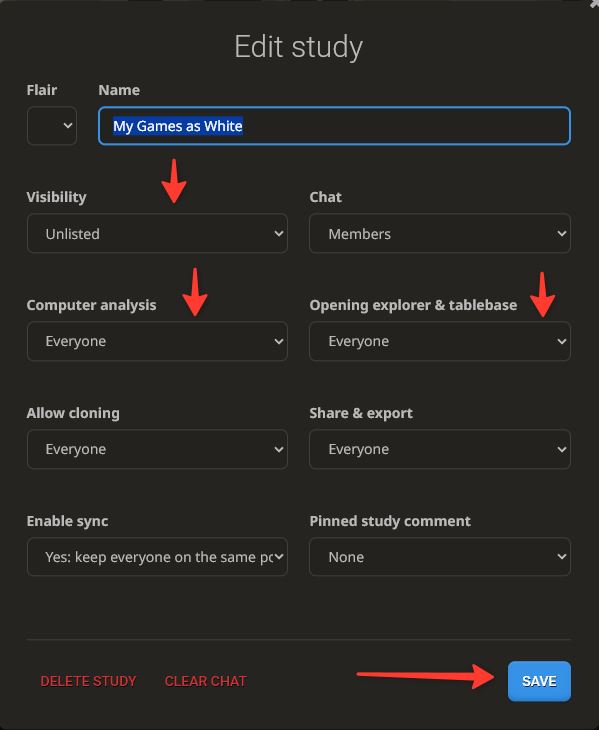
Next, in the settings we select:
Visibility: Unlisted (access will only be via link)
Computer Analysis: Everyone
Opening Explorer: Everyone
Click Save:
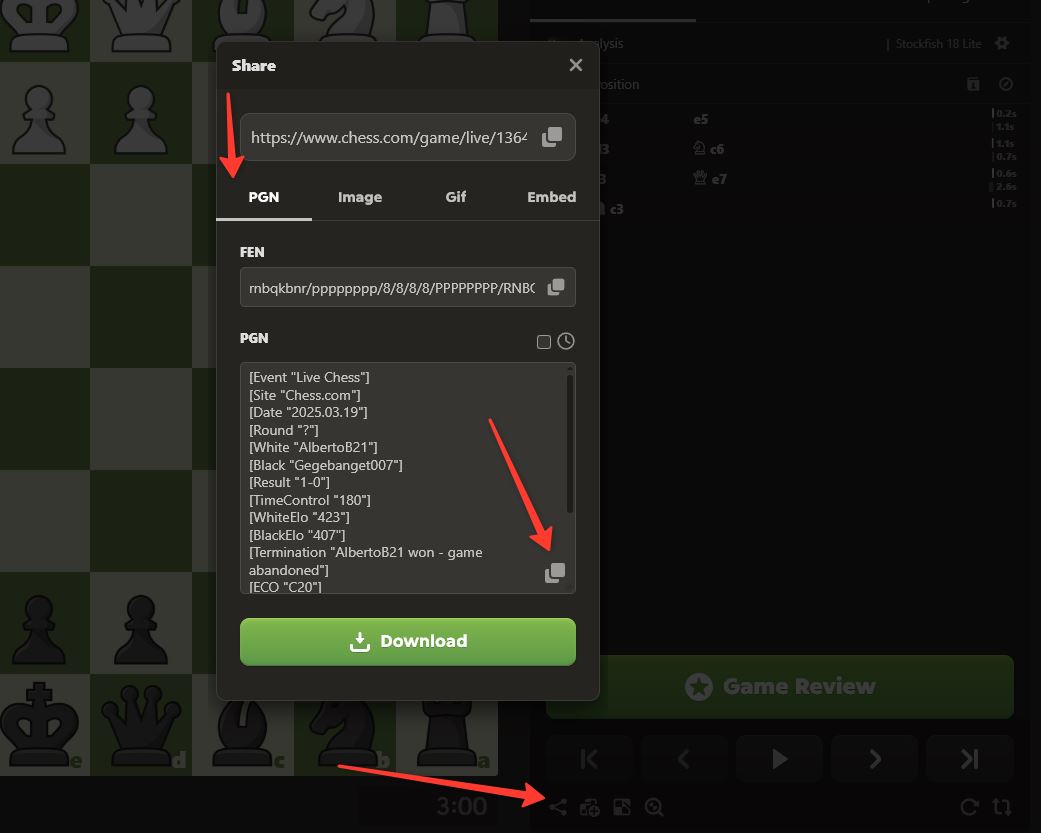
Next, we return to Chess.com and open your profile with games. Select the most recent one and click on it. After the game has opened, on the bottom right you need to find the Share button and then select PGN and press the copy button.
Now we return to Lichess and paste the PGN into this window. Then Save. If you accidentally closed the previous window on Lichess, simply click “Add New Chapter” in the top-left corner.
Your game has been uploaded to Lichess! If it so happens that the board is flipped and you are looking at it from the opponent’s side, then click on the little gear icon and then change the orientation.
Finally, we only have to run a deep engine analysis. To do this, click on the Computer Analysis button and then Request Computer Analysis. After that, wait for 1 minute. If you did everything correctly, you should get something like this:
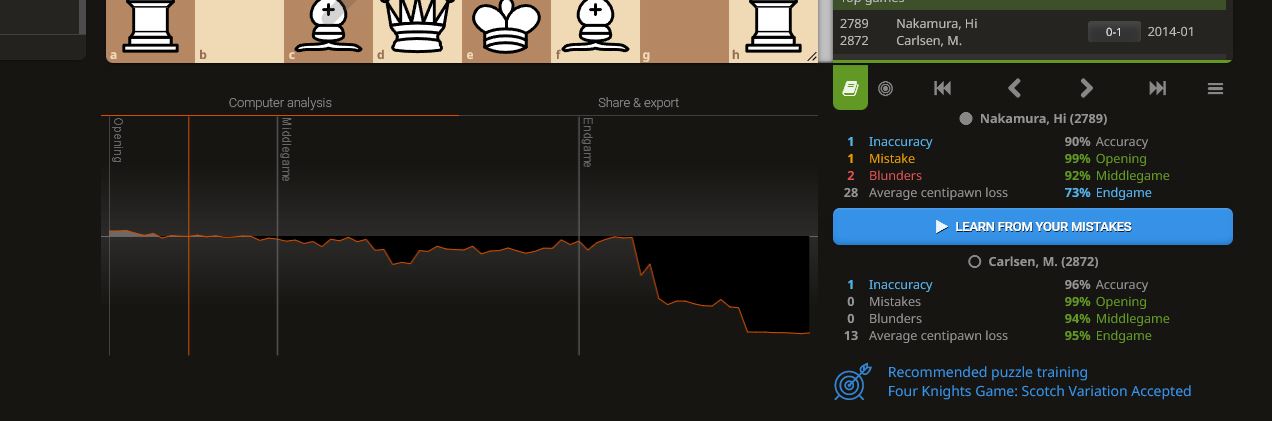
Now you might ask me: Valery, why complicate everything so much if the result is almost the same as on Chess.com? You will be right, but only partly. Firstly, there is an excellent tool at hand here called the Opening Explorer. With its help, you can study and, most importantly, improve your openings based on the experience and games of the strongest chess players in the world.
For example, in this line of the Scotch Game, you’ve been consistently playing Bg5. It seemed like such a good move, and the engine didn’t mark it as a mistake. But looking into the Opening Explorer, you see that the vast majority of players always played Nxc6 here. And more than 6 thousand such games were played. Whereas your move Bg5 was used in only 3 professional games.
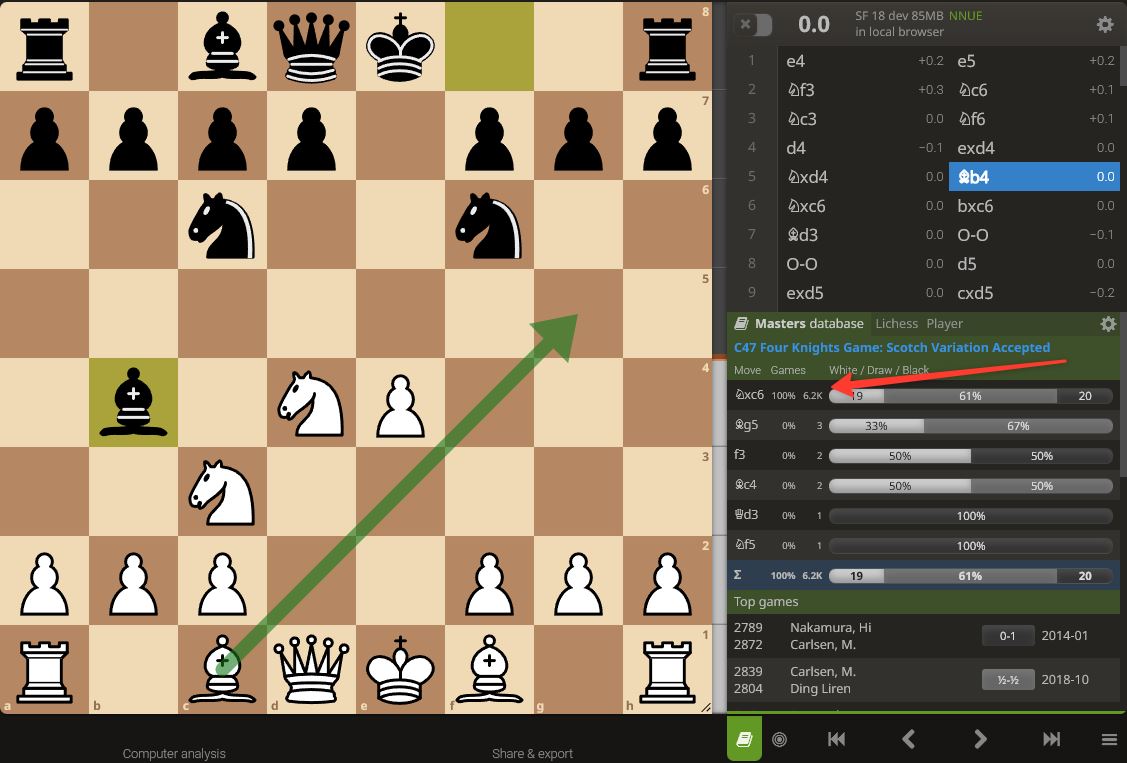
What does it mean? That in the future, you will likely get a less promising position, which means your move Bg5 definitely needs to be changed. This is exactly how, step by step, you will strengthen your opening repertoire!
Another useful feature of the Opening Explorer is the Lichess database. It contains a huge collection of online games. And believe me, it differs greatly from master games. It will be incredibly useful for you to know the most common opening lines among beginners and amateur chess players. After all, this will help you find traps and win at an early stage of the game.
Also, if necessary, you can open and fully analyze the best games of the strongest grandmasters that Lichess will offer you for your specific line. This is also incredibly valuable and interesting.
On my part, I want to add that I like Lichess much more for game analysis than Chess.com, because on Lichess there is no endless distracting animation and a large number of unnecessary features. True, I won’t object if you think that I’m too old-fashioned and not very good with modern technology. In fact, you will be partly right! But I believe that the Opening Explorer on Lichess is literally worth its weight in gold. On Chess.com, it’s also possible to launch it, but it’s much less convenient there.
Lichess Study Interface Overview
Below I will attach a screenshot and a full explanation for all the important functions of studies on Lichess.
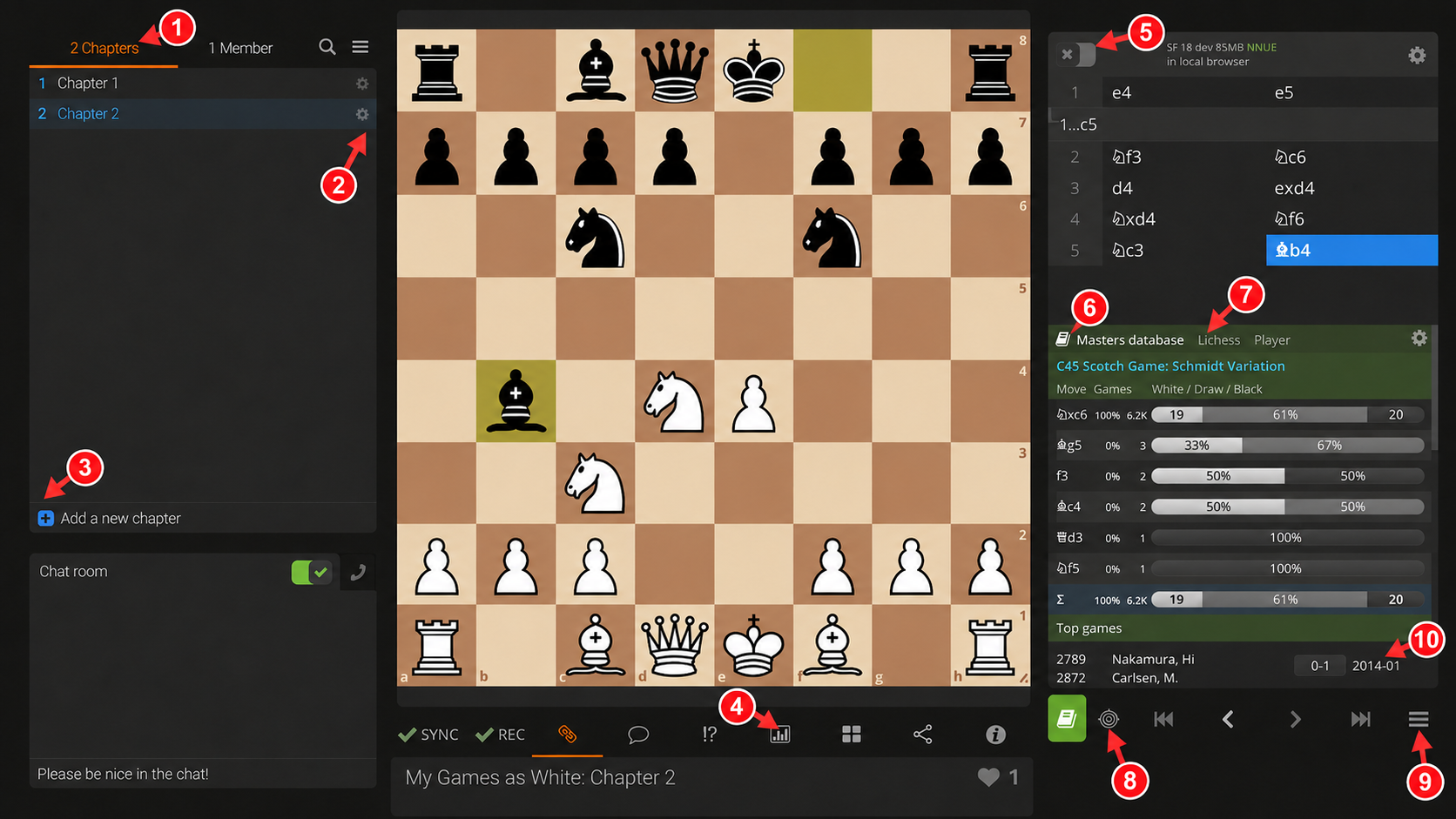
1) List of all chapters (games) in the current study
2) This gear icon brings up a small settings menu where you can change the board orientation
3) Allows you to add a new game (after clicking, you will need to paste the PGN of the game)
4) Opens a window with the “Request Computer Analysis” button
5) Button responsible for activating the chess engine
6) Clicking here will open the opening book based on master games (it usually opens by default when you click on the Opening Explorer)
7) And this is the database of games from all online chess players of any level (mostly beginners)
8) Here, the arrow is incorrectly pointed. We are interested in the green button slightly to the left. It opens the Opening Explorer
9) This button opens the main menu of the study mode where there are many useful settings that you can use to your liking
10) This is the window with the best games of the strongest chess players who played the same opening that is set up on your board
Chessify
Another interesting tool for analyzing your games (and not only your games) is the Chessify platform, which I discovered recently and whose features I am still gradually exploring. First of all, I would recommend it to active tournament players: powerful cloud engines and a large game database can be really useful for serious analysis and opening preparation.
I especially liked the Video Search feature, which can be particularly useful for less experienced players: it allows you to find a video where a specific position appears and get not only engine variations, but also a human explanation of the ideas. Imagine that you come across an unusual and rare variation of the Caro-Kann Defense and you have no idea how to develop your pieces there. You check the engine, but you cannot understand why it suggests putting the knight on a3 when normally we develop it toward the center.
This is exactly where this, in my opinion, unique feature can help you. All you need to do is set up the position on the board and run a search. Then, among the suggested videos, choose the one that looks most like an opening lesson, where a more experienced chess player explains everything to you in detail and in an understandable way. For me, as someone from the previous century, it almost feels like magic. But it exists, and it works.
Final words
Never neglect the analysis of your played games! Believe me, if you show patience and effort at the first stage, then over time you will develop the habit of analyzing, and it will not take much of your energy and time. One analyzed game is equivalent to 7-8 played games without analysis! Also remember that chess is very similar to our life. And as you know, if we do not learn from our mistakes, we do not develop and we make them again and again.
♟ Article prepared by Grandmaster and chess coach Valery Filippov ♟
📖 Continue Improving Your Chess:
▸ How I Help Adult Chess Players Improve Faster
▸ Why Kids and Adults Improve at Chess Differently
▸ How to Choose the Right Chess Coach for Beginners
FAQ
How long should I spend analyzing a chess game?
If we’re talking about an online rapid game, I advise analyzing it for at least 10 minutes. And remember, even if you spend an hour on it, getting carried away with studying opening improvements in the Opening Explorer – that is only encouraged.
Should I analyze every chess game I play?
Ideally, yes! Except, perhaps, for those cases where you were very tired and regretted starting the game while already in the process. In such a situation, of course, there is no point in torturing yourself!
Should I analyze my game on my own – without an engine?
Fully independent analysis is an excellent training exercise, but only if your playing level is already very high (for example, online rating exceeding 2000). For chess beginners, such an approach is practically useless.
Is Lichess better than Chess.com for game analysis?
It’s hard for me to judge objectively, but it is at least much more convenient. I know that Chess.com also has the Opening Explorer and other features, but in my opinion, they work worse in practice and the interface there is less user-friendly. As far as I know, the majority of professional chess players use Lichess or Chessbase.
Can analyzing chess games improve my rating faster?
Definitely yes. There cannot be even a shred of doubt here. Just trust me on this, and I promise you, in a few months it will bear fruit. Good luck!