Why Adult Chess Players Quit Improving Too Early
There is one situation that I think is especially common among adult chess players. A person seriously decides to improve their game. They buy several books, start solving tactical puzzles, watch grandmaster games, and perhaps begin working with a coach. For the first few weeks, everything goes very well. There is interest, energy, and the feeling that real work on chess has finally begun.
A few months pass. The rating goes up a little at first, then stops. Sometimes it even returns to where it started. And gradually an unpleasant question appears: is there any point in continuing?
My name is Valery Filippov, and I am an International Grandmaster and chess coach. And it seems to me that this is exactly the moment when many adult players make one of the most frustrating mistakes. They judge the results of their work too early.
I certainly don’t want to say that any adult can become a master or that you only need to study for ten years and the result will inevitably come. I don’t like promises like that at all. Everyone has different abilities, amounts of free time, age, health, motivation, and starting level. But I really do believe that many adult chess players stop working seriously on their game long before it becomes clear what they are actually capable of.
And the reason is often not chess. The problem is expectations.
♟️ Adults Are Used to Seeing a Connection Between Work and Results
If you spend several months learning a language, you will probably already notice some changes. If you start going to the gym regularly, results that you can see or measure appear fairly quickly. If you are learning a new program for work, after a few weeks you can already do things that you couldn’t do before.
So an adult quite naturally applies the same model to chess.
I study more -> I should play better -> my rating should go up.
At first glance, everything seems logical. But in practice, quite a lot of time can pass between these three points.
You can understand isolated pawns much better, but then go through your next twenty games without getting a suitable pawn structure even once. You can seriously improve your calculation and then lose 40 rating points because of two unsuccessful tournaments. You can study rook endings and continue losing points for several more months because of a completely different problem.
And this, in my opinion, is where the main test for an adult chess player begins. You are working, but you are not yet getting confirmation that this work actually makes sense. This is one of the reasons why I think adults need a slightly different approach to chess improvement, which I discuss in more detail in my guide on how to improve at chess as an adult.
📈 We Expect Progress to Be Far Too Linear
It seems to me that one of the most harmful pictures you can imagine in chess is a beautiful rating line that constantly goes upward.
- Then 1300. Three months later 1400. Another three months and 1500. A year later 1700.
It would be wonderful if chess worked exactly like that.
But usually it doesn’t.
Especially once a player has moved beyond the beginner level. At the beginning, it really is possible to eliminate obvious mistakes fairly quickly. Stop giving away pieces for free. Learn the basic opening principles. Start noticing simple forks and pins. Learn a few basic endings. Each of these changes can produce results quite quickly.
After that, everything becomes much more difficult. To become stronger, it is no longer enough to learn one more chess principle. You have to learn to apply what you know directly at the board. And you have to apply it regularly.
In my opinion, that is a huge difference.
Knowing that you should look for your worst-placed piece and actually remembering to do it in the right position during a game are not the same thing.
Quite a lot of time can pass between understanding an idea and turning it into a habit. And from the outside, that period can sometimes look like no progress at all.
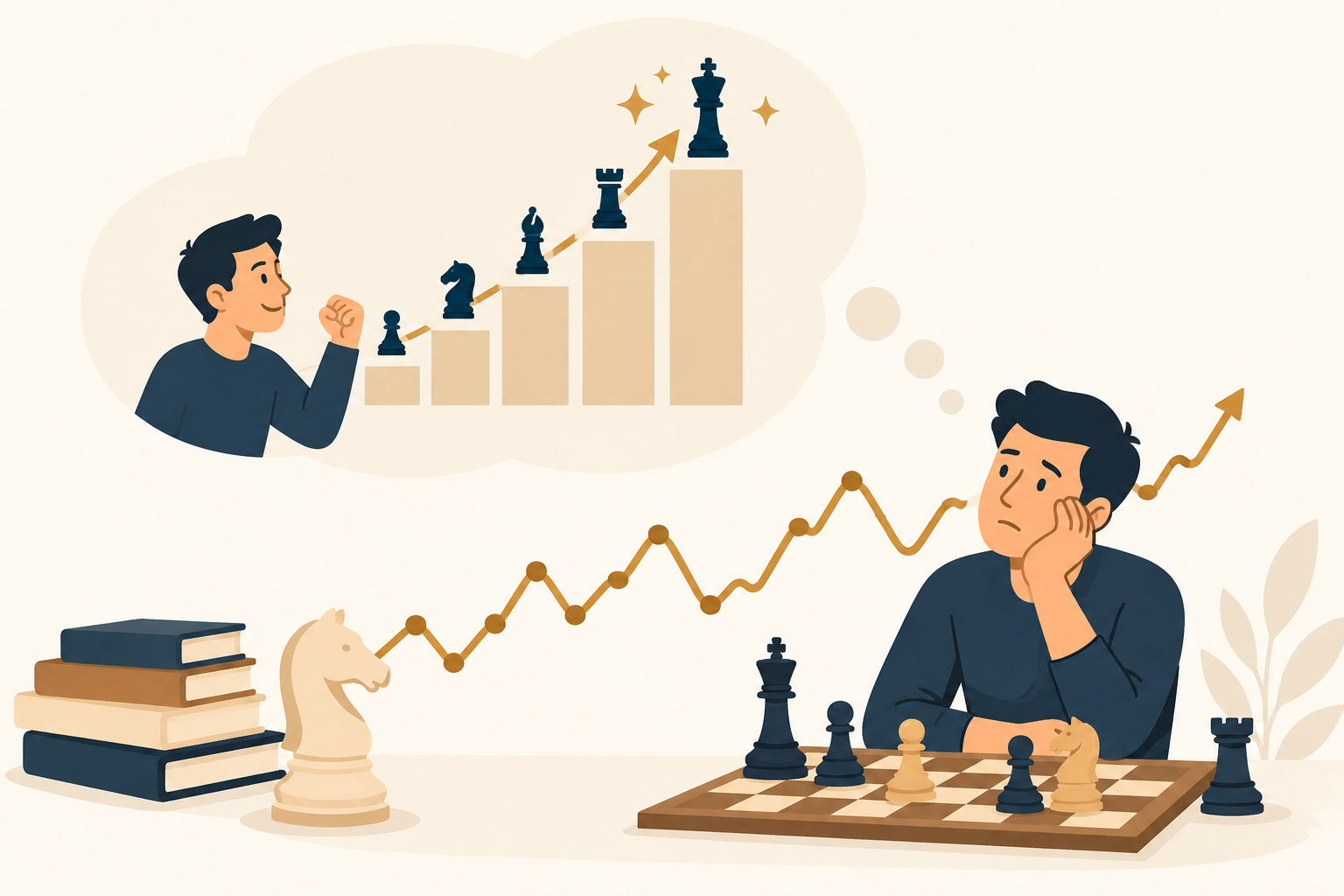
🧠 You Can Become Stronger Before Your Rating Shows It
This is something I consider especially important.
Rating is very convenient precisely because it gives us one number. You were 1650, now you are 1720. That means progress. You were 1720 and you’re still 1720. That means there has been no progress.
I would not make that conclusion so quickly.
Imagine a chess player who used to regularly get into time trouble by move 25, but now manages their time much better. Have they become stronger? In my opinion, yes.
Another player used to turn on the engine immediately after a game, but now first analyzes their decisions independently and tries to understand the reasons behind their mistakes. Is that an improvement? To me, obviously yes.
A third player has stopped playing ten different openings and has finally started understanding the typical positions from their repertoire. A fourth makes fewer automatic moves and checks the opponent’s tactical ideas more often. A fifth has become much better at defending unpleasant positions.
None of this guarantees that the rating will go up by 100 points next month.
But I would find it very strange to say that there has been no progress simply because the number has not moved yet.
Rating usually interests me over a longer period. The quality of decisions can be evaluated much earlier.
⏳ Adults Often Underestimate How Long It Takes to Build a New Skill
You can explain an idea to a chess player in one evening. Sometimes twenty minutes is enough for someone to understand perfectly what you are talking about.
And that creates a trap.
If I understand it, then I can do it now.
Not quite.
Suppose you constantly start calculating the first move you like too quickly. Someone explains to you that you should first identify several candidate moves. Everything is clear. Moreover, when you solve a training position and already know that you are supposed to look for candidates, you do it perfectly well.
Then the tournament game begins.
You have 18 minutes left. Your opponent makes an unexpected move. You immediately notice an interesting possibility and start calculating it. Four minutes later, you make the move. After the game, it turns out that there was a much stronger candidate nearby that you never considered at all.
Does that mean the training isn’t working?
I don’t think so.
More likely, the new habit has not yet become part of your normal decision-making process. You understand it intellectually, but you don’t use it automatically yet.
It seems to me that adult players often give new skills too little time.
👶 Comparing Yourself With Children Almost Always Ruins Your Mood
This is a separate subject altogether.
An adult player studies chess for a year and gains 100 rating points. It seems like a good result. Then they come to a tournament and meet a child who gained 400 points during the same year.
And that’s it. For some reason, those 100 points no longer feel satisfying.
I consider this comparison almost useless.
A child may have a completely different amount of chess in their life. A different schedule. Different responsibilities. They may play a huge number of tournaments, train several times a week, and spend an amount of time at the board that a working adult simply cannot afford. There are also deeper differences in how children and adults learn chess, which I discuss in more detail in my article on why kids and adults improve differently in chess.
But that is not even the main point.
Why should your progress be judged through someone else’s progress at all?
If an adult chess player at 42 goes from 1500 to 1700, what difference does it make that some talented twelve-year-old went from 1700 to 2100 during the same period?
These are two completely different chess stories.
I am much more interested in comparing an adult player with themselves a year ago.
🎯 Sometimes the Problem Isn’t Slow Progress, but a Goal That Is Too Big
There is another reason for disappointment that I find fairly obvious. A person sets a goal that is too far away.
Suppose your current rating is 1500 and you want to reach 2000.
A good goal? Why not.
But psychologically, it can be inconvenient. You gain 80 points, but you are still 420 away from the goal. Another six months of work, another 70 points. And instead of seeing the step you have already made, you only see the remaining 350.
At some point, it starts to feel like you are walking forever.
I prefer to divide big goals into much shorter sections. And not only rating goals.
For example: learn to manage your time better. Stop automatically responding to your opponent’s threats. Analyze your main mistakes from the last twenty games. Put your Black repertoire in order. Improve your basic rook endings.
I like goals like these much more because you can actually work with them.
“Become a 2000 player” sounds nice, but tomorrow morning it is not very clear what exactly you are supposed to do. “Analyze my last five losses and identify the recurring causes of my mistakes” is already much more practical.
⚠️ Sometimes an Adult Player Really Does Study a Lot, but Studies the Wrong Things
Here I don’t want to go to the other extreme and say: if there are no results, just keep doing the same thing for another five years.
No.
Sometimes a lack of progress really does mean that the training process needs to change.
If someone plays only blitz for years, never analyzes their games, and is surprised by the lack of serious progress, I would not advise them simply to be patient. If a chess player buys a new opening course every month but continues losing because of simple tactical mistakes, the problem is also unlikely to be solved by one more course.
So I would separate patience from inaction.
Patience means that you understand what you are working on, regularly check your weaknesses, and give the training process enough time. In my opinion, this becomes much easier when your work has some structure instead of being a collection of random exercises. I explain how I approach this in my guide on how to build a chess training plan.
Inaction looks different: you repeat familiar activities because they are enjoyable and then hope for a different result.
It seems to me that it is especially important for an adult chess player to stop from time to time and ask themselves: is what I am studying actually connected to the way I lose games?
A very useful question.
📚 It Is Easy to Confuse Consuming Chess Content With Training
Today, in my opinion, this is one of the biggest traps.
It has never been easier to “study chess.” You can open YouTube and spend three hours watching chess videos. You can buy a huge course with hundreds of variations. You can watch a grandmaster’s stream, browse a game database, or solve puzzles in an app.
After an evening like that, you really do get a pleasant feeling: I worked a lot on chess today.
But did you?
Sometimes yes. Sometimes, in my opinion, you simply entertained yourself with chess very effectively.
And there is nothing wrong with that. I don’t believe that every minute spent with chess has to be turned into hard training. Chess should be enjoyable.
The problem begins only when three hours of watching videos are counted as three hours of serious work, and six months later the person is disappointed with the result.
Active work is usually less comfortable. You have to calculate yourself. Evaluate positions yourself. Analyze your own game before turning on the engine. Answer questions, make mistakes, return to the position.
It is not surprising that the passive option often feels more attractive.
🔄 Constantly Changing Your Method Also Makes It Hard to See Results
This is another habit I don’t particularly like.
For two weeks, someone solves difficult puzzles. Then they read that they need to study classical games, so for the next three weeks they do only that. Then someone convinces them that openings decide everything. A new course is purchased. A month later, they get the idea that the real problem is the endgame.
In the end, the person is constantly starting.
But almost nothing has enough time to become a stable skill.
It seems to me that the internet has made this problem much worse. You can always find someone who confidently tells you that their particular training method is the main secret to improvement.
I would treat statements like that cautiously.
Chess improvement is fairly boring in a good way. You need to spend enough time doing several useful things: playing serious games, analyzing them, working on calculation, tactics, positional understanding, endings, and your repertoire. I discuss how these different areas fit together in more detail in my guide on how to get better at chess. The proportions may be different, but a magical new method every Friday is usually not necessary.
Sometimes the best training plan feels boring precisely because it works for months rather than promising a revolution in a week.
😟 A Bad Tournament Too Easily Turns Into a Verdict
I completely understand why a tournament result feels so emotional. You prepared, spent time, perhaps spent money on the trip, and wanted to see some confirmation of your work.
And you got minus 35 rating points.
The first reaction is understandable: so all of this was useless.
But I would be very careful about drawing conclusions from one event.
A tournament is a small sample of games. You may have had several uncomfortable positions. You may have made one serious mistake after four hours of good play. You may have managed your time badly. You may simply have played below your normal level.
Of course, a bad tournament should be analyzed. Perhaps it really will reveal a serious problem in your preparation.
But there is a huge distance between “the tournament revealed a problem” and “I am not capable of becoming stronger.”
For some reason, after five good games we rarely decide that we have finally unlocked our full chess potential. But after five bad ones, we are sometimes ready to make a final diagnosis.
That seems like an unfair way to judge yourself.
🕒 Adult Chess Players Have a Problem That Rating Doesn’t Show
Time.
Not time on the clock during a game, but ordinary time in life.
Work, family, children, travel, everyday responsibilities. Chess has to compete with all of it. And if you can give chess five hours a week, I think it makes no sense to build a training plan as if you had twenty-five.
This is another reason why I don’t like comparing adult players with professionals or actively training juniors.
An adult doesn’t need a perfect training plan. They need a plan that actually fits into their life.
I would rather choose four hours of proper work every week for a year than fifteen hours in the first week, ten in the second, two hours in the third, and completely quitting chess a month later.
Consistency here, in my opinion, is much more valuable than the enthusiasm of the first few days.
🔥 Motivation Is Overrated Anyway
“I lost my motivation.”
I often think that this is not quite an accurate description of the problem.
It is impossible to want to study chess equally strongly for twelve months in a row. One day you want to solve twenty puzzles. Another day you want to watch a movie. That is normal.
If the entire training process depends only on inspiration, it will almost inevitably become inconsistent.
That is why I believe much more in habit.
Not “today I feel like studying for two hours,” but “on Tuesday and Thursday I study chess for an hour.”
It sounds less romantic.
But it seems to me that these boring decisions are exactly what most often create long-term results.
Motivation is good for starting. For the long run, you need a system.
🧩 The Stronger You Become, the More Expensive the Next Step Can Be
This is also important to accept.
Gaining your first 200 points and gaining the next 200 points are usually very different tasks.
As your rating grows, your opponents become stronger too. Mistakes become less obvious. Things that used to bring easy points stop working. It is no longer enough simply not to hang pieces. Then it is no longer enough to see simple tactics. You need to calculate better, evaluate positions more accurately, understand structures, defend well, and convert advantages.
So I am not surprised when progress slows down over time.
On the contrary, it would be strange to expect the same speed forever.
If you went from 1200 to 1600 in one year, that absolutely does not mean that you must reach 2000 the following year.
Chess never promised you that.
And in my opinion, accepting this fact makes training psychologically much calmer.
🛑 But When Should You Actually Stop?
Here my answer may not please everyone.
When you no longer want to do it.
Not because your rating hasn’t gone up for three months. Not because you lost to a child. Not because you failed to reach the number you planned to reach by September.
But because the process itself no longer gives you anything valuable.
An adult is under no obligation to improve at chess. You can simply play blitz in the evening. You can go to a chess club once a month. You can stop studying completely and keep chess as entertainment.
I don’t see any problem with that.
What I don’t like is something else: when a person genuinely wants to become stronger, loves chess, is willing to work, but stops trying only because they expected to see results after four months and didn’t.
That really does seem premature to me.
🎓 What I Would Change in an Adult Player’s Approach
First of all, I would give less importance to short periods of time.
I would not judge a training system after two weeks. I would not draw conclusions about my level after ten games. I would not change the entire plan after every rating drop.
Instead, I would look at recurring mistakes.
What was happening in your games six months ago? What is happening now? Are you still losing because of the same tactical blunders? Has your calculation improved? Is your time management better? Do you understand your opening positions better? Can you explain your own mistakes without the help of a computer?
That is much more interesting to me.
And only after that would I look at the rating.
Because if the quality of your chess really is getting better, over a long enough period the rating has more and more reasons to show it.
🏁 My final words
It seems to me that adult chess players often stop trying to improve not because they have reached their limit. They simply demand proof from chess too early that their work is paying off.
We want a clear deal: I invested one hundred hours, give me 150 rating points.
Chess doesn’t sign that contract.
Sometimes results come quickly. Sometimes nothing happens for a long time and then the rating starts moving. Sometimes you have to admit that your chosen training method isn’t working, change it, and wait again. And sometimes the progress turns out to be much more modest than you originally hoped.
All of these things are possible.
That is why I would not promise an adult player a specific rating after a specific number of months. I much prefer another approach: give yourself enough time, train thoughtfully, and don’t confuse a temporary lack of results with proof that you lack ability.
If your rating has been standing still for several months, that is not the end of the story.
Look at your games. Look at your mistakes. Look at the way you make decisions now and the way you made them before.
Maybe something needs to change.
Or maybe you simply need to continue.
And it seems to me that sometimes this is exactly the hardest thing for an adult chess player to learn.
Not to demand that progress appear on schedule.
♟ Article prepared by Grandmaster and chess coach Valery Filippov ♟
📖 Continue Improving Your Chess:
▸ How I Help Adult Chess Players Improve Faster
▸ How to Reach a 1500 Rating on Chess.com as an Adult
▸ Why You’re Not Improving at Chess: 8 Mistakes You Must Fix
FAQ
1. Is it normal for my chess rating to stay the same even if I am training?
Yes. I would not expect rating to react immediately to every improvement in your game. You may be calculating better, managing your time better, or making fewer positional mistakes without seeing an immediate change in rating. I prefer to look at longer periods rather than a few weeks.
2. How long does it take an adult to improve at chess?
There is no number I would trust here. It depends on your current level, how much time you have, what you are working on, and how regularly you play serious games. For some players progress becomes visible quite quickly. For others it takes much longer.
3. Can adults still improve at chess after 30 or 40?
Of course. I don’t think turning 30 or 40 suddenly makes improvement impossible. An adult may have less free time than a junior and may improve differently, but that is not the same as being unable to improve.
4. Why am I studying chess but my rating is not going up?
I would first look at what you are actually studying. If you keep losing games because of tactical mistakes but spend most of your time studying openings, more training hours may not solve the problem. Sometimes you need more patience. Sometimes you need to change what you are doing.
5. Should I stop playing chess if I am not improving?
Only if you no longer enjoy it or no longer want to work on it. I would not quit simply because my rating had been flat for several months. That is far too short a period to make a final judgment about your potential.