Chess Rating System Explained: FIDE, USCF, Chess.com & Lichess
If you have been playing chess for some time, you have probably noticed something strange about ratings. You can be 1800 FIDE, 1950 USCF, 2100 on Chess.com, and 2300 on Lichess. So which number tells the truth? What is your actual chess rating?
My answer is quite simple: all of them do, but in their own way. I don’t think it makes much sense to search for one “real” number among them. These ratings belong to different systems, different groups of players, and in some cases completely different types of chess.
My name is Valery Filippov, and I am an International Grandmaster and chess coach. Rating is obviously an important part of competitive chess. I would never say that players should simply ignore it. At the same time, I think we sometimes give these numbers more meaning than they actually have. Losing 20 rating points does not suddenly make you a worse chess player, just as gaining 30 points in one evening does not mean that your understanding of chess improved overnight.
So before comparing FIDE with Chess.com or trying to convert Lichess into USCF, I think it is much more useful to understand what these numbers actually represent.
♟️ What Is a Chess Rating, Anyway?
The general idea is not particularly complicated. A rating system tries to estimate your strength from your results against other rated players. If you consistently perform well against players around 1800, your rating should eventually reflect that. If you regularly struggle against players rated much lower, it will move in the other direction.
But there is one word here that I consider especially important: relative.
A chess rating is not an exam score. There is no universal chess test where a player scores 2000 points and becomes a “2000 player.” Your number exists inside a particular pool of players and according to the rules of a particular rating system.
This is why I don’t really like statements such as “I’m a 2000 player” without any additional context. My first question would be: 2000 where?
FIDE 2000, USCF 2000, Chess.com rapid 2000, and Lichess blitz 2000 are four different things. Of course, all of them tell us something about the strength of a player. But I would not treat them as interchangeable numbers.
🌍 FIDE Rating: The Rating Most Chess Players Consider the Main One
When we talk about professional over-the-board chess, FIDE is normally the rating that matters most. If someone tells you that a grandmaster is rated 2550, they are almost certainly talking about that player’s FIDE Standard rating.
Personally, I think this distinction is important because people sometimes put all ratings into the same category. FIDE Standard is based on official rated over-the-board games. It is not the same environment as playing rapid games online from home.
FIDE also has separate ratings for classical chess, rapid, and blitz. A player might be 2200 Standard, 2250 Rapid, and 2150 Blitz without there being anything unusual about it. Different time controls reward somewhat different skills.
The FIDE system is based on Elo. The mathematics behind it can look more complicated than the basic idea really is. The system has an expected result for you based on the difference between your rating and your opponent’s rating. Your actual result is then compared with that expectation, and your rating changes accordingly.
So if you beat someone much stronger, you gain considerably more than you would for beating someone much weaker. If you lose to a much weaker opponent, the opposite happens.
To me, this is the easiest way to understand Elo. The question is not simply whether you won or lost. The question is how your result compared with what was expected from a player of your rating.
📉 Why Does a Win Sometimes Give You Almost Nothing While a Loss Costs So Much?
This part can feel unfair, especially when you first start paying close attention to rating changes.
Suppose you are rated 2200 and your opponent is 1900. You win and perhaps gain only a few points. Then in another game you lose to the same kind of opponent and suddenly lose much more.
I understand why this can look unpleasant, but mathematically it is quite logical. The system already expected the 2200 player to score very well against the 1900 player. A win therefore confirms what was expected. A loss contradicts that expectation much more strongly.
This is also why I don’t think a tournament result should be judged only by the number of games you won. Seven wins and one loss may sound excellent, but the ratings of those eight opponents matter enormously.
Rating systems do not care whether 7/8 looks beautiful on paper. They care about the strength of the opposition and the result that was expected from you.
🆕 How Do You Get Your First FIDE Rating?
This is one section where I would always recommend checking the current FIDE regulations rather than trusting an article written ten years ago. The rules have changed.
Under the current system, an initial published FIDE rating must be based on at least five games against rated opponents. They do not necessarily have to come from one tournament. The rating also has to reach the minimum level required for publication, which is currently 1400, and the current formula limits the maximum initial rating to 2200.
FIDE made an important change in 2024 when the rating floor moved from 1000 to 1400. Players below 2000 also received a one-time adjustment.
I mention this because there is still plenty of old information online. You may find explanations about getting a 1000 FIDE rating that were perfectly correct when they were written but no longer describe the current system.
With rating regulations, the publication date matters.
🇺🇸 What Is a USCF Rating?
For players in the United States, there is another number that matters a lot: the US Chess rating, still commonly called USCF.
And here I would immediately get rid of one idea:
USCF 2000 is not FIDE 2000.
People naturally want to convert one into the other. I understand why. If you know one rating, you want to know approximately what it “means” in another system.
There is certainly a relationship. A genuinely strong chess player is unlikely to have a very high USCF rating and a very low FIDE rating after playing enough games in both systems. But that does not give us a clean conversion formula.
US Chess has its own calculation system, including its own mechanisms and rating floors. The player pools are also different. Because of that, I would be very skeptical of tables that promise an exact conversion like “2100 USCF = 2000 FIDE.”
Approximately? Perhaps useful.
Exactly? I don’t think so.
If someone tells me they are 2100 USCF, that already gives me useful information. I don’t need to artificially turn that number into 2017 FIDE or 2032 FIDE to understand their approximate level.
💻 So What Does a Chess.com Rating Mean?
Chess.com is different again. It uses the Glicko rating system, which introduces something that I think is quite sensible for online chess: the system also considers how certain it is about your rating.
Think about a completely new account. Chess.com does not really know whether the person behind it is a beginner, a club player, or a grandmaster. The initial number therefore has a lot of uncertainty attached to it.
This is why ratings can change dramatically during the first games. I don’t see anything strange about that. The system is essentially trying to find the correct neighborhood for the player as quickly as possible.
After enough games, it becomes more confident. Rating changes normally become smaller because the system now has much more information about you.
If you stop playing for a long time, uncertainty can increase again. This also makes sense to me. A rating from a long time ago may not describe your current level as accurately as a rating based on many recent games.
For online chess, I actually prefer this idea to pretending that the system knows exactly how strong a player is after three games. Of course, rating is only one part of playing and improving online, and I discuss the rest in more detail in my complete guide to online chess.
⏱️ Why Are My Chess.com Rapid, Blitz, and Bullet Ratings Different?
Because they should be allowed to be different.
I don’t see any reason why a player should expect the same number in rapid, blitz, and bullet. These are separate pools, and the games themselves are very different.
In rapid, you have more time to calculate and correct your first impression. This gives you a much better opportunity to actually go through candidate moves and calculate variations instead of relying almost entirely on intuition. If calculation is one of the areas you struggle with, I explain my approach in more detail in my guide on how to calculate in chess without missing tactics. In blitz, speed and practical decision-making become much more important. Bullet goes even further. At some point, mouse speed, time management, pattern recognition, and the ability to make reasonable decisions almost instantly become a huge part of the result.
A player can understand chess very well and still be relatively weak at bullet. Another player may be exceptionally good at very fast online chess while being much less impressive in a slow over-the-board game.
Neither rating is “wrong.”
They are answering different questions.
This is why I would never look at someone’s bullet rating and automatically assume that their classical chess should be at the same level.

🟢 Why Does a Lichess Rating Usually Look So High?
This is probably where the most confusion comes from.
Someone has 2100 on Lichess and asks whether that makes them approximately 2100 FIDE.
No, not automatically.
But I also don’t like saying that Lichess ratings are “fake” or simply “inflated.” That explanation is too easy.
Lichess uses Glicko-2, and new ratings start at 1500. It also tracks uncertainty, so ratings can move quickly when the system has little information about a player and become more stable later.
More importantly, Lichess has its own player pool. That alone means the numbers do not have to match FIDE, Chess.com, or USCF.
This is why I would be careful with statements such as “Lichess is always 200 points higher.” Always? At what rating? Which time control? Compared with which platform? Based on which group of players?
At one level, the difference may be 100 points. Somewhere else it might be 250. For another time control, the relationship may look different again.
I think it is much better to accept that these are separate rating systems rather than desperately trying to make all of them produce the same number.
🔢 So Can You at Least Roughly Convert Chess.com to FIDE?
Roughly – yes.
Precisely – I would not.
I know why players want something like this:
Chess.com 1500 = FIDE X
Chess.com 1800 = FIDE Y
Chess.com 2000 = FIDE Z
It would make everything very convenient. Unfortunately, chess players are not that convenient.
Take two players who are both 2000 Chess.com rapid. One may have played thousands of online games but never sat through a serious classical tournament. The other may have years of over-the-board experience.
Put both of them into a FIDE classical tournament and I would not automatically expect the same performance.
Classical chess asks different things from you. You may need to stay concentrated for four or five hours. You have to manage a completely different amount of time. One careless decision after several hours can destroy the work of the entire game. Then you may have another round the next day.
Online rapid is still chess, of course. But it is not the same competitive environment.
So I am perfectly comfortable using Chess.com rating as a rough indication of strength. What I would not do is pretend that there is a mathematical conversion that can tell us someone’s FIDE rating before they actually play FIDE chess.
🧮 Why Does My Rating Change by a Different Number of Points?
Because rating systems are not simply adding ten points for a win and removing ten for a loss.
With FIDE, the difference between the ratings matters, as does the K-factor. With Glicko systems, uncertainty about the rating matters as well.
This is especially noticeable with new online accounts. Your rating can jump dramatically after one result and then move much less after you have played many games.
I would not pay too much attention to these early fluctuations. The system is still trying to understand where you belong.
Once it becomes reasonably confident, the number normally stops behaving so wildly.
📈 What Are Rating Inflation and Rating Deflation?
These two terms are used a lot, and in my opinion they are also misused a lot.
Rating inflation generally refers to ratings within a pool becoming higher over time without an equivalent increase in actual playing strength. Deflation describes the opposite movement.
But saying “my Lichess rating is 200 points higher than my Chess.com rating, therefore Lichess has 200 points of inflation” is not the same thing.
Those are different systems with different pools and different rating distributions.
If one thermometer measures temperature in Celsius and another in Fahrenheit, we don’t say that Fahrenheit suffers from number inflation because 68 is higher than 20. Obviously chess ratings are more complicated than temperature scales, but the basic point is similar: different scales can produce different numbers.
So I would not use the word “inflated” simply because one website gives you a larger rating number.
🎯 Which Chess Rating Matters the Most?
For me, the answer depends entirely on what you are trying to achieve.
If your goal is serious over-the-board classical chess, FIDE Standard is obviously the number I would pay the most attention to. If you compete mainly in the United States, USCF is also highly relevant. If you are an online player and have no interest in tournament chess, your Chess.com or Lichess rating may be much more useful in your everyday chess life.
I don’t think there is any need to declare one of them the universal “real rating.”
What I find much more informative is movement within the same system.
If you were 1600 Chess.com rapid a year ago and now you are consistently around 1900, that tells me something. Same platform, same rating pool, same time control, significant period of time.
That comparison is much more useful to me than arguing whether your 1900 Chess.com should be called 1720, 1780, or 1830 FIDE.
😟 Why Do Chess Players Care So Much About Their Rating?
I think the answer is obvious: because rating gives us a number.
Chess is difficult to evaluate emotionally. You can play a wonderful game and lose. You can play terribly and win because your opponent blundered last. But the rating gives you something very clear to look at.
Yesterday: 1812.
Today: 1794.
And suddenly those 18 points feel extremely important.
This is where I think rating becomes dangerous for improvement. A player starts protecting the number instead of developing their chess. They avoid tournaments where they might lose points. They become nervous when facing underrated opponents. Online, one loss turns into an immediate rematch because they want their points back. Focusing too much on short-term results is only one of the habits that can slow down your progress, and I discuss several others in my article on common mistakes that stop players from improving at chess.
Then another loss.
Then another.
At that point, you are not really making chess decisions anymore. You are negotiating with a number on the screen.
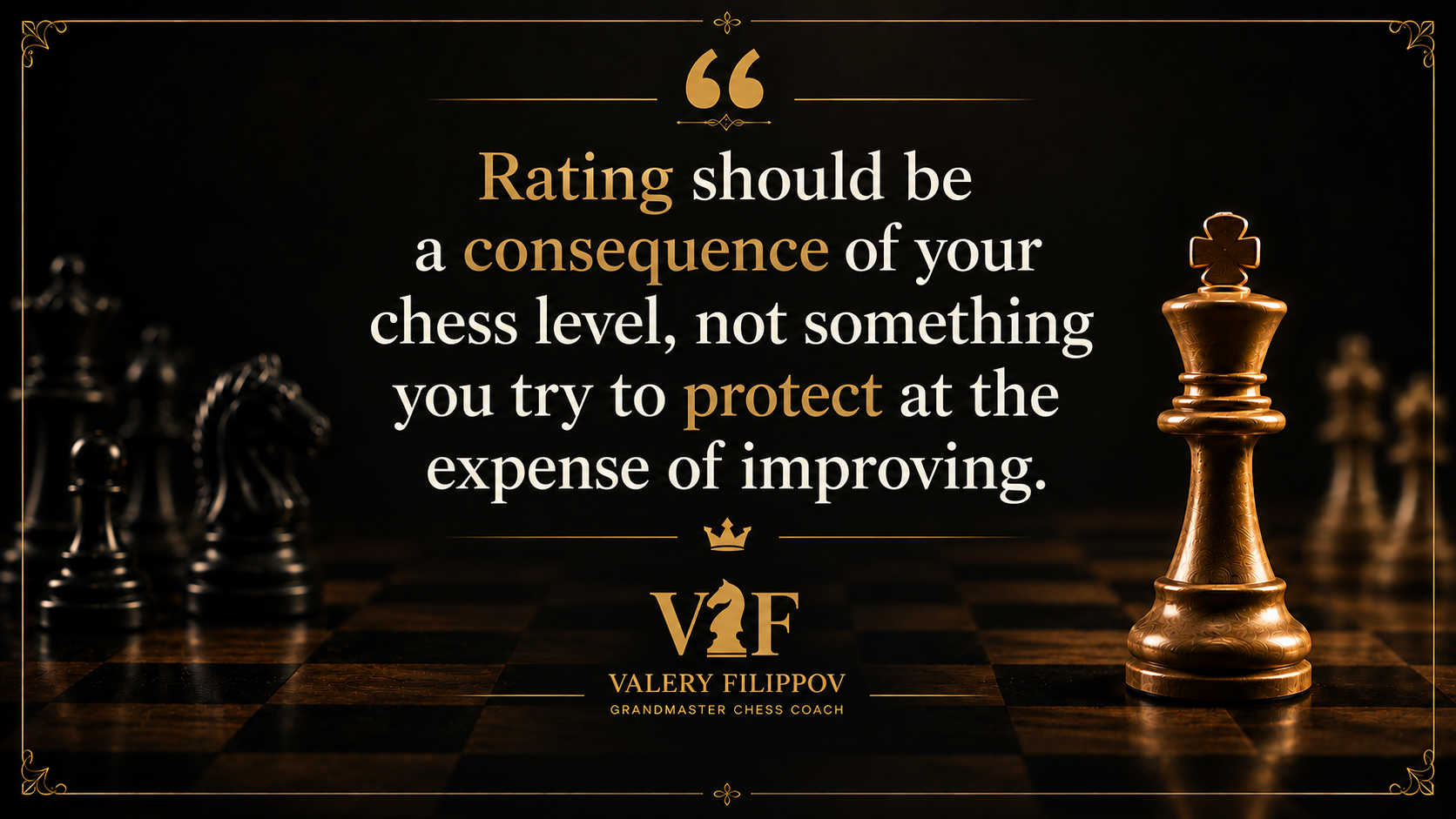
I don’t believe in pretending that rating does not matter. Of course it matters, especially if you are competitive. But I prefer to see rating as a consequence of your level, not the level itself.
🏆 Chess Rating and Chess Title Are Not the Same Thing
This distinction is quite simple but worth mentioning.
Reaching a certain rating does not automatically give you the corresponding international title. FIDE titles have their own requirements. For IM and GM, rating is only one part of the process. Norms and other conditions are also required.
The reverse is important too.
A grandmaster can later fall below the rating level associated with earning the title and remain a grandmaster.
I think this illustrates the difference quite nicely.
A rating describes your current position in a rating system.
A title is an achievement you have earned.
The two are connected, but they are not the same thing.
🎓 How I Recommend My Students Think About Rating
I prefer to treat rating as information.
Nothing more dramatic than that.
If your rating has been stuck around the same level for a year despite hundreds of games, that is useful information. Something is probably preventing you from moving forward. Perhaps you repeat the same positional mistakes. Perhaps you play a lot but rarely analyze your games. Perhaps your training is focused on areas that are not actually limiting you. This is also why I believe having a clear chess training plan is so important – it helps you understand what you are actually working on and why.
That is worth investigating.
But a 70-point drop over a short period? I would be much less interested in drawing conclusions from that alone. Chess form is not perfectly stable. Results come in waves. The opposition changes. Sometimes several bad games happen close together.
Online, one bad evening can make the graph look terrible.
So I prefer a longer view. Where were you six months ago? Where are you now? Has the quality of your chess changed? Are the same mistakes still appearing?
Those questions interest me much more than whether your rating was 1873 on Monday and 1849 on Thursday.
📊 FIDE, USCF, Chess.com and Lichess – What Should You Remember?
If I had to reduce the entire article to a few simple points, I would put it this way.
FIDE is the main international rating system for official over-the-board chess. Standard, Rapid, and Blitz ratings are separate.
USCF / US Chess is the American rating system used for US Chess rated competition. It has its own calculation rules and should not be treated as identical to FIDE.
Chess.com uses Glicko and has separate ratings for different time controls. The system also considers how certain it is about your current rating.
Lichess uses Glicko-2 and has its own rating pool and scale. Its numbers should not be directly treated as FIDE or Chess.com equivalents.
So if someone is 1900 FIDE, 2050 USCF, 2150 Chess.com, and 2300 Lichess, I don’t see four conflicting answers.
I see four ratings.
🏁 My final words
I don’t think there is one number in chess that can perfectly describe how strong you are.
Rating is useful. Very useful, actually. It allows tournaments to organize players, helps us find opponents of approximately similar strength, gives competitive chess a clear ranking system, and allows us to measure progress over time.
But it still has limits.
A FIDE rating tells us something different from a Chess.com bullet rating. A Lichess rapid number exists inside a different pool from USCF. Trying to force all of these numbers into one universal scale creates more confusion than clarity.
For improvement, I would pay much more attention to the direction of your rating over a long period than to small changes from week to week. If your level is improving consistently, the rating normally has a good chance of following it sooner or later.
And I would definitely not allow one bad tournament or one terrible evening online to decide how I feel about my chess.
In the end, rating is a very useful number next to your name. But it still cannot play the game for you.
♟ Article prepared by Grandmaster and chess coach Valery Filippov ♟
📖 Continue Improving Your Chess:
▸ How to Calculate in Chess Without Missing Tactics
▸ How to Improve at Chess as an Adult
▸ Everything Parents Need to Know About Chess
FAQ
1.Why does my chess rating change so much after every game?
If your account is new or you have not played for a long time, the system may still be uncertain about your actual level. In that situation, larger rating changes are normal. Once you play enough games and your rating becomes more established, the changes usually become smaller.
2. Which rating matters more – rapid, blitz, or bullet?
That depends on what kind of chess you care about. If your goal is to improve at serious chess, I personally would not judge your overall strength by bullet rating. Rapid gives you considerably more time to actually think about the position. But if your only goal is to become a stronger blitz player, then naturally your blitz rating is the most relevant number.
3. How long does it take to get a FIDE rating?
There is no fixed number of tournaments. Under the current rules, you need enough games against FIDE-rated opponents to meet the requirements for an initial published rating. Depending on the tournaments you play and the opponents you face, this can happen fairly quickly or take considerably longer.
4. Does losing rating mean I am getting worse at chess?
Not necessarily. This is one of the reasons I don’t like judging progress from a few weeks of results. You can lose rating because of poor form, stronger opposition, or simply several bad games in a row. I would be much more interested in what happens to your rating and the quality of your chess over six months or a year.
5. Should I care about my chess rating?
Yes – but not too much. I think rating is useful because it gives you a simple way to follow your progress over time. The problem begins when every small rating change affects the way you feel about your chess. I would rather see a student improve their actual game and temporarily lose 30 points than protect those 30 points by avoiding difficult opponents.