How to Make a Plan in Chess: A Step-by-Step Guide
One of the questions I hear very often from my students is: “I finished the opening. What should I do next?”
For the first ten or fifteen moves, everything is relatively clear. You know your opening, place your pieces on familiar squares, and castle. Perhaps you even remember several variations from a course or database. But at some point, the theory ends. You have a normal position in front of you, nothing is immediately hanging, there are no tactics – and this is exactly where the real problems begin.
My name is Valery Filippov, and I am an International Grandmaster and chess coach. Over the years of teaching, I have noticed an interesting thing: for many chess players, it is much easier to find a move in a bad position than in a good, quiet position. When you are under attack, you need to defend. When a piece is hanging, you need to save it. When there is a combination, you can calculate it. But what should you do when nothing is happening? This is exactly when you need a plan.
At the same time, I want to say right away: a good plan in chess does not necessarily have to be something grand like, “I will launch an attack on the kingside and checkmate my opponent in ten moves.” Very often, a good plan is much more modest: improve your worst piece, occupy an open file, prepare a pawn break, or prevent your opponent from carrying out their own idea. In this article, I will try to show how I look for plans over the board myself and how I teach my students to do it.
♟️ What Does a “Plan” in Chess Actually Mean?
I think beginners and even fairly experienced chess players sometimes take the idea of a plan too literally. They want to know in advance what they are going to do for the next five, seven, or ten moves. But chess is a game for two. You cannot say, “Now I will put my knight on e5, then my queen on g4, then play f5 and start an attack,” and expect your opponent to quietly watch you do all of this.
After every move your opponent makes, the situation can change. So I would define a chess plan much more simply: it is the direction in which you want to improve your position. For example, your opponent has a weak pawn. Your plan is to increase the pressure on it. You have a bad bishop – find a more active diagonal for it. You have a pawn majority on the queenside – prepare its advance. Your opponent’s king is weak – bring additional pieces into the attack. The specific moves can change. And that is completely normal.
🔎 Step 1. First, Evaluate the Position
It is impossible to make a good plan without understanding what is happening on the board. So when the theory ends or the game reaches a quiet moment, I do not recommend immediately looking for a move. First, try to evaluate the position.
I usually pay attention to several things: material, king safety, piece activity, pawn structure, space, weak squares, and open files. You do not have to turn this into a school exercise and mentally go through ten different points before every move. But you should understand the main thing: what is good about my position and what is bad about it? Suppose you have more space, but one of your pieces is very poorly placed. Or your opponent has an isolated pawn, but their pieces are more active. Or the material is equal, but your king is significantly safer.
The plan should come from the actual features of the position. Not from what you would like to do. This seems obvious, but this is exactly where a huge number of mistakes happen. A chess player likes attacking, so they start an attack in a position where there is simply no basis for it. Another player likes endgames and automatically offers a queen trade, even though the queen is exactly what is creating the main problems for the opponent. First the position. Then the plan. Not the other way around. And when the position becomes more concrete and tactical, evaluation alone is no longer enough – you also need to know how to calculate in chess without missing tactics.
💪 Step 2. Find Your Worst Piece
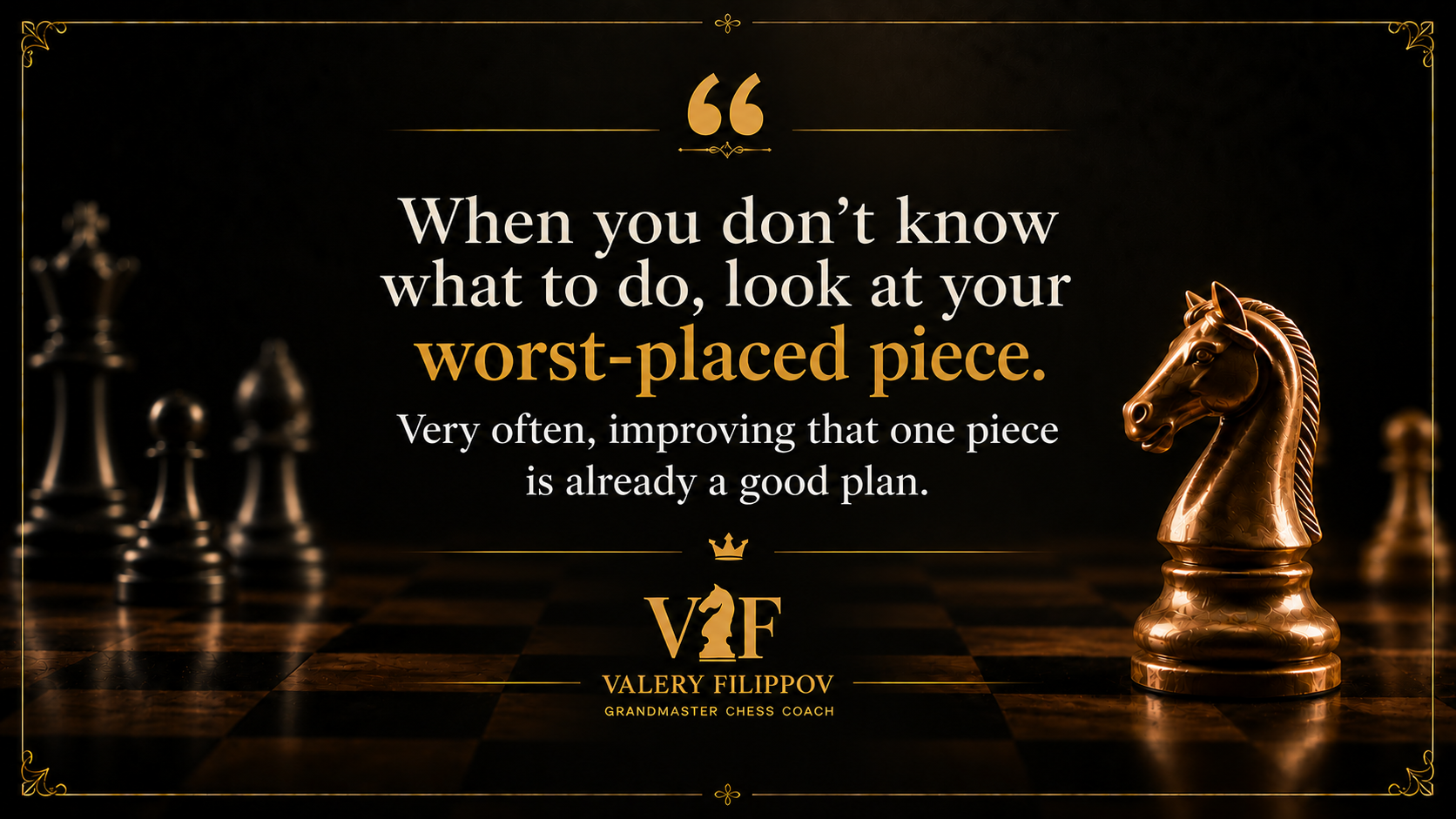
If a student tells me, “I have absolutely no idea what to do here,” one of the first questions I may ask is: Which of your pieces is placed the worst right now? This is an incredibly useful question.
Imagine that your rooks occupy open files, your queen is active, one knight is beautifully placed in the center, while your other knight is sitting on a1 and is barely participating in the game. Perhaps you do not need a complicated strategic plan at all. Find a way to bring that knight back into the game. A lot of good positional moves work exactly this way. They do not win material and do not create an immediate threat. They simply make one of your pieces better.
I often see the opposite situation with my students. They continue playing with the part of their army that is already perfectly placed. The active rook becomes even more active, the good knight gets another good square – while the bad bishop has been staring into its own pawn chain for ten moves. If you do not know what to do, look at your worst piece and ask yourself whether you can improve its position. Sometimes that is enough to find a plan for the next several moves.
🧱 Step 3. Find Weaknesses in Your Opponent’s Position
The next question is: what can I actually attack? A weak pawn, a weak square, an undefended piece, an exposed king – all of these can become the basis of a plan. But there is an important point here. Not every weakness is actually worth attacking.
Suppose your opponent has a weak a6-pawn. Theoretically, it is weak. But if attacking it requires you to transfer your queen, two rooks, and a knight there while completely abandoning your own kingside, perhaps that pawn should not interest you at all. I like to ask a more practical question: Which weakness can I realistically attack? And even better – can I create a second one?
This is especially important in endgames. Your opponent can often defend one weakness. When they have to defend two different parts of the board at the same time, the task becomes much more difficult. A strong player does not simply notice weaknesses. They understand which of them have practical importance.
🚀 Step 4. Look for Pawn Breaks
The pawn structure very often literally tells you where you should play. If the center is closed, both sides often have the opportunity to play on different flanks. If you have a pawn majority, advancing it can become a natural plan. If there is a typical c5, f5, e4, or b4 break, the entire placement of your pieces can be built around preparing it.
And here I often see the same mistake: a chess player knows which pawn move they want to make and plays it too early. For example, the right idea is f5. But that does not mean that f5 should be played right now. Perhaps first you need to put the rook on f1. Move the king away from a potentially dangerous diagonal. Bring the knight closer. Force an opponent’s piece into a less favorable position. In other words, the break itself may be correct, but the timing may be wrong.
In general, I find it useful to separate two questions: What do I want to do? and What do I need to prepare in order to do it well? The second question is often more important than the first.
👑 Step 5. Compare King Safety
You can understand the pawn structure perfectly and still choose a completely wrong plan if you forget about the kings. If your opponent’s king is weak, this can change the entire evaluation of the position.
Suppose there is a weak pawn on the queenside that you can start attacking. That is a good positional idea. But at the same time, there are almost no defenders around your opponent’s king, while your queen, rook, and bishop are already pointing in its direction. Perhaps this is absolutely not the time to go hunting for a pawn. And the opposite is also true: if your own king is in danger, sometimes you need to give up an active plan and solve that problem first.
Before serious active play, I always recommend looking at both kings. Especially when the queens are still on the board.
🛑 Step 6. Don’t Forget That Your Opponent Has a Plan Too
This is probably one of the most underestimated points. We have found our plan and we are very happy. “I will transfer my knight to d5.” Great. But what is your opponent going to do? Sometimes their idea is so dangerous that your beautiful positional maneuver simply does not matter.
When I analyze my students’ games, I regularly come across positions where the player makes a perfectly normal move. The move itself is good. The problem is that it does not meet the demands of the position at all. The opponent is preparing b5 and opening the queenside. Or they are going to play f4. Or they want to occupy an open file. And meanwhile, we are calmly improving our bishop.
So after you have found your own plan, always ask: What would my opponent do if it were their move right now? I really like this question. It quickly shows you how urgent your own idea actually is. Sometimes the best plan is not carrying out your own idea at all, but preventing your opponent’s plan.
🔄 Step 7. Don’t Be Afraid to Change Your Plan
This is especially important. You made a plan five moves ago. During that time, your opponent also made five moves. Why should your original plan necessarily still be correct?
I have seen plenty of games where a player came up with a good idea and then continued carrying it out even after the position had completely changed. In chess, you do not get extra points for consistency. If the circumstances have changed – change your plan.
Suppose you were planning to attack a weak pawn. Your opponent pushed it and got rid of the weakness. That’s it. The old plan no longer exists. Or you were preparing an attack on the king, but your opponent offered a favorable transition into a winning endgame. There is no reason to refuse it just because five minutes ago you were planning to checkmate them.
A good chess player is not someone who comes up with one brilliant plan and carries it out from beginning to end. Much more often, strong play is a series of small, correct plans that change together with the position. Learning to adapt your thinking instead of following the same ideas automatically is also an important part of improving at chess as an adult.
⚠️ Don’t Look for a Plan When the Position Requires Concrete Calculation
This is a fundamentally important point. Not every position needs a plan. If your opponent’s piece is hanging, their king is facing a mating threat, or a forcing tactical operation is beginning, discussions about weak squares can wait. Concrete calculation comes first.
I sometimes see chess players trying to apply strategic rules in positions where they simply need to calculate variations. They think, “I have a better pawn structure, so I want to trade pieces,” but the specific exchange loses a pawn. The opposite extreme happens all the time as well: a player tries to calculate everything in a quiet position where there is nothing forcing. They spend ten minutes on variations that cannot possibly be calculated to the end because the opponent has five normal responses after every move.
One of the important chess skills is understanding what kind of decision the position requires right now. Need calculation? Calculate. Need a plan? Evaluate the position.
🧠 Don’t Try to Find the “Perfect” Plan
Sometimes students spend too much time looking for the best strategic plan, as if there were one correct answer hidden in the position by the author of a puzzle. But this is a real game. Very often, there are several perfectly reasonable plans.
You can improve a piece. You can gain space. You can prepare a pawn break. You can limit your opponent’s counterplay. The engine may prefer one of these options by 0.3, but for a human player, that difference may mean practically nothing.
Especially in quiet positions, I would prefer a clear plan that you are capable of carrying out correctly over a complicated idea whose point you do not fully understand yourself. You do not need to find a grandmaster move every time. You need to understand why you are making your move.
🎓 My Simple System for Finding a Plan
If we reduce everything to a practical sequence, I would suggest the following approach.
First ➡️ check the tactics. Is there anything forcing right now? Checks, captures, threats, undefended pieces.
Second ➡️ evaluate the position. Where are your advantages? Where are your problems? Which side of the board is more important for you?
Third ➡️ find your worst piece. Can you make it more useful?
Fourth ➡️ find your opponent’s real weaknesses. What can actually be attacked?
Fifth ➡️ look at the pawn structure. Which breaks are available, and what needs to be done to prepare them?
Sixth ➡️ compare the kings. Is there a reason to attack? Is your own king in danger?
Seventh ➡️ find your opponent’s idea. What do they want to do next?
Only after that should you choose a specific move. Of course, I do not sit at the board and repeat all seven points to myself every time. For an experienced chess player, most of this process happens automatically. But if you regularly find yourself thinking, “I don’t know what to do,” this sequence can really help.
🏁 How to Learn to Find Plans on Your Own
Unfortunately, learning a few rules is not enough here. To develop a good feeling for plans, you need to see a lot of good chess.
Study games by strong players, but do not simply click through the moves quickly. Stop in a quiet position and try to guess the next move. Better yet, try to guess the idea, not the move. What would you do here? Which piece would you improve? Where is the weakness? Which pawn break would you prepare? Then look at what the strong player did and try to understand why.
I consider this type of work extremely useful. Over time, you begin to recognize familiar structures and ideas. You no longer have to invent a plan from scratch every time.
The same applies to your own games. After the game, find positions where you thought for a long time and did not understand what to do. Do not rush to turn on the engine. First, try once again to make a plan on your own without the pressure of the clock. Only then check yourself. This kind of work becomes even more effective when it is part of a structured training routine. If you are not sure how to organize your chess study, I have explained my approach in more detail in my guide on how to build a chess training plan.
🏆 My final words
The ability to make a plan often seems like something quite abstract. Tactics are clear: there is a combination, and you need to find it. With a plan, everything looks much less concrete. But in practice, I do not think you need to try to see the future ten moves ahead.
Start with the position in front of you. What is good about it? What is bad? Which of your pieces is placed worse than the others? What can you attack? Which pawn break is possible? What does your opponent want to do? Once you answer these questions, you will very often already understand which direction you should move in.
And remember one more thing: a plan is not a promise to yourself that you will play the next five moves in a certain way. It is simply a direction. After every move your opponent makes, you should be ready to check it again.
In my opinion, this is where an important line is drawn between a chess player who simply makes moves that look good and a chess player who truly understands what they want to achieve on the board.
♟ Article prepared by Grandmaster and chess coach Valery Filippov ♟
📖 Continue Improving Your Chess:
▸ How to Reach a 1500 Rating on Chess.com as an Adult
▸ Why Blitz Chess Is Hurting Your Improvement
▸ How to Choose the Right Chess Coach for Beginners
FAQ
1. What is more important in chess, tactics or planning?
It depends on the position. If there is a concrete tactical situation, calculation comes first. There is little value in making a beautiful positional plan if your opponent can win a piece on the next move. In a quiet position without forcing moves, strategic planning becomes much more important.
2. How do strong chess players find plans so quickly?
A lot of it comes from experience and pattern recognition. After you have seen the same pawn structures, weak squares, typical breaks, and piece maneuvers many times, you do not have to discover every idea from scratch. This is one reason why studying well-annotated games of strong players is so useful.
3. Is improving my worst piece really a chess plan?
Absolutely. In fact, it is often one of the best plans available. Players sometimes think a plan has to involve an attack or some complicated maneuver. But if your position has no immediate weaknesses and one piece is badly placed, improving that piece may be exactly what the position requires.
4. How can I practice making plans in chess?
Take positions from your own games or games played by strong players and stop before an important positional move. Do not try only to guess the move. Ask yourself what you would like to achieve over the next few moves and why. Then compare your idea with what was actually played. I find this much more useful than simply clicking through hundreds of master games.
5. Can a position have more than one good plan?
Of course. Chess is not always like a tactical puzzle with one correct solution. In many quiet positions, two or three plans can be perfectly reasonable. One may be slightly better according to an engine, but that does not necessarily make the others bad. For practical play, I often prefer a clear plan that you understand well over a complicated idea that may be objectively a little stronger.