My Child Hates Losing at Chess. What Should I Do?
Over the years I have spent working as a coach, I have seen very different reactions from children after losing.
One child loses a game, shakes hands with the opponent, and five minutes later is already running around with friends in the tournament hall. Another comes out to their parents in tears. A third gets angry and says the opponent was simply lucky. A fourth stays silent the entire way home. And some children, after one bad tournament, quite seriously announce, “I’m never playing chess again.”
These reactions often worry parents. Especially if the child is usually quite calm at home. It is one of those situations where parents of young chess players can easily start wondering whether they are doing something wrong.
“Maybe tournaments are not right for them yet?”
“Should I explain that it’s only a game?”
“What should I say after a loss?”
“What if they cry every time?”
In my opinion, it is very easy to start solving a problem here that may not actually exist yet.
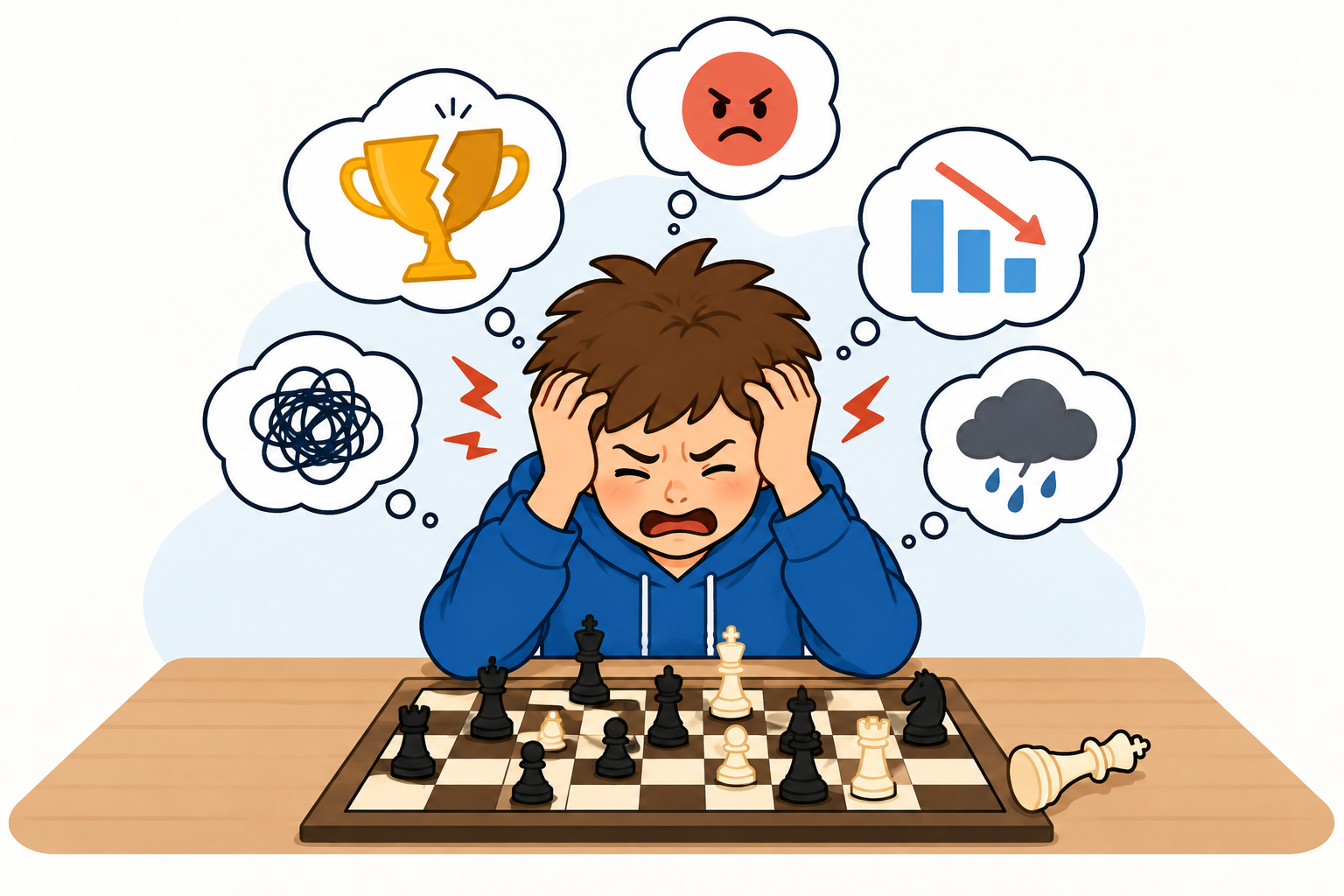
I do not think a child has to be calm about losing. If they really wanted to win and they lost, it is completely natural to be upset. In fact, I would find it a little strange to expect an eight-year-old child to react to a difficult loss like an adult professional athlete.
For me, the more important question is what happens afterwards. Ten minutes later, an hour later, the next day. Does the child want to play again? Can they look at the game calmly later? Are they gradually learning to handle losses a little better?
That is what I would pay much more attention to.
First, I Would Let the Child Be Upset
I think adults sometimes try to fix a child’s emotions too quickly.
They lost and they are crying.
“Why are you so upset? It’s only chess.”
“Nothing terrible happened.”
“But you played well.”
“You’ll win next time.”
All these things are said with the best intentions. But at the moment of defeat, they may not work at all.
For the child, this is not “only chess” right now. Maybe they prepared for the tournament for several weeks. Maybe they were in first place before the final round. Maybe they were a queen up and somehow got checkmated. Or they lost to a friend they really wanted to beat.
I understand this feeling very well. Chess losses are unpleasant for adult players too. I am a grandmaster and have played an enormous number of tournament games, but that does not mean I am always in a wonderful mood after a bad loss.
So my first task would not be to convince the child that they should not feel upset.
Let them be upset.
I am much more interested in gradually teaching them that this feeling passes.
Do Not Analyze the Game in the First Two Minutes
This is one of the situations I see especially often at children’s tournaments.
The child comes out after losing, and Dad already knows where everything went wrong.
“Why didn’t you take the pawn?”
“I told you not to play this opening.”
“What were you thinking when you put your queen there?”
Maybe Dad is completely right from a chess point of view. I would still wait.
When a child is very upset, I am usually not expecting a high-quality analysis of the position from them. And I certainly do not expect this particular moment to become the best chess lesson of their life.
Sometimes fifteen minutes is enough. Sometimes I would postpone the analysis until the evening. After a particularly difficult game, we can calmly look at it during the next lesson.
The position is not going anywhere.
But something a parent says in the first few minutes after a loss can sometimes be remembered for a surprisingly long time.
I Would Not Immediately Try to Turn a Loss Into a “Useful Lesson”
There is another reaction that seems a little artificial to me.
The child has just lost, and the adult immediately starts explaining:
“Losses make us stronger.”
“You should be grateful to your opponent.”
“You learned a very valuable lesson today.”
All of this may be true. I constantly use my students’ lost games in training. Very often a loss shows a problem much more clearly than a win does.
But there is a time for everything.
If the child currently wants to throw their trophy at the wall, a lecture about the benefits of losing is unlikely to have the desired effect.
Sometimes I think it is enough to say, “Yes, that was a painful game.” And leave it there.
Later, when the emotions are gone, you can calmly look at what happened. That is when the loss really becomes material for improvement.
I generally do not like the idea that after every unpleasant experience, a child must immediately find something positive in it. Sometimes they can simply be upset first.
Do Not Make the Loss Even Harder With Your Own Disappointment
This, in my opinion, really is important.
Children are very good at noticing their parents’ reactions.
Sometimes the father does not even say anything bad. But the child comes out after the game and can already see it on his face: Dad is disappointed.
This is especially noticeable when the family has invested a lot in chess. Private lessons, travel, hotels, tournament fees. The parents gave up their weekend to come to the tournament. And then the child loses in twenty moves to an opponent rated 300 points lower.
Of course, the adult may be disappointed too.
But I would try very hard not to turn my own disappointment into an additional burden for the child. Sometimes the best way to help your child improve at chess is simply to give them enough space to make mistakes and lose games without feeling that they have disappointed you.
They have already lost a chess game. They do not also need to feel that they have let the family down.
I have met children who, after losing, were not afraid of the result itself. They were afraid of the conversation with their parents afterwards. I like this much less than seeing a child cry after a game.
If a child cries because they wanted to win, I see a strong emotion.
If a child cries because they are afraid to walk out of the tournament hall and face Dad, I see a very different problem.
Be Careful With the Question “Why Did You Play That?”
To an adult, this question seems perfectly logical.
The child made a terrible move. You want to understand why.
“Why did you play there?”
And the child answers:
“I don’t know.”
The parent becomes even more frustrated. How can you not know?
Very easily.
Children make impulsive moves. They forget to check the opponent’s threat. Sometimes they see a beautiful idea and stop looking at the rest of the board. Sometimes they are tired. Sometimes they simply make a mistake.
Adult chess players cannot always explain why they did something stupid either.
So I prefer slightly different questions.
“What were you trying to do here?”
“What move did you expect from your opponent?”
“When did you first start feeling uncomfortable with your position?”
Questions like these help me understand the student’s thought process.
But after a serious mistake, “Why did you do that?” can sometimes sound less like an attempt to understand and more like, “How could you possibly do something so stupid?”
Children understand that difference very well.
If Your Child Cries After Losing, It Does Not Necessarily Mean Chess Is Bad for Them
I would not make conclusions too quickly because of tears.
Some children are simply more emotional than others. They may cry after losing a soccer game, getting a bad grade, or arguing with a friend. Chess is simply another situation where they wanted a particular result very badly.
A tournament game can also last several hours. For a young child, that is an enormous amount of concentration and tension. Then one mistake decides everything.
It is hardly surprising that the emotions come out.
I would look at the bigger picture.
What happens an hour later? Is the child playing blitz with friends again?
Do they want to play the next round the following day?
Do they open the chessboard themselves at home?
Are they looking forward to the next lesson?
If the answer is yes, tears alone would not worry me very much.
I would be much more concerned if a child who used to want to play all the time suddenly starts looking for reasons not to go to tournaments, does not want to study, and becomes nervous before the game even begins.
That is a very different signal.
Do Not Promise Rewards Only for Winning
I am fairly cautious about the system of “win the tournament and you’ll get a present.”
Not because a child should never be rewarded. Why not? If the family goes out for ice cream after a good tournament, I do not see any tragedy in that.
The problem starts when the reward is directly tied to the result.
Win three games, get the present. Win two, no present.
Now losing does not simply mean a zero in the tournament table. The child has also lost the prize, disappointed the parents, and perhaps lost rating as well.
That is too much meaning for one chess game.
If parents want to celebrate something after a tournament, I prefer rewarding things the child can actually control. They worked well before the tournament. They played seriously. They did not rush. After a loss, they recovered and played the next game normally.
But even here, I would not turn chess into a payment system.
Ideally, the child should still want to play for reasons other than getting a new LEGO set.
Do Not Expect Your Child to Lose “Beautifully”
Of course, there are limits when it comes to behavior.
You cannot insult your opponent. You cannot throw the pieces around. You should not refuse to shake hands just because you lost. In my opinion, respect for the opponent and normal behavior at the board should be developed gradually, just like chess skills.
But I would separate behavior from emotion.
A child can be extremely angry and still shake the opponent’s hand correctly.
For me, that is already enough.
I do not need them to smile ten seconds after losing, congratulate everyone around them, and explain what a wonderful life experience they have just received.
Let them learn to control their actions. Controlling the fact that an emotion appears in the first place is much harder.
Over time, many children begin to handle losses more calmly simply because they have already lost many games and know that tomorrow there will be another one.
That is experience too.
Losing a Winning Position Is Especially Difficult
There are losses, and then there are losses.
If a much stronger opponent simply outplays a child, sometimes the child accepts it quite calmly.
It is completely different when the game was already won.
An extra rook. Five minutes left. The parents behind the glass have already mentally put a 1 on the tournament table.
And suddenly there is a blunder.
Checkmate.
One of the worst things you can say at that moment is, “How could you not see that?”
Believe me, the child already understands perfectly well that they could have won.
Later, I would use a game like this for very specific work. Why did they lose concentration? Were they rushing? Did they stop looking at the opponent’s threats because they thought the game was already over? Were they short on time?
These are chess questions we can work on.
But first I would let the child deal with the fact that an almost won game turned into a loss.
That hurts when you are eight, when you are forty, and when you are a grandmaster.
There Is No Need to Immediately “Win It Back” After a Loss
This problem is especially noticeable online.
The child loses.
Clicks New Game.
Loses again.
Another game.
Forty minutes later, the rating is down 100 points, the mood is terrible, and the quality of the chess has very little to do with the child’s normal level.
In chess, we often call this tilt. The emotions from one bad result begin to affect the next decisions. The player rushes, takes unnecessary risks, and plays worse.
I would teach a child to notice this moment.
You do not necessarily need a strict rule like “after two losses, we turn off the computer.” For one child it may be useful, for another completely unnecessary.
But I like the habit of stopping sometimes.
Lost a painful game? Get away from the computer. Eat something. Go for a walk. Do something else.
Chess will still be there an hour later.
I Would Not Let a Child Explain Every Loss as Bad Luck
There is another extreme here.
Supporting a child does not mean agreeing with everything they say after losing.
“He found that move by accident.”
“I was unlucky.”
“My opponent played terribly, I just blundered.”
“The clock was bad.”
“It was too noisy.”
Sometimes some of this is true. Tournament conditions really can be unpleasant. An opponent really can find a strong move almost by accident.
But if every lost game is always somebody else’s fault, I do not like that either.
I would not argue in the first few minutes. Later, we can simply open the game.
Fine, let us say the opponent played badly. Where exactly could we have won? What happened afterwards? Why did we not use our chance?
Chess is quite an honest game in this sense, I think. The moves remain on the board. We can go back to them.
Gradually, a child should get used to a simple idea: there is no need to blame yourself for everything, but it is worth seeing your own share of responsibility for the result.
Do Not Compare Their Reaction With Other Children
“Look at Masha. She lost and she isn’t crying.”
I would not say that.
We do not know what Masha is feeling. Maybe she does not care. Maybe she will cry in the car. Maybe she has already played three hundred tournament games and really has learned to lose calmly.
Your child is different.
I generally think that comparing your child with other children is rarely useful in chess, and I like comparing their emotional reactions even less.
For one child, major progress will mean no longer crying after every loss. For another, it will mean no longer getting angry at the opponent. For a third, it will mean being able to calmly analyze a lost game half an hour later.
That is what I would look at.
If a year ago a loss ruined the child’s entire day, and now they are upset for twenty minutes and then go play the next round, that is already a noticeable change to me.
They do not need to become the calmest child in the tournament hall.
Parents Show Their Children How Scary Losing Is
Children watch adults very carefully.
Imagine Dad is playing online. He loses a game and starts getting angry.
“What an idiot I am!”
“Minus twenty rating points!”
“How could I play like that?”
The next day the child loses a game, and Dad explains that losses do not matter at all.
Not the most convincing system.
I think the way parents react to their own mistakes sometimes tells a child more than special conversations about sports psychology.
There is no need to pretend you do not care.
You can say, “Yes, I’m upset. I had a good position and ruined it. I’ll look later and see where I went wrong.”
I like that reaction much more.
The loss is unpleasant, but nothing catastrophic happened.
When I Would Actually Start to Worry
Strong emotions by themselves do not frighten me.
But there are situations I would take more seriously.
If a child is constantly afraid of tournaments several days before they begin. If losing causes a very strong reaction that lasts for hours or regularly ruins the entire day. If they begin avoiding opponents of their own level simply because they might lose. If chess clearly no longer brings them any enjoyment, but they continue only because of pressure from adults.
I would pay particular attention if the fear of losing starts changing the way the child plays.
Sometimes a child does not want to play in a strong tournament because their rating might go down. They do not want to face strong opponents. They offer a draw in a good position simply because they do not want to take any risk.
At that point, it is already interfering with their chess development.
A chess player cannot grow if the main goal of every game is to avoid losing at any cost.
In a situation like this, I would talk to the child and the coach and try to understand where all this pressure is coming from.
Sometimes the solution is very simple: fewer tournaments, less talk about rating, a short break.
You Do Not Need to Teach a Child How to Lose on Purpose
Parents sometimes ask me, “Maybe I should beat them more often at home so they get used to losing?”
I would not create a separate training program for losing.
If a child plays chess regularly, they will get plenty of losses anyway.
In my opinion, it is much more useful to create a normal attitude toward something that is already happening naturally.
Today you win.
Tomorrow you lose.
The day after that you draw.
At one tournament you get a medal. At the next one you finish twentieth.
That is chess.
Even a very strong child will eventually find themselves in a group where the opponents are stronger. And that is a good thing. If a student wins almost all the time, I am more likely to wonder whether it is time for them to play stronger opposition.
I do not want to protect a child from losing.
I want losing to gradually stop feeling like a catastrophe.
What I Would Say to a Child After a Difficult Game
To be honest, sometimes I would not say anything special at all.
That is probably one of the main points of this article.
Parents often feel there must be a correct phrase that will fix everything right now. But a child does not always need a phrase.
Sometimes it is enough just to be there.
If they want to tell you about the game, listen.
If they want to show you a position, look at it.
If they do not want to talk, I would not try to pull an analysis out of them.
And when the emotions pass, you can return to the chess.
What happened? Where did the position change? What can we do differently next time?
Without turning it into a tragedy.
After a few dozen or a few hundred games, the child will probably see many of today’s losses very differently.
What Matters More to Me Is Whether the Child Wants to Play the Next Game
If a student is upset after losing, that is completely normal to me.
If they cry, that is not the end of the world either.
If they say, “I hate chess,” I would not start looking for a new hobby just yet.
I would wait.
The most interesting question for me comes a little later: do they want to sit down at the board again?
If the answer is yes, then chess is probably still fine.
I think one of the best things chess can teach a child is not how to stop being upset about losing. That seems like a rather artificial goal to me. It is much more useful to learn how to lose, be upset, understand what happened, and then play again.
I have lost an enormous number of games during my chess life. Some of them I forgot a long time ago. Some I still remember.
But after every one of them, at some point, there was another game.
And that is the attitude toward losing that I would gradually like to teach a child.
♟ Article prepared by Grandmaster and chess coach Valery Filippov ♟
📖 Continue Improving Your Chess:
▸ How to Analyze Chess Games
▸ Chess Rating System Explained: FIDE, USCF, Chess.com & Lichess
▸ Do You Really Need a Chess Coach as a Beginner?
FAQ
How can I stop my child from getting angry after losing?
I am not sure “stop” is the right goal. Being angry for a while is not necessarily a problem. I would focus more on behavior. A child can be angry and still shake hands, respect the opponent, and avoid throwing pieces around. Learning to handle the emotion usually takes time.
Should I punish bad behavior after a chess loss?
I would separate the loss from the behavior. Losing is fine. Being upset is fine. Insulting an opponent or throwing pieces is not. I think children can understand that distinction quite well: you are allowed to be angry, but there are still limits to what you can do because you are angry.
What if my child always blames the opponent after losing?
I would not start an argument while the child is still emotional. Later, I would simply look at the game together. If the opponent was really lucky, fine. But where could we have played better? Chess has a useful advantage here: we can go back to the position and see what actually happened.
Can losing too often make a child hate chess?
It can, especially if every tournament becomes a stressful experience. But I would not try to protect a child from all losses either. If they win almost every game, they may simply need stronger opponents. What matters to me is whether the level of competition is reasonable and whether the child still enjoys playing.
When should I worry about how my child reacts to chess losses?
I would pay attention when it goes beyond being upset after a game. If the child becomes anxious before tournaments, avoids strong opponents, worries constantly about rating, or no longer seems to enjoy chess because they are afraid of losing, I would take that more seriously. At that point, I would want to understand where the pressure is coming from.