How to Help Your Child Improve Faster at Chess
One of the most common questions I get from the parents of my young students is, “Valery, how can I help my child get better at chess if I don’t understand anything about it myself?” And it’s true, chess is one of the most complex intellectual games out there, and at first glance, it seems impossible to even approach without knowing the rules. But the first and most important thing I want to tell you in this article is that chess is a real sport. And because of that, a lot of the same rules apply to it as to any other discipline. As a parent, you don’t need to know how to play chess. Your job is to point your child in the right direction. In this article, I, International Grandmaster and coach Valery Filippov, will explain in detail exactly how you can do that.
And If you’re completely new to the world of children’s chess, I also recommend reading my complete guide for parents, where I explain everything from ratings and tournaments to coaches, online platforms, and long-term improvement.
Let Your Child Love the Game First
This is the foundation of any sport, any activity where we or our children want to excel. It seems to me that almost every child has had someone try to teach them chess at some point. Or at the very least, they’ve witnessed a chess game being played. At first, they show a genuine interest and curiosity, then they slowly get acquainted with the game, learn how the pieces move, how to deliver checkmate, and how to pull off beautiful combinations. But then, as often happens, the child’s interest cools down and shifts to something else.
And it’s true, the statistics don’t lie-that’s exactly what happens in 90% of cases. But since you, dear parent, are reading this article, I suspect your child is part of that special 10% who took the next step-they fell in love with the game. And this is no longer just an interest; this is, if you’ll allow me to say so, their first little addiction.
The child constantly talks about chess. They keep asking you or another family member to play with them. And instead of cartoons and YouTube, they now only consume chess content. And here, I want to make an incredibly important point-the most valuable information in this article and on my website in general. A child’s love for chess is their most powerful engine of progress. Everything is built on this. And without it, nothing is possible.
Because in chess, as in any other sport, the number of hours an athlete dedicates to it is crucial. And for someone who truly loves what they do, training time flies by in an instant. For others, it’s genuine torment that lasts an eternity. Therefore, the most important thing you, as a parent, can do for your chess-playing child is to try to support, and even better, multiply their love for chess. And under no circumstances should you suppress it. I also recommend you read my other article on the topic of the 10 mistakes parents of chess players make.
Try to Immerse Them in the Chess Environment
Be sure to find out if there’s a chess club in your area and what level the groups there are. Of course, it all depends on the city you live in, but as a rule, there’s at least one chess club per district, and in megacities, there are even more. There, your child will find like-minded people and new friends who will be united by their love of chess.
Another important factor is that they’ll be placed in a competitive environment, which will push them even harder. When choosing a club, be sure to ask what activities they offer. Many clubs organize summer camps, training sessions, and various entertainment events that are, one way or another, connected to chess. And of course, chess tournaments!
🏆 Find Tournaments for Them
Tournaments are what will forge your child’s sporting character. Chess tournaments are almost always a good thing, but it’s also important to approach them with care. It’s at this stage of your child’s development as a chess player that you’ll first encounter their tantrums and tears. It’s here that your child will first tell you that they hate chess and want to quit. And in that moment, as a parent, it will be crucial for you to offer them support and explain that defeats are just part of the journey. Try to soften the blow and under no circumstances make it worse!
From my coaching experience, I can say that after an unsuccessful tournament, many parents statistically make one of two mistakes:
- Excessive criticism. I’ll say right away that this should be avoided completely. Especially if you see that your child is already suffering and regrets blundering their queen in one move. Only in cases where the child simply doesn’t care about the loss does it make sense to delicately but seriously explain that they need to take the sport more seriously. But as a rule, that isn’t necessary.
- Parents try to immediately shield them from chess because it caused stress and upset the child. I understand this position, but unfortunately, you can’t always do that in life. Especially in the future, when your child wants to build a career in their profession. It seems to me that chess is the ideal sport (non-traumatic) where a child can develop as a person and learn to take losses with resilience. Even if they tell you emotionally that they never want to play again, believe me, their opinion will most likely change by the next day.
Don’t Let Rating Become the Main Goal
As they develop as a player and participate in various tournaments, your child will eventually reach official tournaments that are rated by the USCF rating system. Most likely, initially, their rating will be low, like everyone else’s, but with the right training approach, it will grow noticeably over the next 1-2 years.
And here I want to point out a very important thing-don’t focus too much on that rating. Neither the child nor the parent should. Don’t make it the measure of all things. Yes, the rating system was created to more or less accurately reflect the level of a player. It was invented with good intentions. But in practice, ratings become a headache for many players, especially children.
You can’t even imagine the stress children often experience at tournaments when they get paired against someone with a rating 200-300 points lower than theirs. In their heads, a mental chain forms: “His rating is much lower, so I have to win, otherwise if I lose, I’ll lose a lot of rating points, and my parents will scold me because they can also see how much weaker he is.” And these kinds of thoughts lead to excessive worry and, as a rule, to mistakes.
So try to teach your child to detach from the rating and always play roughly the same way, against both strong and weaker opponents-calmly, thoughtfully, without cluttering their head with unnecessary thoughts. I also urge you not to push your child or set goals like “By the end of the year, you must be 1200.” All that does is create unnecessary pressure. And in chess, it’s completely unnecessary-it’s already a psychologically difficult game!
Develop the Habit of Training Systematically
If your child has decided to become a chess professional, it’s very important from childhood to develop the skill of systematic training. The best way to start is with 30-40 minutes a day, but try to make it a daily habit. To make it easier for you to monitor their learning process (and in the beginning, you’ll have to do this anyway), I recommend using the Chess.com website for training. On the Chess.com platform, there’s a section with puzzles, and more specifically, custom puzzles. In it, you can set a selection of tasks of different difficulty levels, and a timer will start, along with a display of the number of solved puzzles. At the end of the training session, you’ll be able to clearly see how many tasks your child solved and how many mistakes they made.
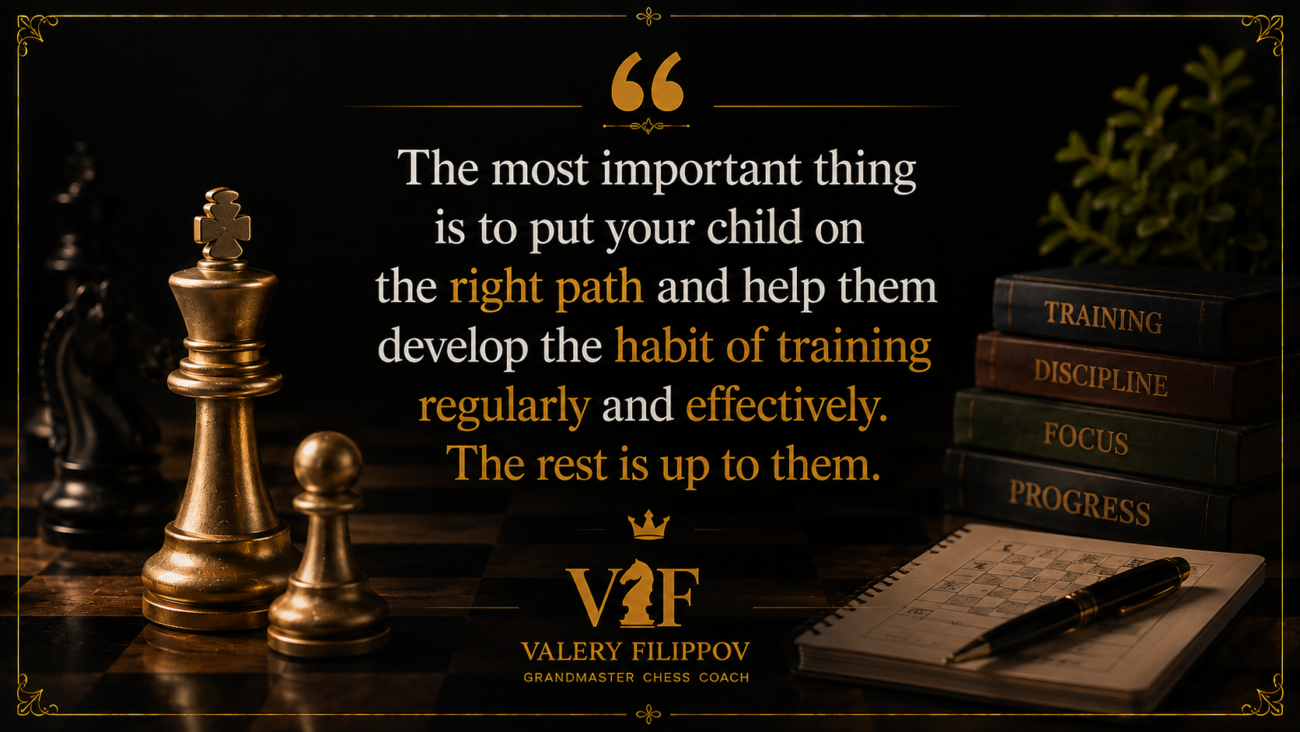
Of course, if you don’t know chess, you won’t be able to control all aspects of the game and all types of training. For example, you won’t be able to check how well they’ve learned a particular opening. But the most important thing is to put your child on the right path, to develop in them this habit of training regularly and effectively. Leave the rest to them.
Guide Your Child Toward Quality Chess Content
This is another important point. Most likely, your child already watches or will watch some chess YouTube channel or stream. Even here, I advise you to very carefully and gently guide them. To be honest, chess has become a mass sport now more than ever before. Along with the influx of many new players, a large number of content creators have also appeared. Their main goal is primarily to entertain their audience, not to focus on the usefulness of the content.
For instance, among my students (children and teenagers), I often encounter the following problem. During a lesson, I ask: “Tell me, how often do you train on your own and what do you do for that?” To which I get the answer: “Valery, I train almost every day for several hours-I constantly watch A.B.’s stream.” And the stream of chess player A.B. consists of casual chats about chess and online blitz games. Is it spectacular? Probably. Is it useful for your child as a chess player? Hardly at all. And the worst part is that it creates the illusion of training, while no actual progress is being made. Often, this can lead to a false impression, for both parents and children, that the child has no talent for chess. When in reality, the reason is completely different.
From my side, I can recommend (on YouTube) Eric Rosen and the Remote Chess Academy channel (Igor Smirnov). They are time-tested professionals who focus on quality and usefulness.
Don’t Let Your Child Play Blitz and Bullet Time Controls
I’m almost certain that most of your child’s training process is currently spent playing online. No surprise there-practice is much more interesting than theory! And there’s nothing wrong with that, as long as your child plays games with longer time controls. For example, 15 minutes per game (for each opponent) or at least 10.
But statistically, children often get carried away with blitz-that’s 3 minutes per game. And when blitz gets boring and too stale, they might even switch to bullet, which is 1 minute per game. I think, even if you’ve never played chess, you understand that the usefulness of such games is almost zero. Both opponents make template moves, putting practically no effort into calculating variations. And of course, they don’t analyze the games after they’re over, which, by the way, is one of the most important aspects of the game.
When your child gets hooked on lightning-fast time controls, they start to perceive chess not as a competitive sport, but as a computer game. And if that were all it was-just a waste of time… But unfortunately, in practice, it’s even worse. Because the habit of moving without thinking, the habit of rushing and making only superficial moves-all of this carries over into their classical tournament chess. Which undoubtedly negatively affects their results.
I advise my students, especially children, to completely avoid playing blitz. Even if they promise me they’ll do it rarely and can fully control the potential habits. It still fosters a non-serious attitude toward the game. So try to explain this to your child and gradually reduce blitz play to zero. I explain the problems with fast time controls in much greater detail in my article about why blitz chess can hurt long-term improvement.
Find Them a Chess Coach
And of course, I can’t fail to mention the benefits of a chess coach. Just let’s clarify right away that I’m not going to advertise myself in this paragraph. I’m always happy to help enthusiasts and professionals develop, but I’m far from the only coach you can turn to. Moreover, I believe that a good coach doesn’t necessarily have to be a grandmaster or have a high rating.
Please, when you’re signing your child up for individual or group training, first and foremost pay attention to whether the coach knows how to build a rapport with the child. And how much you and your child like them as a person.
A big mistake many parents make is that they first turn to coaches who have at least 1-2 famous students. And this essentially becomes their only selection criterion. In any sport, including chess, there are many mentors who have indeed raised the strongest players, but at the same time “broke the psyche” of dozens of other children who are never mentioned anywhere. And those children were also talented; the coach just couldn’t find an individual approach for them.
Also remember our main goal, which I mentioned in the first paragraph-to preserve and multiply the child’s love for chess. A good coach will come to your aid and help with this. I know of examples where a student literally outgrew their coach in playing level within 3-4 years, but still continued training with them for years, because they valued that connection and received motivation from the coach.
If you’re not sure what exactly to look for, I’ve written a separate guide on how to choose the right chess coach and which qualities matter most.
❤️ Always Try to Be Supportive
This is my final piece of advice in this article for you, dear parents. I’ll repeat: chess is not just a board game. It’s a big and very serious sport. Maybe not a physical one, but still a sport. And on the path to the top, your child will genuinely need a lot of support and positive motivation from you. Especially at a young age. They will definitely have many unsuccessful tournaments, painful losses, mistakes, and blunders. Please don’t criticize them for it, but rather encourage them to analyze those failures. Because that’s the only way to overcome them.
Also, celebrate their victories. Even if they seem insignificant to you. For example, after a year of training, the child became the best at school. You thought they trained so much and had talent, that by this time they should already be the district champion, or even the city champion. But it’s important to encourage even the seemingly small successes, because they are intermediate results on the way to a bigger goal. So please, never belittle their victories; instead, start a tradition of celebrating them in a special way, like going out for pizza all together.
Final words
In conclusion, I just want to wish success to your children and to you in this interesting and new chess world! As a grandmaster and simply a player who has dedicated their life to chess, I can confidently say that it is the most amazing and interesting game I’ve ever had the chance to learn. And I wouldn’t have achieved anything I have now without the help of my coach and, of course, my parents, who gave me great support, first and foremost on an emotional level. And I want to wish you, dear parents, to become a pillar of support for your children in this challenging and fascinating sport-chess.
♟ Article prepared by Grandmaster and chess coach Valery Filippov ♟
📖 Continue Improving Your Chess:
▸ Why Kids and Adults Improve at Chess Differently
▸ How to Analyze Chess Games
▸ How to Get Better at Chess: A Complete Step-by-Step Guide
FAQ
How often should my child practice chess?
Ideally, you want to try and turn it into a healthy habit of training at least 30 minutes a day. If your goal is for your child to become a professional chess player and, down the line, a titled player, I would advise aiming for around 10 hours of independent training per week.
When should I hire a chess coach for my child?
The sooner, the better-it really just comes down to your circumstances and budget. I know many children start one-on-one work with a coach as early as 6 or 7 years old.
Should my child focus on tactics or openings first?
Definitely tactics. That’s the reason behind 99% of wins and losses, especially at the beginner and intermediate levels. The opening only helps you get a promising position, but without proper tactical preparation, it’s all too easy to throw away all that opening advantage in a single move.
Can chess help my child improve concentration?
Absolutely! And on top of that, your child’s school teachers will certainly notice improvements in subjects like math and, a little later, geometry. Chess develops a huge number of skills-concentration included!
Should children analyze their own chess games?
Yes, it’s difficult, but we need to strive for it. That said, the best person for this job is a chess coach. It’s literally their number one responsibility, because it’s tough for a child to do it properly on their own.