How to Stop Blundering in Chess: A Practical System to Eliminate Simple Mistakes
So, today we’re going to talk about the most hateful and frustrating part of the chess game: your chess blunders. Every chess player dreams of getting rid of them once and for all. But is it possible to do so? And if so, in what way? I, international grandmaster and coach Valery Filippov, will try to answer these and other questions concerning blunders once and for all, in as much detail and as clearly as possible in this article.
What We Call a Blunder
A blunder is not just a mistake. It is specifically a gross, critical mistake that can dramatically affect the outcome of the game. It is almost always a mistake of a tactical nature. For example, you did not notice your opponent’s knight and placed your queen under it. A blunder can also be a huge missed opportunity. Continuing the previous example: after you placed your queen under the knight’s attack, your opponent did not notice this and made another ordinary move. The result – each of you committed a blunder.
If you have at least once analyzed your games with a computer (please, tell me, make me happy by saying that you always analyze every single one of your games), you have at least once noticed that besides blunders, the computer also marks your mistakes and inaccuracies.
A mistake is something between a blunder and an inaccuracy. When, for example, you made an unfavorable exchange of a rook for a knight. Or lost a bishop, but gained some initiative. After a mistake, it is quite possible to save the game, especially at the level up to 2000 on chess.com. But the chances of winning or drawing are reduced in any case.
An inaccuracy is a minor slip. And it is more often of a strategic nature. For example, you placed your knight very poorly in the opening. Or gave away a pawn. Or deprived yourself of castling with a careless move. In online games, inaccuracies occur all over the place. Once I saw a total of 25 inaccuracies between two opponents over 40 moves. But they are almost always non-critical and do not greatly worsen your position.
❗ Why We Commit Blunders Most Often
I will tell you about several main reasons and I’ll start with the most frequent one:
- Haste. This is by far the most common reason. Especially if we are talking about online blitz games, where both opponents’ time is severely limited. By the way, if you play predominantly blitz, then you simply have to come to terms with the fact that you will never get rid of blunders. Even grandmasters make mistakes in blitz games, especially in the last seconds. But if you play rapid or classical, I very much advise you to thoroughly think over each move and never respond to your opponent instantly, even if you are 100% sure of your choice. If blitz makes up a large part of your games, I recommend reading my separate article on why blitz chess can hurt your improvement.
- Problems with calculation. They arise because you devote very little time to training tactics. It is solved simply (easy to say) – by increasing the amount of time allocated to solving puzzles. More details on this will be discussed later in this article.
- Tunnel vision. In chess, we use this term when talking about a player who focuses only on one idea/combination/piece. For example, you noticed that you can prepare a mate threat with the queen and bishop. But this will require about 4 moves. And so you literally become blind to everything else and just bring these 2 pieces towards your opponent’s king, completely ignoring their threats. In 90% of cases, the outcome of such a strategy is quite deplorable.
The Biggest Myth: Blunders Are Not Caused by Low Intelligence
Before giving you real ways to solve the problem of blunders, allow me to add a small remark and dispel one very popular myth. There is absolutely no connection between low intelligence and blunders. You cannot even imagine how often I have to explain this to my new students, especially adults. I understand where this comes from. It seems to players that if they cannot grasp the same concept for years, then something is clearly wrong with them. For example, after you blunder a fork, you can scold yourself by saying: “God, this is the most basic theme, how have I still not understood this? What is wrong with me?”
We nip all these destructive thoughts in the bud, immediately. You need to very clearly understand and, most importantly, believe that making blunders is normal! Especially in online chess, where to overlook a piece it is enough to blink at an unfortunate moment. I want to repeat once again – all grandmasters make mistakes, and I make mistakes, and others do too. Therefore, let’s think positively and work on reducing the frequency of your blunders, and when they do happen, we will accept them with dignity, without self-criticism.
My 5 Main Techniques That Will Significantly Reduce the Number of Blunders
So let’s move on to the very essence – to what you opened this article for. To the methods of eliminating blunders. I offer you exactly the system that I give my students in chess lessons.
First and foremost
Always, absolutely always ask yourself the question: “Why did my opponent make this move?”. Even if you are 100% sure that they have no plan and made a completely meaningless move, always try to understand their intention. Spend at least 20-30 seconds on this if you play rapid, and a minute if classical. And only then respond. As I said earlier – haste is the number 1 reason for blunders and this reason must be eliminated almost immediately.
Second
Look for the hidden idea behind your opponent’s natural moves. This point partially relates to the previous one, but I would like to separate it to emphasize its special importance. So that you better understand what I mean, I will show you a real example of a game from one of my students. Pay attention to the diagram:
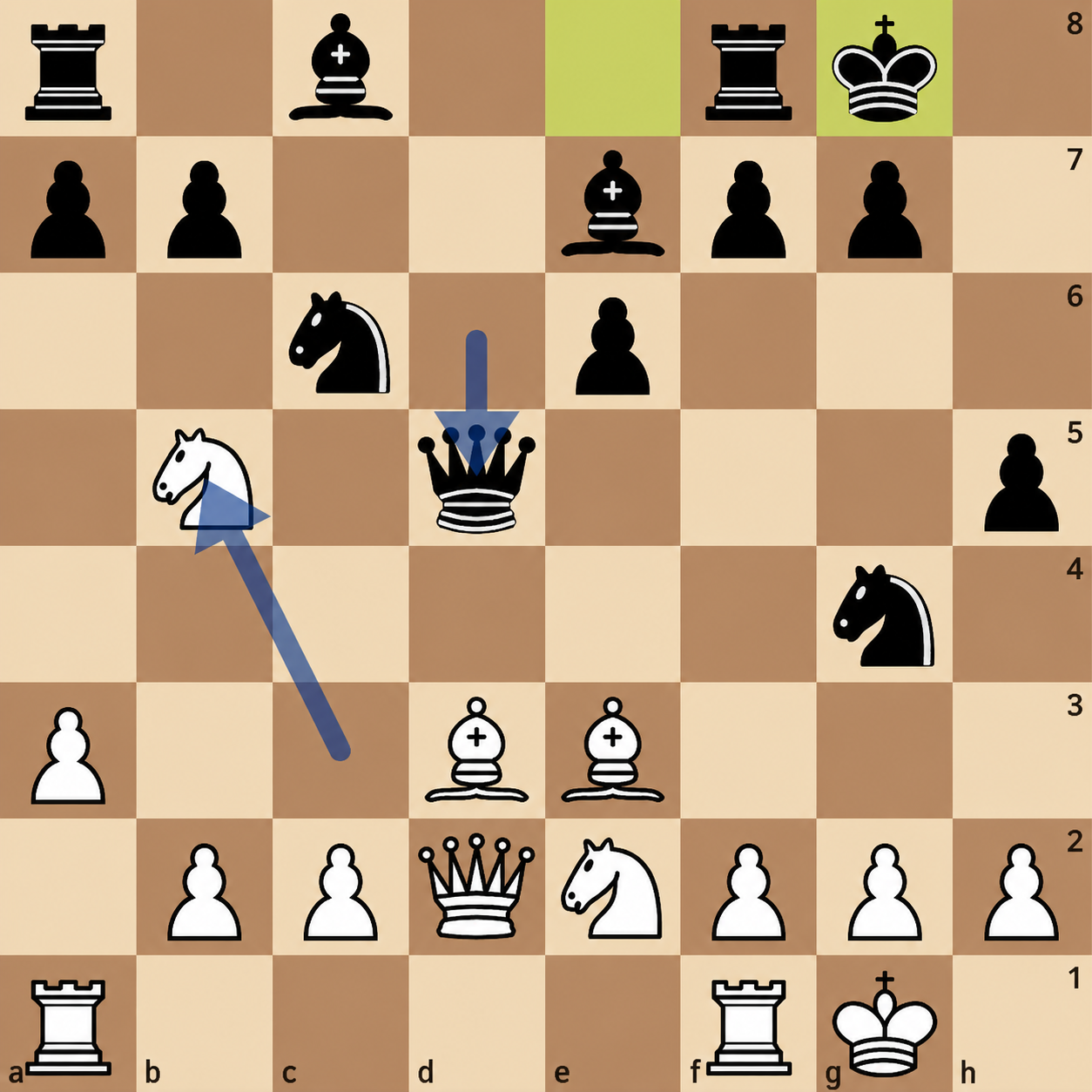
A move ago, the following happened: the white knight from the c3 square went to b5 and attacked the queen which was then still standing on d6. After that, the queen moved to d5 and the resulting position is this one. White, after some thought, played knight to c7, to which Black moved the queen to e5:
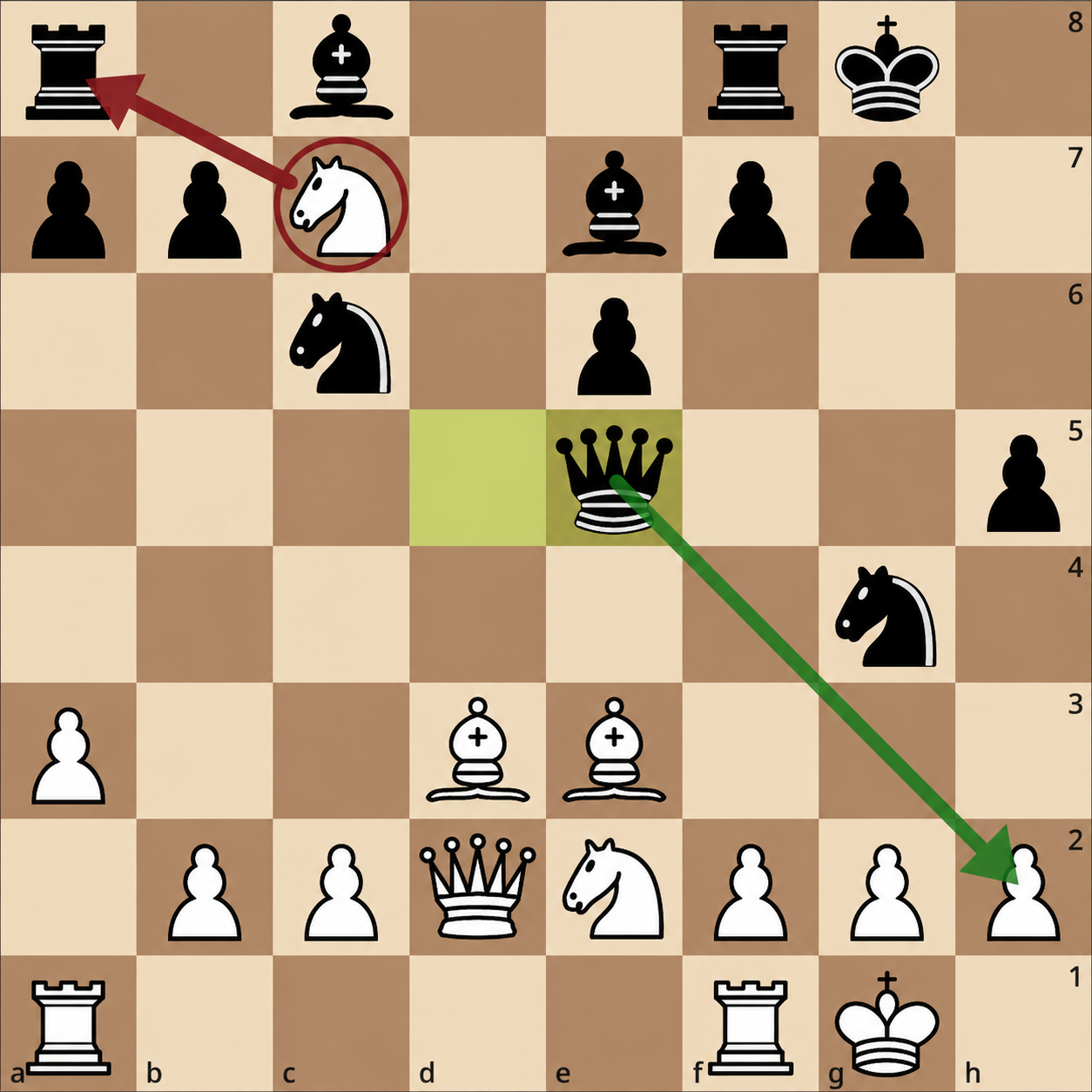
And here is the critical moment of the game. White did not even think for a second about the meaning of the move Queen to e5 and did not look at what had changed in the position. Specifically, what threats the black queen creates standing on e5. And I think you have already guessed what White did? They immediately, literally in that same second, captured the rook on a8. To which they instantly got checkmated with the queen on h2. Frustrating? Absolutely. Especially if you think about the fact that most likely the opponent did not see this fork and did not deserve the win at all.
And if White, before the most obvious move in the world Nxa8, had thought for at least 30 seconds, they would have surely discovered the mate, and after another 30 seconds or even earlier, they would have found the incredibly strong move Bf4, which not only protects the h2 square but also attacks the queen while defending the knight. And on the next move, they could have taken the rook with a clear conscience and most likely would have won the game.
Third
Almost never respond to an attack with an attack! If your opponent attacked one of your pieces, simply move it out of the attack or defend it with another piece. But do not counter-attack another piece of your opponent’s that is standing aside. Otherwise, you risk getting 2 attacked pieces on the next move, which is guaranteed to lead to losing one of them.
Again, an example from my student’s game:
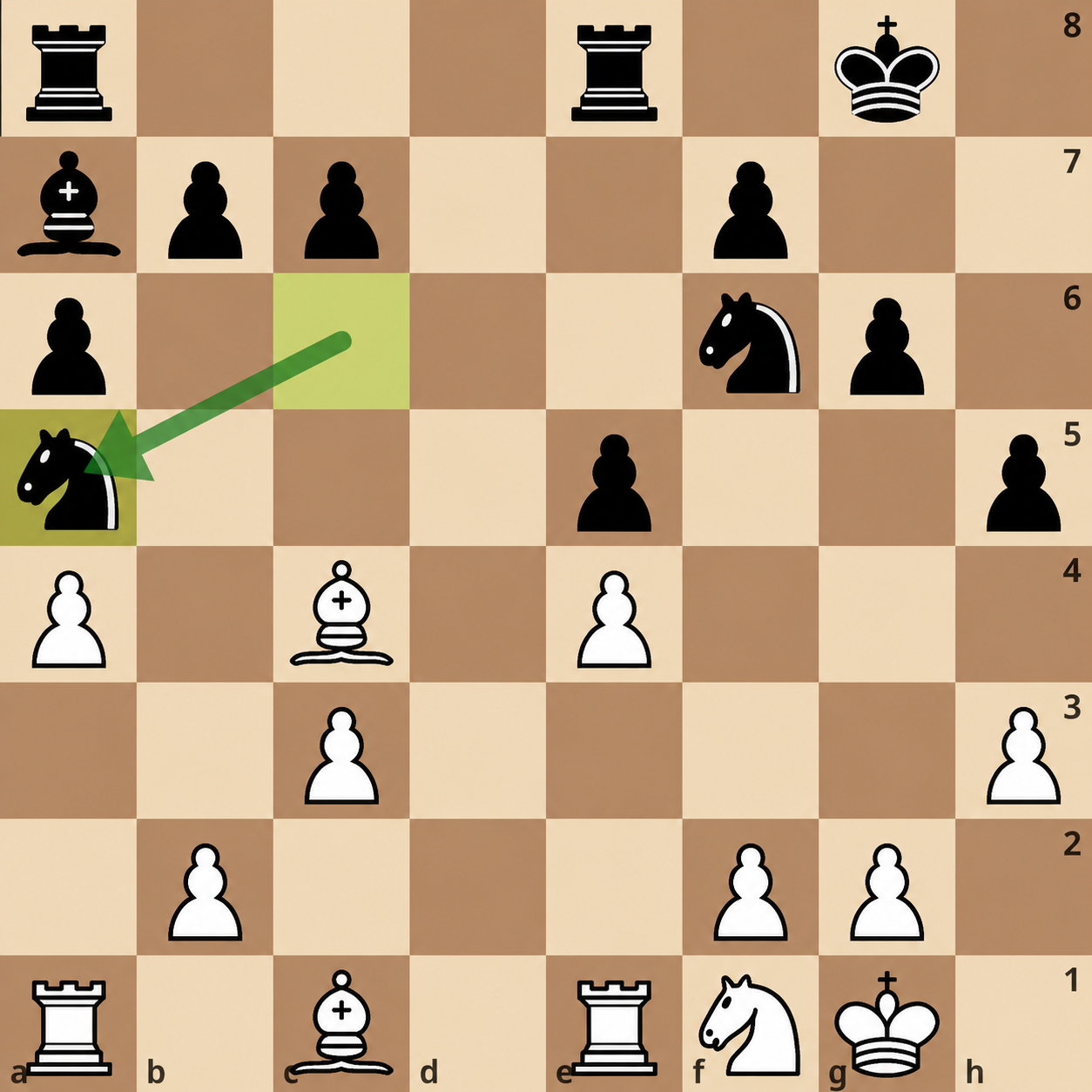
Black has just moved the knight to a5, attacking the bishop on c4. In chess, actually, the simplest move is the most correct one. And if White had retreated the bishop to a2, thus placing it in a safe spot, everything would have been fine. But instead, White decided to make the cunning move Bg5, counter-attacking Black’s knight. For which they immediately paid the price after Black’s response knight to h7!
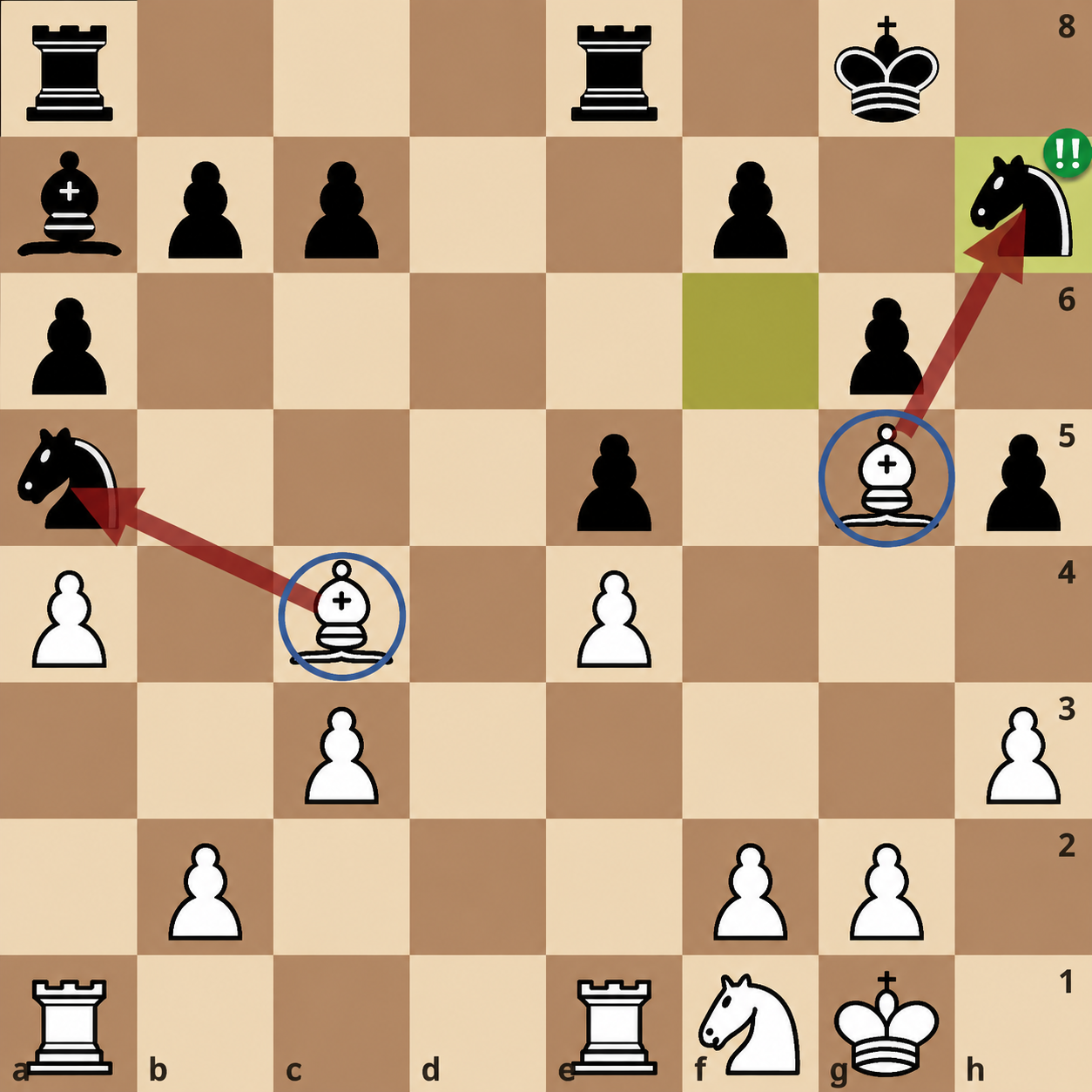
Now, 2 bishops are under attack at once, and one of them will have to be sacrificed. Therefore, I beg you, do not complicate your life and follow my simple advice!
Fourth
Do not leave many undefended pieces on the board. Try to ensure that each of your pieces defends some other one. And then, even if you do not notice an attack, your losses will be less significant, or it will be a full-fledged exchange. This rule also applies to pawns! Try to create a solid, monolithic pawn structure on both flanks. So that each pawn supports another as much as possible.
Fifth
If you are not sure – do not sacrifice! This applies to cases when we want to take a risk in an attempt to create a beautiful combination, sacrificing a piece in the process. If your position is good, or at least equal, and you have spotted an interesting sacrifice on the horizon, but you do not see what will happen at the end of the variation, then trust me – do not tempt fate.
It is much more correct to try to steer the game into a strategic battle, developing over time a small positional advantage into something much bigger. Yes, it is long, yes, it requires a lot of patience, but according to statistics, this very method brings more wins than an unjustified sacrifice.
Improve Your Tactical Vision
And now I want to give you 2 more global pieces of advice. The most important of them – devote a lot of time and attention to training tactics. In almost every one of my articles, I never stop repeating that this is the key to success and the reason for defeats in 99% of losses. Especially at ratings up to 2000 online. The more chess puzzles you solve, the easier it will be for you to notice various tactical opportunities during the game. Both for yourself and for your opponent.
Try to work on tactics systematically. Ideally, every day. And then in just 2 months, you will see huge results from your work. To all my students and readers, I always advise dedicating at least 80% of training time specifically to this. I explain in much more detail how to train tactics effectively and which resources to use in my complete guide to tactical training for chess improvement.
Analyze Every Blunder After the Game
The second very important element in working on eliminating blunders is identifying them and understanding why they happened in your games. At the same time, it is very important not just to look at where exactly the mistake was made. But also to understand its causes and how it would have been more correct to play. It does not matter where you practice, on chess.com, lichess, or another site. Almost everywhere, it is offered to analyze the game with a computer upon its completion. Please do this, even if you want to close and forget forever an unsuccessful, lost game. Believe me, this is not the way out, because then a similar blunder will surely happen to you again. If you’re not sure how to do this properly, I’ve prepared a step-by-step guide on how to analyze your own chess games.
Is It Possible to Get Rid of Blunders Completely?
If we are talking about online chess – then definitely no. Playing online, we often do so while not in the best shape, not in the best environment, which almost always guarantees reduced concentration and, as a consequence, the emergence of a blunder. This is also why developing the right habits and setting up your online playing process properly can make such a big difference.
Therefore, if you play only online, strive not to get rid of mistakes, but to reduce their number in your games. I suggest you make an Excel table and keep track of the number of mistakes in each rapid game you play. This way you will see the dynamics and results of your training.
In over-the-board chess, especially if we are talking about classical tournaments with a long time control, the situation is much better. There, you definitely will not have any problems with concentration, and you will also be provided with 60 to 90 minutes of time. If you spend it correctly, you can avoid the overwhelming majority of blunders that you make in online games due to inattention or under time pressure.
Therefore, if you have never tried chess in person, I strongly recommend you do so. Yes, it will be difficult at first, since you will be looking at the board from a different, unfamiliar angle. But when you adapt, trust me, the quality of your games will reach a completely different level, and you will get much more pleasure from your game.
Let’s Sum Up
Blunders can and should be worked on. The best way to do this is to regularly train tactics and analyze your games in depth. Also, do not forget the 5 important points during the game that I listed in this article. Especially avoid hasty decisions. Remember, blunders happen to chess players of any level, even grandmasters. Trying to eliminate them completely is unrealistic, especially in online chess. Therefore, focus on reducing their number. And most importantly – blunders are part of your journey, by working through which you can become stronger. Treat them patiently and in no case beat yourself up over them. Of course, eliminating blunders is only one part of the process, and becoming a stronger player requires a much broader approach to getting better at chess.
I believe that you will succeed. I sincerely wish you good luck!
♟ Article prepared by Grandmaster and chess coach Valery Filippov ♟
📖 Continue Improving Your Chess:
▸How to Reach a 1500 Rating on Chess.com as an Adult
▸How to Break Through Your First Chess Plateau
▸Can You Become a Grandmaster After 30? Facts vs. Myths
FAQ
Does solving chess puzzles reduce blunders?
Definitely yes! This is literally the most effective and almost the only way to get rid of the hated blunders. Never neglect tactical training.
How many puzzles should I solve every day?
If you have at least an hour of free time, I would do it like this: 5 hard puzzles (will take 30 minutes), 20 medium ones (will take 20 minutes), and 20 easy ones (will take 5-10 minutes).
Why do I blunder even when I know the tactical pattern?
Knowing a pattern and recognizing it are 2 different things. To get to know it, 15 minutes is enough. But to be able to recognize it practically always when it occurs – for that, you need hours of training with puzzles on this pattern.
At what rating do players stop making blunders?
If we are talking about over-the-board games with a long time control, then at the 2200+ level, players almost do not make mistakes. In online games, practically everyone makes mistakes.
Is playing too many blitz games bad for reducing blunders?
Of course. Blitz only contributes to the development of bad qualities in a chess player and only increases the chances that you will make mistakes more often. Better to avoid fast time controls.