Why Blitz Chess Is Hurting Your Improvement
This article is about the true fast food of the chess world-blitz and other ultra-fast time controls. Right away, I want to make one clarification. If you are simply a chess enthusiast and you play chess purely for enjoyment, then I honestly see no reason to give up blitz. Of course, it does not do any harm to your health and has virtually no effect on your mental well-being. For many people, it simply replaces a video game like Fortnite or FIFA. But if you treat chess as a sport, then this article will be very useful for you and may even make you rethink some of your views on chess.
So, I will begin by listing all the side effects of blitz that can negatively affect you as an athlete.
⏰ Blitz Creates the Habit of Rushing
And this is undoubtedly the greatest evil of blitz. The most popular blitz time control is 3+0. That means each player is given literally three minutes for the entire game. If you play thoughtfully, try to develop strategic plans, carry out complex maneuvers, and calculate tactical combinations, you will simply lose on time. And yes, by that moment you may even have an extra queen on the board, which, by the way, appeared because you found a winning combination. But what difference does that make if all you see on your screen is: Time Out and minus 8 rating points, which have happily been added to your opponent, who, by the way, absolutely did not deserve them.
Naturally, you want to win and increase your rating. That means in the next game you will play faster, which means you will think less and analyze the position less deeply. Then even faster. And in direct proportion to the increase in your playing speed, the effectiveness of every game decreases, and over time it becomes practically zero-just like it does for 99% of blitz players.
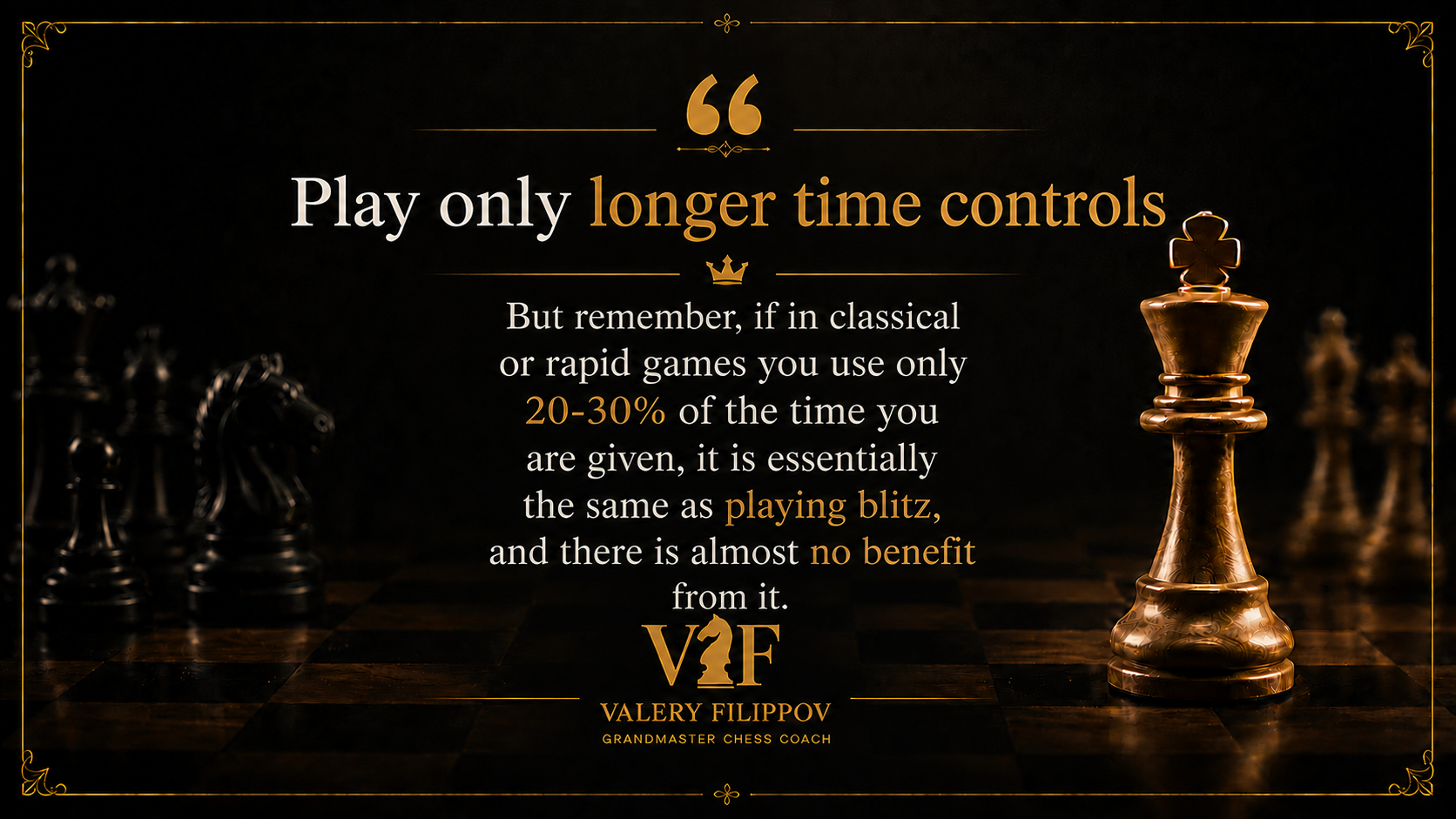
And the worst part is that this habit will inevitably carry over into your games with longer time controls. And there you will definitely be punished for it. Of course, only if your opponent does not follow your fast pace. By the way, did you know that this is one of the most common problems I see among my students? When I try to break them of the habit of playing blitz and switch them to rapid games, do you know what happens? They continue to “play blitz,” except now they do it in longer games. In other words, they start a 15-minute game and make 30-40 moves in the first three minutes. Choosing a longer time control is only part of the solution – you also need to develop the right habits when playing chess online.
👉 Blitz Creates the Habit of Being Lazy
This is the second very serious blow to you as a chess player. On Chess.com, the majority of players do not calculate tactics at all, or they only analyze one or two moves ahead. Partly, this is because of what we discussed in the previous section. But the main reason is laziness. Many people think like this: why spend time calculating variations if you can simply make the move that seems natural and obvious to you? And that is exactly what happens in practice. Both players simply make routine moves, and this continues until one of them hangs a piece. Meanwhile, the brain is not occupied with looking for less obvious continuations or comparing different candidate moves by analyzing them step by step. If simple mistakes like this are costing you games even at longer time controls, you need to work separately on developing a system for preventing blunders.
Laziness is also a result of fatigue. Many players play around 30-50 blitz games a day! Can you even imagine such a number? And can you imagine what happens to your brain by, let’s say, the fifteenth blitz game? It gets tired, and your focus disappears. Your moves become even more predictable because it becomes harder and harder to force yourself to think. As a result, such a deep intellectual game as chess gradually turns into a contest of whose clock will run out first.
Blitz Destroys Your Concentration
Every blitz player has this problem. The reason is the fact that they start a blitz game almost every time they have 10-15 minutes of free time. And this can happen literally anywhere: at work, on the subway, at school during class, or even while talking to another person. Yes, that’s not a joke!
Now let me ask you another question. Why do you think every single professional chess tournament is held in complete silence? Why, for example, don’t organizers play music or turn on a television in the background? Or why aren’t tournaments held somewhere crowded? The answer is simple: because chess is one of the most difficult games in the world and requires maximum concentration from the player. If you lose your focus for even a single second, you may overlook one tiny detail that eventually becomes fatal. Besides studying openings, strategy, and endgames, every professional chess player also trains the separate skill of being able to concentrate at 100%.
And beginners and amateur players simply do not have this skill by default. Instead of developing and improving it, you are literally destroying it by playing blitz. Then, when you decide to play your very first rated tournament, you simply will not be able to concentrate at the board, and the game will end very quickly-and not in your favor.
Blitz Is Extremely Limited
What can you actually accomplish in three minutes? You can spend the first 20-30 seconds getting through the opening. If it is an unfamiliar line, it may take an entire minute. Then, in the middlegame, another minute or minute and a half will be spent improving your pieces and looking for tactical combinations. That leaves roughly 30 seconds for the endgame. And those will probably be the most stressful 30 seconds imaginable, filled with a huge number of inaccurate moves.
So what do we end up with?
- The opening brought you no real benefit. You simply developed your pieces the same way you did in most of your previous games.
- In the middlegame, you spent about one minute practicing tactical calculation.
- Strategy remained completely untouched because finding complex plans and maneuvers requires at least 3-5 minutes.
- The endgame. Either you never reached it at all, or you did reach it, but because of severe time pressure you played it in the most thoughtless and poor way possible. And honestly, it would probably have been better if you had never reached it in the first place. (Just kidding.)
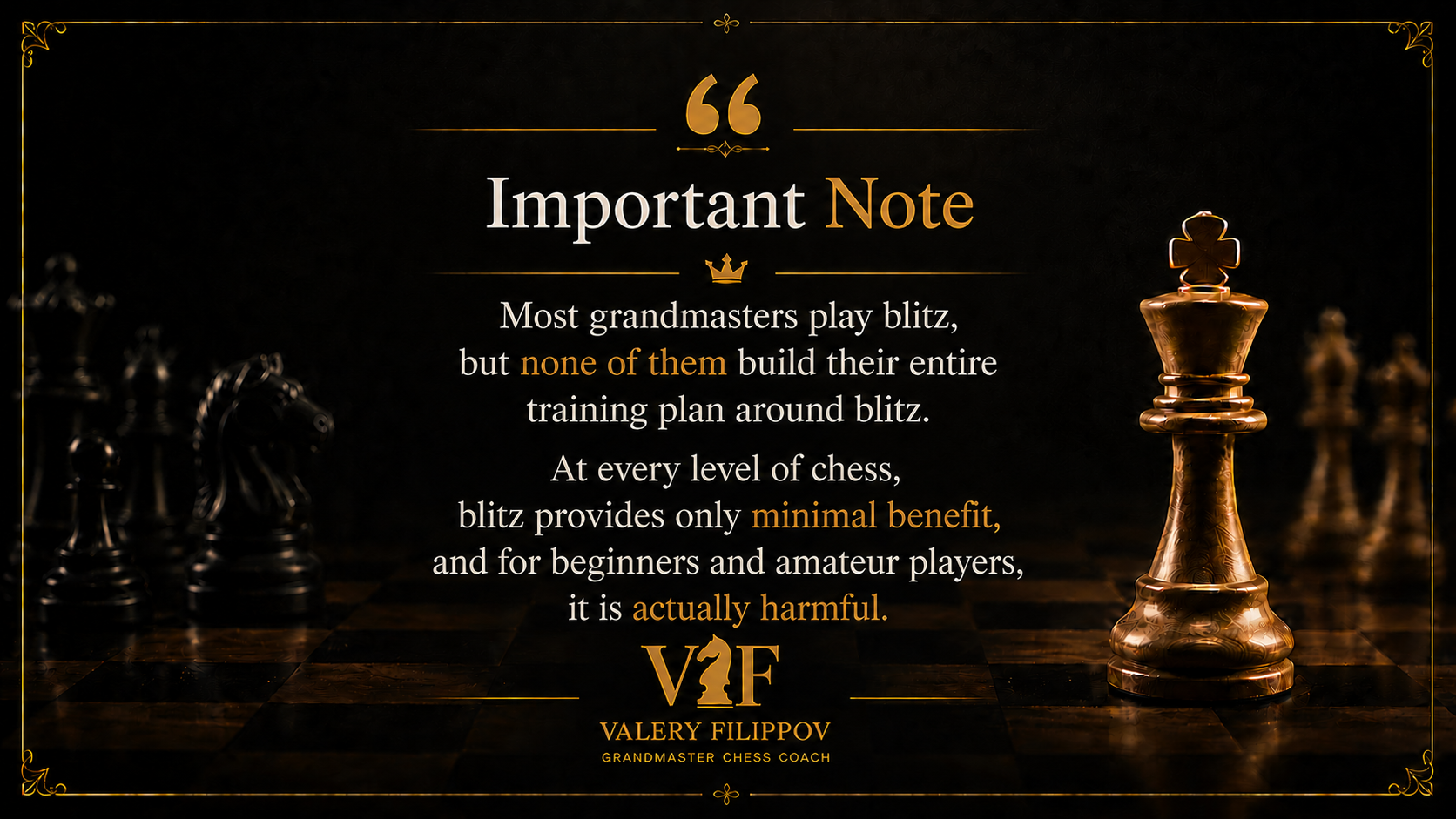
In the end, the entire benefit of a blitz game comes down to a minimal amount of tactical training. And that is doubly disappointing, especially if you spend time training all the other aspects of chess. It is triply disappointing if you happen to be good at endgames. For example, you spent several days mastering the technique of winning the king and queen versus king and rook endgame. Then, by pure luck, you finally get exactly that position! But because it is a blitz game and there are only 30-40 seconds left on your clock, you now have to make almost one move every second without thinking. You simply do not have enough time to apply what you learned. As a result, you fail to convert the endgame and end up thinking: Why did I even spend my time learning this technique? In blitz, you simply do not have enough time to put 75% of the knowledge you acquire during training into practice.
Blitz Does Not Help You Learn From Your Mistakes
Be honest with yourself-what percentage of your blitz games do you actually analyze? Or do you analyze them at all? And when I say “analyze,” I do not mean simply clicking the Game Review button to check your accuracy, see whether you got any Brilliant Moves, and quickly glance over your mistakes. I mean a proper analysis that takes 10-15 minutes and includes, at the very least, working on your opening. If you’re not sure what proper analysis should look like, I’ve explained the entire process step by step in my guide on how to analyze your own chess games.
For example, your opponent plays a new opening variation against you, and you end up with a bad position. After the game, you open an online opening database, study the best continuations, and try to memorize them. Then, the next day, you refresh that variation in your memory so that you will be ready with a proper response the next time you face it. And that is only the bare minimum. There is also the middlegame, which should ideally be analyzed in detail as well. It is difficult, it is boring, but that is exactly what working on your mistakes looks like-and it is something that 99% of blitz players never do.
And what happens if you do not do it? Exactly. Those mistakes will inevitably come back. They will be repeated again and again until you finally correct them. This, by the way, is the answer to the question of why most players do not make any real progress in chess for years. If you are not ready to give up blitz completely, then at least reduce the number of games you play each day and spend the time you free up analyzing the games you have already played. Trust me, it will be much more beneficial.
Is There Any Benefit to Blitz at All?
A very small one. And I would say that only professional-level chess players are really capable of getting any benefit from blitz. For them, blitz can be a decent (but definitely not the best!) way to practice opening variations. Since grandmasters know an enormous number of opening lines, they sometimes use fast time controls simply to keep them fresh in their memory. Even so, believe me, most of them still take those games seriously and analyze every single one afterward.
Is there any benefit to blitz for amateur players? Here I can mention one point, although it is a bit of a stretch. Imagine an ideal situation where you constantly play blitz, yet it does not interfere with your improvement or with your performance in longer time controls. In that case, your blitz rating-and especially its growth-can reflect the results of your training. For example, you spend an entire month working hard on your calculation by solving a large number of tactical puzzles every day. Then you decide to play some blitz games and notice how much easier and faster it has become for you to calculate variations. As a result, you become even more motivated to continue training. If improving your calculation is the goal, proper tactical training is a much more effective approach than simply playing more games.
That is all. I’m sorry, dear readers, but I simply do not have enough imagination to come up with anything else.
Why Do Grandmasters Play Blitz?
You might ask me: “Valery, if you say blitz is so bad, then why do all the top grandmasters play it all the time?” That is a very good question, and I will be happy to answer it.
Indeed, you have probably watched broadcasts of tournaments such as Titled Tuesday, where the very best grandmasters, such as Magnus Carlsen and Hikaru Nakamura, take part. Even in smaller events, you can often find some of the strongest professionals competing.
- For a grandmaster, blitz is a way to relax and have fun. Professional chess is extremely exhausting. Did you know that a single game between two grandmasters can last five or even six hours? That is why blitz can be a great way to unwind.
- Contracts and prize money. Believe me, players like Carlsen or Caruana do not participate in blitz tournaments for no reason. They are often invited on very attractive financial terms because their participation attracts players, viewers, and attention to the event. And quite often, the prize funds are very substantial as well.
- Blitz as a training tool. Once again, even for grandmasters the practical benefit of blitz is quite limited, but it is still a good way to practice opening variations and evaluate your current tactical form. And because a grandmaster is an extremely experienced chess player with many years of experience, they are able to reduce almost all of the negative consequences of playing blitz to a minimum.
Is There Anything Worse Than Blitz? Bullet.
Yes, believe it or not, despite all the drawbacks of blitz, someone managed to come up with something several times worse-bullet. In other words, games with a time control of one minute or even 30 seconds for the entire game.
I don’t think this section needs much commentary. At this point, it is no longer really chess-it is a computer game where the winner is simply the person who clicks the pieces faster.
Let me tell you a funny story. One day, a student came to me with the goal of reaching 1800 bullet on Chess.com. As a joke, I told him that there was a much cheaper and more effective way to achieve that goal: just buy a gaming mouse and get high-speed internet. And that is actually true. By the way, I eventually managed to convince him to change his goal, and later he reached 2000 in rapid, which, according to him, had previously seemed almost impossible.
Is Chess a Sport or a Video Game for You?
I believe every chess player should answer this question for themselves. Once again, there is absolutely nothing wrong with deciding not to pursue chess professionally. In that case, you really can simply enjoy the game without thinking about all of its complex aspects. Chess can become a great way to relax after work or pass the time during a boring lecture at university. Once again, I think that is a perfectly good approach, and I have great respect for amateur chess players. In fact, among my own students there are people whose only goal is, for example, to beat their father or a friend. I gladly take on requests like that, and I am genuinely happy when we achieve those goals together.
However, if you want to become a professional chess player, or if making steady progress in your online rating is very important to you, then I would strongly recommend giving up blitz and other ultra-fast time controls completely. Even if you spend 90% of your playing time on rapid or classical chess, do not waste the remaining 10% on blitz. I completely understand that sometimes you simply want to experience the fun side of chess. But in that case, solve some easy and entertaining chess puzzles instead. Or experiment with other chess variants such as Horde, Antichess, or Crazyhouse. Chess.com also has a very interesting mode called Solo Chess. Or simply play a different computer game. But please, do not put yourself at risk of developing one of the problems described in this article that can be caused by playing blitz.
♟ Article prepared by Grandmaster and chess coach Valery Filippov ♟
📖 Continue Improving Your Chess:
▸ How to Reach a 1500 Rating on Chess.com as an Adult
▸ How to Build a Chess Training Plan
▸ Why You’re Not Improving at Chess: 8 Mistakes You Must Fix
FAQ
Does playing blitz improve calculation skills?
Definitely not. It is more likely to reflect your current calculation skills than improve them. The best way to improve your calculation is by solving chess puzzles.
Can blitz chess make you a worse classical player?
Statistically, yes. Especially if you play a lot of blitz without any control or moderation.
Is rapid better than blitz for improving at chess?
Much better, but still not ideal. The most beneficial time control is classical chess (45 minutes or more per game). However, such time controls are usually played only in over-the-board chess. For online play, 15+10 is a good option.
Should I stop playing blitz completely?
Honestly, yes. It is the best and safest option if you want to make steady progress in chess.
Should I analyze my blitz games?
Analyzing blitz games is less effective than analyzing rapid games, but it is still useful. So my answer is yes.