Should Parents Let Their Children Win at Chess?
Parents ask me this question quite often.
Usually, the situation looks more or less the same. The father plays chess better than the child. Sometimes much better. They sit down at the board, the child tries hard, but objectively has very little chance. The father wins the first game, then the second, then the third.
After the fourth, the child no longer really wants to play.
And then a perfectly logical thought appears: maybe sometimes you should lose on purpose?
I understand this logic. If a child is only beginning to learn chess, ten losses in a row are unlikely to make the evening particularly enjoyable. Especially since, in my opinion, the purpose of a game at home does not necessarily have to be for the adult to prove their superiority as convincingly as possible.
But I do not like the idea of constantly giving a child victories either.
If I had to answer briefly, I would probably not lose on purpose. I would try to make the game itself fair enough that the child has a real chance to win.
For me, there is quite a big difference between these two things.
I Do Not See Much Value in a Victory That Did Not Really Happen
Let us imagine a simple situation.
A child is playing against his father. The father is up a rook and has a completely winning position. Then he suddenly puts his queen under attack.
The child takes the queen and wins.
If this happens once, it is probably not a problem at all. The child is happy, the father is smiling, and everyone had a good time.
But if it happens constantly, I already do not like this system very much.
At some point, children begin to notice that the adult is playing strangely. Especially if the child already understands chess a little.
“Did you do that on purpose?”
And what are you supposed to answer?
I think it feels much better to win a game knowing that your opponent was actually trying to beat you. Even if we changed the conditions a little before the game started.
A real victory usually feels completely different.
But Winning Twenty Games in a Row Against a Six-Year-Old Seems Strange to Me Too
There is another extreme.
Sometimes an adult says, “Chess has to be fair. They need to learn how to lose.”
And after that, they play against a beginner child as if it were the deciding game of a tournament.
Technically, everything is fair.
But I am not entirely sure what exactly we are trying to teach the child this way.
If the adult is significantly stronger, the result of the game is practically known in advance. The child is not getting a normal competitive experience. They are simply playing against someone they cannot beat yet.
After several games like this, chess can easily turn into a game where Dad always wins.
For the adult, these victories mean very little. For the child, the enjoyment gradually disappears.
It matters much more to me that after the game the child asks, “Can we play again?”
I Would Rather Give the Child Odds
This is my favorite option.
Suppose the father plays much better than his son. Why do they necessarily have to start from the normal starting position?
You can play without a queen. Without a rook. Without two pawns. You can give the child extra time on the clock. You can start from a position where the child already has a material advantage.
Now we have an interesting situation.
The adult is genuinely trying to win.
The child is too.
If the child wins, nobody gave them the victory. They received an advantage before the game and managed to convert it.
For me, this is much more honest than putting your queen under attack on move twenty and pretending you did not notice.
Chess is especially convenient for this because the size of the handicap can be adjusted quite precisely.
The Handicap Should Give the Child a Chance, Not Guarantee a Victory
There is an important point here.
If I remove my queen and the child still loses almost every game, perhaps the handicap is too small.
If the child wins every game without much effort, it is probably too large.
I would like to find something in between.
Suppose the child can win three or four games out of ten. Now it becomes interesting. Sometimes the adult manages to escape, sometimes the child converts the advantage, and sometimes something completely unexpected happens.
And as the child gets stronger, you can gradually change the conditions.
I used to play without a queen. Now without a rook. Later without a knight. Then only without a pawn. And one day we sit down and play on equal terms.
I think that in a system like this, a child can feel their own progress very clearly.
A few months ago, they needed an extra queen. Now they can almost handle Dad with no handicap at all.
That is already a very real achievement.
Sometimes I Would Allow a Child to Take Back a Move
Strictly speaking, this also breaks the normal rules. But with beginner children, I am completely comfortable with it.
The child makes a move and a second later notices:
“Oh, I left my queen hanging!”
If this is a training game at home, I might simply say, “Take the move back.”
Especially if the child is just learning.
I see little point in spending the next twenty minutes playing a position without a queen just to prove to a five-year-old the importance of taking responsibility for a decision.
They already saw the mistake. Sometimes that is enough.
You can even ask:
“Do you want to take the move back, or should we continue like this?”
As the child becomes stronger, I would gradually remove these little allowances. In a tournament, of course, nobody will let them take a move back.
But a game at home and a tournament game are not the same thing to me.
I Would Not Turn Every Game at Home Into a Lesson
This is another thing parents sometimes do with the best intentions.
The child makes a move.
The father says, “Think again.”
The child chooses another move.
“What is your opponent threatening?”
Next move.
“Are you sure?”
Ten minutes later, this is no longer a game. It is a private lesson with Dad.
Sometimes that is useful. But sometimes a child simply wants to play. I think becoming a second chess coach for your child is one of the easiest mistakes to make with the best intentions.
I would let them make a bad move. Lose a pawn. Miss a fork. Try to save the position on their own.
If we correct every mistake before it actually happens, the child is not really playing their own game.
And I am interested in seeing their chess.
Sometimes It Really Is Useful for a Child to Beat an Adult
I do not consider winning unimportant.
Quite the opposite. Winning feels great. I have played chess all my life, and I still prefer winning to losing.
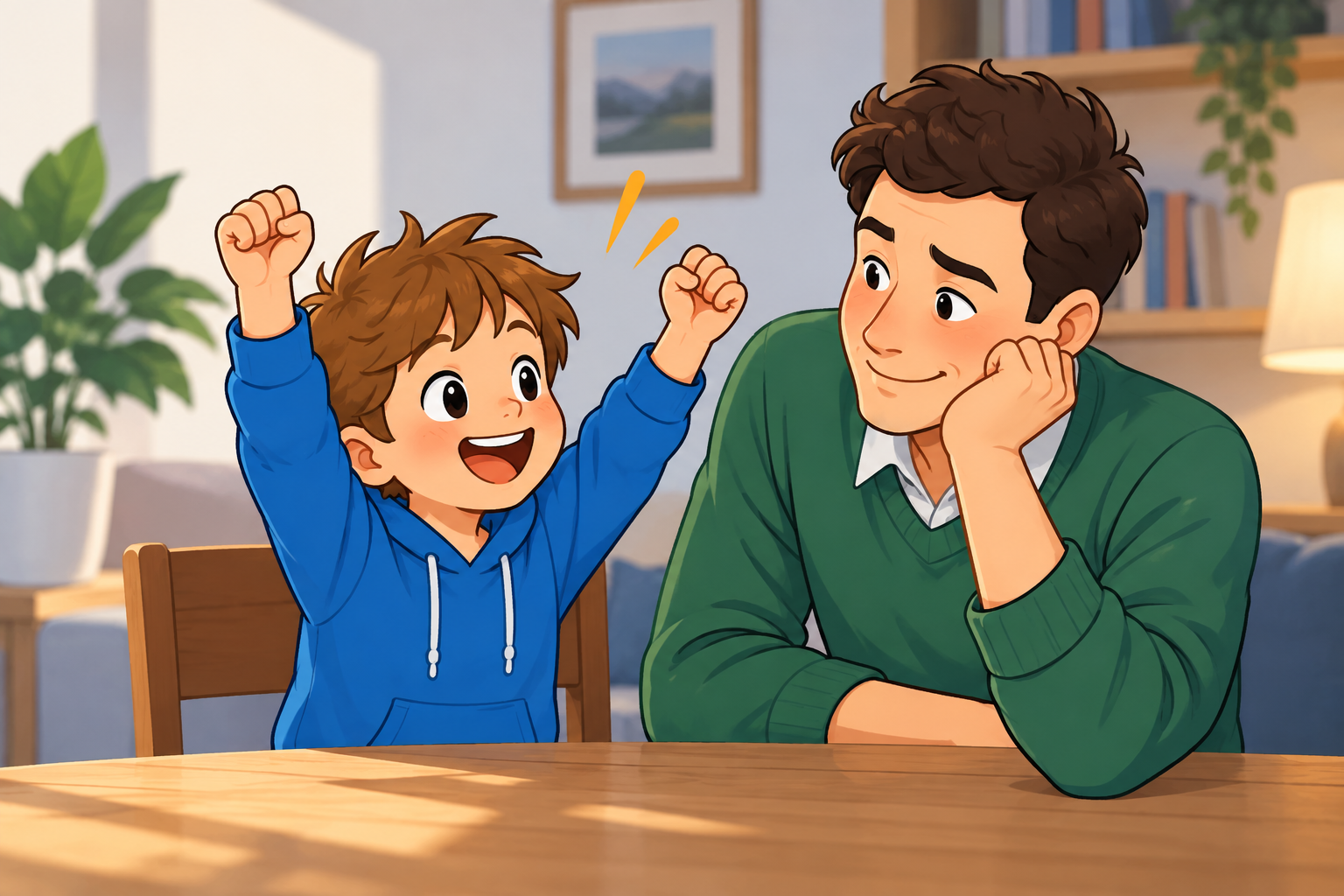
For a child, the first victory over Mom or Dad can be a huge event.
They come to their coach later and say:
“I beat Dad yesterday!”
And then they show the game.
I like that kind of excitement.
So I completely disagree with the idea that children should be given only difficult losses in order to build character. In a child’s experience with chess, there should sometimes be an opportunity to feel successful.
But I still prefer creating the conditions for a real victory rather than secretly arranging the result.
You Do Not Have to Pretend That You Are Playing at Full Strength
Suppose the father has a rating of 1800 and the child has only recently learned how to play.
The father can certainly play more simply.
There is no need to calculate variations for five minutes. There is no need to choose the most unpleasant continuation in every position. You can play an unusual opening, create a complicated position, and give the child an opportunity to attack.
I do not see this as cheating.
There is a difference between not using one hundred percent of your chess strength and deliberately losing a game that you are already winning.
When a grandmaster gives a simultaneous exhibition against twenty children, he also does not spend as much time on every position as he would in a serious tournament.
The format is different.
A game at home with a child can have its own format too.
What if the Child Gets Very Angry After Losing?
I would not try to solve this problem with a constant supply of gifted victories.
I understand the temptation. The child loses and starts crying. In the next game, Dad deliberately blunders a rook. The child wins, and the good mood is restored.
It works perfectly.
Until the next loss.
I think we are simply postponing the problem.
The child will still have to lose. At a chess club, online, in tournaments, against a coach, against friends. Even a very strong young chess player loses regularly. Learning how to handle losing at chess is simply part of the game.
So I prefer to gradually make losing a normal part of the game.
Not pleasant. It does not have to be pleasant.
Just normal.
You lose, you get upset, you rest for a little while, and then you play again.
I Would Also Pay Attention to How the Adult Wins
This, by the way, can sometimes be more important than the result itself.
Dad gives checkmate and says:
“So, you lost again?”
Or he immediately starts explaining in detail just how obvious the mistake was.
It is hardly surprising if, after a few games like this, the child no longer wants to sit down at the board.
You can win very differently.
“Good game. You almost caught me here.”
And that is enough.
There is no need to pretend the child actually played better if that is not true. But in almost every game, you can find a moment that genuinely went well.
Through their own behavior, the adult shows that winning does not give you the right to humiliate your opponent.
I think that is more useful than many special conversations about sportsmanship.
Adults Need to Know How to Lose Normally Too
Now imagine that the child finally wins.
And this time, they really earned it.
Then Dad starts saying:
“Well, I wasn’t really paying attention.”
“I just gave you my queen.”
“If I had played normally, you wouldn’t have won.”
I really do not like this reaction.
If the child won, let them have the victory.
Congratulate them. Shake their hand. If you want, look at the game together later.
There is no need to immediately explain why the result does not really mean anything.
For the child, it may mean a lot.
And if an adult wants to teach a child how to lose gracefully, it would be useful to know how to do the same themselves.
As the Child Gets Stronger, I Would Gradually Remove the Help
At some point, the additional rules are no longer necessary.
The child knows the basics, can convert a winning position, and is capable of playing a normal game from beginning to end.
Then I would gradually move toward regular chess.
It does not have to happen ceremonially.
One day, instead of playing without a rook, you play without a pawn. Then eventually you play without any handicap at all.
And something very pleasant can happen here.
Before, the adult had to create chances for the child.
Now there is no need to create them.
The games become competitive on their own.
And then one day the child beats the parent for the first time in a normal game.
That is exactly the kind of victory I would not want to take away from them by giving them years of artificial victories beforehand.
If the Parent Cannot Play Chess at All, the Situation Is Even Easier
Sometimes parents tell me:
“I can’t really practice with him anymore. He already plays better than I do.”
In my opinion, that is great.
Now you definitely do not have to think about whether you should let the child win.
Just play.
Let the child win.
Let them explain why your move was bad. Sometimes you can even ask them to show you an idea.
It is quite an interesting reversal of roles for a child. Usually the adult knows everything better, but here the child becomes the expert.
I do not think a parent needs to be a strong chess player to play an important role in their child’s chess life.
Sometimes it is enough simply to sit across from them and play a game.
Chess at Home Should Not Constantly Test the Child
In general, I do not really like it when every game at home turns into an exam.
“Let’s see what you’ve learned.”
“You studied this with your coach.”
“Why did you miss the fork again?”
The child already receives plenty of feedback during lessons and tournaments.
At home, chess can sometimes remain just a game.
You can play blitz. You can play with a handicap. You can start from a middlegame position. You can give the child a queen and try to survive. You can play two games and then go have dinner.
Not every game has to teach something.
Although, strangely enough, children often learn quite a lot in exactly these relaxed games.
I Would Not Hide the Rules of a Handicap Game
If you decide to make the task easier for the child, I think it is better to say so directly.
“Today you are playing with an extra rook.”
Great.
Now the child understands the conditions.
They do not think they have suddenly become a thousand rating points stronger than the adult. But at the same time, they have a very specific task: use the advantage and win.
It is an honest agreement.
And I think children usually accept it perfectly well.
The problem begins more often when the adult secretly changes the quality of their play, while the child is expected to believe that the victory was completely normal.
Especially when the child already plays well enough to sense that something strange is happening.
If the Child Asks, “Did You Let Me Win?”, I Would Not Lie
Here the answer is very simple for me.
If you did, it is better to tell the truth.
But in my opinion, it is even better not to create this situation regularly.
You can say:
“I wasn’t playing at full strength today because you’re still learning.”
Or:
“I gave you a handicap, but after that I really tried to win.”
I like everything about the second option.
The child understands that the conditions were easier. At the same time, the result remains real.
If they won, they completed the task.
Next time, the task can become a little harder.
A Tournament Is a Completely Different Story
If a child is playing in an official tournament, of course nobody should give them anything.
And I would not want them to expect it.
The opponent came to play their game. They want to win. That is normal.
Even if the child is facing an adult player, even if this game determines whether the child wins a medal, the opponent has no obligation to play more weakly.
In a competition, the integrity of the result is especially important. Deliberately changing the result may affect not only the two players, but sometimes the standings of other participants as well.
So I would clearly separate chess at home from tournament chess.
At home, we can invent any conditions we like.
In a tournament, we play by the rules.
So Should Parents Let Their Children Win?
I would phrase the question a little differently.
I would let the child have a chance to win.
For me, these are not the same thing.
If the difference in strength is enormous, I would change the conditions. Give a handicap. Allow a serious blunder to be taken back. Play faster. Choose a difficult variation for myself. Sometimes I might simply help the child at a critical moment.
But I would not want all of their victories to exist only because the adult had already decided to lose.
There is a very pleasant moment in chess that is difficult to fake.
The child thinks. Finds a move. You try to resist. They find another good move. A few minutes later, they give checkmate.
And they look at you because they understand that this time it was real.
That is the kind of victory I would want them to have.
And you can get there gradually.
There is no need to beat a child twenty times in a row for the sake of a “life lesson.” But giving them twenty victories does not seem necessary to me either.
It is better to make the game a little more even and actually play.
It is better to make the game a little more even and actually play. In my opinion, this is a much healthier way to help your child improve at chess than trying to control the result of every game.
A game the child wants to play one more time.
♟ Article prepared by Grandmaster and chess coach Valery Filippov ♟
📖 Continue Improving Your Chess:
▸ Does My Child Have Talent for Chess?
▸ When Should Children Start Playing Chess?
▸ Why Kids and Adults Improve at Chess Differently?
FAQ
What if my child gets upset every time they lose?
I would not try to fix this by making sure they always win. Losing will remain part of chess anyway. The goal, in my opinion, is not to make a child enjoy losing, but to help them become comfortable enough with it to play again.
How much of a handicap should I give my child?
Enough to make the game competitive. If your child still loses almost every time, increase the handicap. If they win easily every time, reduce it. There is no perfect formula here.
Should I play at full strength against my child?
Not necessarily. A strong player can play faster, choose an unusual opening, or avoid spending several minutes calculating every position. A game at home does not have to feel like the final round of a tournament.
What should I do when my child finally beats me fairly?
Let them enjoy it. Congratulate them and shake their hand. I would definitely avoid immediately explaining that you were tired, distracted, or would normally have won.
When should we stop using handicaps?
When the games start becoming competitive without them. I would reduce the handicap gradually as the child improves. Eventually there comes a day when you simply start from the normal position and both try to win.