Should Children Play Chess Online? A Guide for Parents
Years ago, if a child was learning chess, they went to a chess club, played with a coach, participated in tournaments, and sometimes analyzed games at home. The Internet was an addition to chess, but certainly not the main environment for playing it.
Today, a child can play ten games, solve fifty puzzles, watch a lesson, work with a coach, and participate in a tournament without even leaving their desk. This is convenient for parents. It is convenient for coaches too. But more online chess does not necessarily mean better chess.
My name is Valery Filippov. I am a chess grandmaster and have worked with students of different ages and playing levels for many years. Online chess is now a normal part of my coaching work. In fact, I think it is already difficult to imagine complete chess training for a modern player without it.
But when we are talking about children, I would separate two questions. Are online chess games useful? In my opinion, yes. But is it useful for a child to play a lot online? Here, my answer would be much more cautious.
The problem is usually not the Internet itself. It is how a child uses it.
Online Chess Does Not Make a Child Stronger by Itself
This is probably the first misconception I encounter. Parents see their child spending a lot of time playing chess and, quite naturally, consider it training.
Suppose a child plays twenty games in one evening. From the outside, that looks like a serious amount of practice. But if most of those games lasted three or five minutes, the child made moves almost automatically, immediately clicked the button for a new game after losing, and ten seconds later could no longer remember where the mistake happened, I would not call that evening a proper chess training session.
In my opinion, the number of games played and the quality of chess work are connected much less closely than people often assume.
Sometimes one game with a reasonable time control, followed by analysis, gives a child more than several dozen blitz games.
An online platform provides a tool. And a tool can be used in very different ways. On the same platform, one child will think seriously about positions, analyze mistakes, and gradually improve, while another will turn chess into something closer to a computer game, where the main goal is to start the next game as quickly as possible.
I like the second approach much less.
The Main Advantage of Online Chess Is Impossible to Deny
Despite all my reservations, online chess has one advantage that is difficult to overestimate: a child can find an opponent of approximately the same level at almost any time.
In ordinary life, finding a suitable opponent is not always easy.
Imagine a child in a small town who has already outgrown the local school chess club. What should they do? Play the same two or three children every week? Travel several hours just to play a game? Wait for the next tournament?
On the Internet, this problem practically disappears.
As a child improves, they also start meeting different opponents, openings, and styles of play. One game might be against a cautious positional player, the next against someone who attacks at every opportunity.
I think this variety is useful.
In tournament chess, uncomfortable positions are unavoidable. I think online play is a good way to reduce the fear of the unknown. It is impossible to prepare for everything in advance when you are constantly facing dozens of different ideas.
That is why I certainly would not remove online chess completely from a child’s training.
But There Is a Big Difference Between Playing Chess and Playing Endlessly
I am rather skeptical about the habit of playing until you finally manage to win.
Adult chess players know this feeling very well too. You lose a game and immediately want to win the points back. You lose a second one and irritation appears. After the third, you just want to recover the rating you lost. At some point, you are no longer playing because the position interests you. You are playing because you cannot calmly close the website.
For a child, I think this mechanism can be even more problematic.
The rating on the screen changes instantly. A win gives you a few points. A loss takes them away. A new opponent can appear within seconds. All of this makes online chess emotionally much faster than an ordinary tournament.
After losing over the board, there is usually a pause. You have to stand up, shake your opponent’s hand, leave the playing hall, and perhaps speak to your coach. Some time passes between the emotion of the loss and the next game.
Online, there may be no such pause.
This is why I would pay attention to what happens after a child loses. If they can finish playing, talk about the game, and move on to something else, I see no major problem. Wanting to play another five games immediately after every loss is a different situation.
Blitz Can Easily Become a Bad Habit
I do not consider blitz harmful in itself. I have played an enormous number of fast games myself, just like practically every professional chess player. Blitz can be useful and enjoyable.
But for a beginner, too many blitz games can be harmful for improvement and, in my opinion, reinforce exactly the habits that a coach later tries to remove.
The child sees a move and immediately plays it. They do not check the opponent’s reply. They do not look at what is under attack. They do not compare several possible moves. They lose a piece. A few seconds later, the next game begins.
If this cycle is repeated hundreds of times, it is difficult to expect the child to suddenly become patient at a real chessboard and carefully check every move.
I much prefer it when a young player has time to stop.
Especially during the early stages of learning.
Let them look at the position for twenty seconds. Let them find two possible moves. Let them make a mistake after actually thinking. For a coach, that kind of mistake can even be more interesting because you can see the child’s logic behind it.
A random move played in one second usually teaches very little.
Online Rating Should Not Become the Center of a Child’s Chess Life
Another thing I would pay particular attention to is rating.
Numbers are very convenient. Yesterday the child was rated 1200, today 1250. Then the rating falls to 1180.
In reality, chess development rarely looks that neat.
A child may begin learning new openings and temporarily play worse. They may be moving from superficial play toward more serious calculation and, for a while, get into time trouble more often. Or they may simply have a bad run of ten games.
Rating has a purpose. It helps find suitable opponents and gives some indication of playing strength. But I would keep it as a measuring tool, not the goal of every evening.
If a child tells me, “I lost 70 points today,” I would rather talk about the games themselves and why they were lost.
That is a much more chess-related conversation.
Online Chess Is Especially Useful When Games Are Analyzed
This is probably where the main dividing line between playing for entertainment and actual training appears.
A child finishes a game. What happens next?
If they immediately start another one, the previous game almost disappears. But if they go back to it and try to find the moment when the situation changed, educational value begins to appear. This is also why I consider analyzing your own chess games such an important part of improvement.
And I would not recommend immediately turning on computer analysis.
An engine will show the mistake instantly. It may label the move an inaccuracy or a blunder. But that still does not explain why the child made it.
I prefer to first ask, “What were you trying to do here?”
The answer can tell you much more. The child saw a good idea but miscalculated one variation. Or they completely missed the opponent’s threat. Or they knew what they should do but simply moved too quickly.
These are three completely different problems, even though a computer might place the same red symbol next to each move.
In my opinion, the habit of analyzing your own decision is much more valuable than the habit of simply checking the computer evaluation.
Online and Over-the-Board Chess Feel Slightly Different
I would not want a child who is seriously studying chess to play exclusively on a screen.
A physical chessboard still matters.
This becomes especially noticeable when children move from the Internet to a real tournament for the first time. On a screen, the entire position fits inside a small rectangle. Pieces cannot be accidentally knocked over. The clock switches automatically. Legal moves may be highlighted. The computer simply will not allow an illegal move.
At a real chessboard, everything is different.
You have to manage your own time, record the game, press the clock correctly, see the position on a large board, and physically move the pieces. Even the visual perception of the position changes slightly.
I have met children who played confidently online but felt uncomfortable during their first real tournament. There is nothing terrible about that. Online experience simply does not completely replace the experience of playing over the board.
That is why I like a combination of both formats.
The Internet provides volume and variety. Real tournaments provide a different level of concentration and responsibility for each decision.
Safety Is More Important Than Chess Results
When a child plays online, parents should remember that this is not only a chess platform. It is also an Internet service.
I would be particularly careful with public chats and private messages.
A child does not need to share their real name, age, school, city, phone number, or social media accounts to play chess. I would keep that information out of a child’s chess profile.
The younger the child, the fewer opportunities for communication with strangers I would leave available.
A good username should not contain a surname, birth year, or school name. Privacy settings should be checked together with the child. For younger children, I would also restrict private messages or disable chat where possible.
There is no need to make this conversation frightening. A few simple family rules are enough.
The person on the other side of the board is a chess opponent. Playing several games together does not make that person a friend.
Should Parents Watch Every Game?
Probably not.
Too much supervision can easily spoil the experience.
If a mother or father stands behind the child during every game and reacts emotionally to every lost queen, it can become much harder for the child to play freely. Especially if they know that every loss will immediately be followed by a detailed discussion of everything they did wrong.
I prefer giving the child some space.
For a younger child, the parent can create the account, set up the safety settings, and occasionally check how the platform is being used. But the chess itself gradually becomes the child’s own territory. I think this balance is an important part of what parents need to know about chess when their child starts taking the game more seriously.
After a session, I would rather ask, “Did you have an interesting game today?” than “How many games did you win?”
The first question invites the child to talk about chess. The second immediately turns the entire evening into a report about results.
How Much Time Should a Child Spend Playing Online?
I do not like universal rules such as “exactly 30 minutes a day.” Children are too different.
One child can remain focused after forty minutes of play and happily analyze a game afterward. Another starts making random moves after twenty minutes.
So I would look first at the quality of the final games.
If a child plays the first two games carefully but starts hanging pieces in one move during the fourth and fifth, perhaps the problem is not their chess knowledge. They are simply tired.
For beginners, I prefer a few meaningful games to a long series of fast ones. Some of that time can also go toward puzzles, analysis, or reviewing previously studied material.
Online chess should not occupy all of a child’s chess time.
If a child has one hour, I much prefer the idea of playing one good game and spending some time analyzing it to the idea of spending the entire hour playing endless blitz.
What to Do After a Loss
Losing online is psychologically strange. On the one hand, it may seem less significant because it is only a game on a screen. On the other hand, immediately seeing the rating points disappear can make the loss surprisingly emotional.
I would not immediately try to comfort a child by saying that the result does not matter.
At that moment, it may matter very much to them.
It is better to acknowledge the emotion and return to the game itself a little later. This is especially important when a child hates losing at chess and every defeat starts to feel much bigger than the game itself.
I like one simple question: “Where do you think the game started to go wrong?”
It shifts attention from the result to the process.
It shifts attention from the result to the process.
Gradually, the child begins to understand that a loss consists of specific decisions. At one point, they missed a threat. Somewhere else, they chose the wrong plan. At another moment, they simply moved too quickly.
And if a mistake can be identified, it can be worked on.
In my opinion, this is one of the most useful lessons chess teaches in general.
When Online Chess Starts Doing More Harm Than Good
I would become concerned if a child stopped enjoying the game itself and became interested almost exclusively in results.
For example, they constantly check their rating. They become extremely angry after losses. They cannot finish a playing session after a bad game. They continue playing late in the evening even though there was an agreement to stop. They begin hiding how many games they have played. They refuse to analyze losses but are ready to start another game immediately.
Another warning sign for me is when fast online games begin replacing everything else.
The child no longer wants to solve puzzles, read, analyze games, or play with a longer time control. They only want blitz.
In that situation, I would not ban chess. A ban rarely seems like the best first solution to me.
I would change the structure instead.
For example, I might limit the number of games in one session, introduce days without blitz, or agree that after several games the child chooses one of them to analyze.
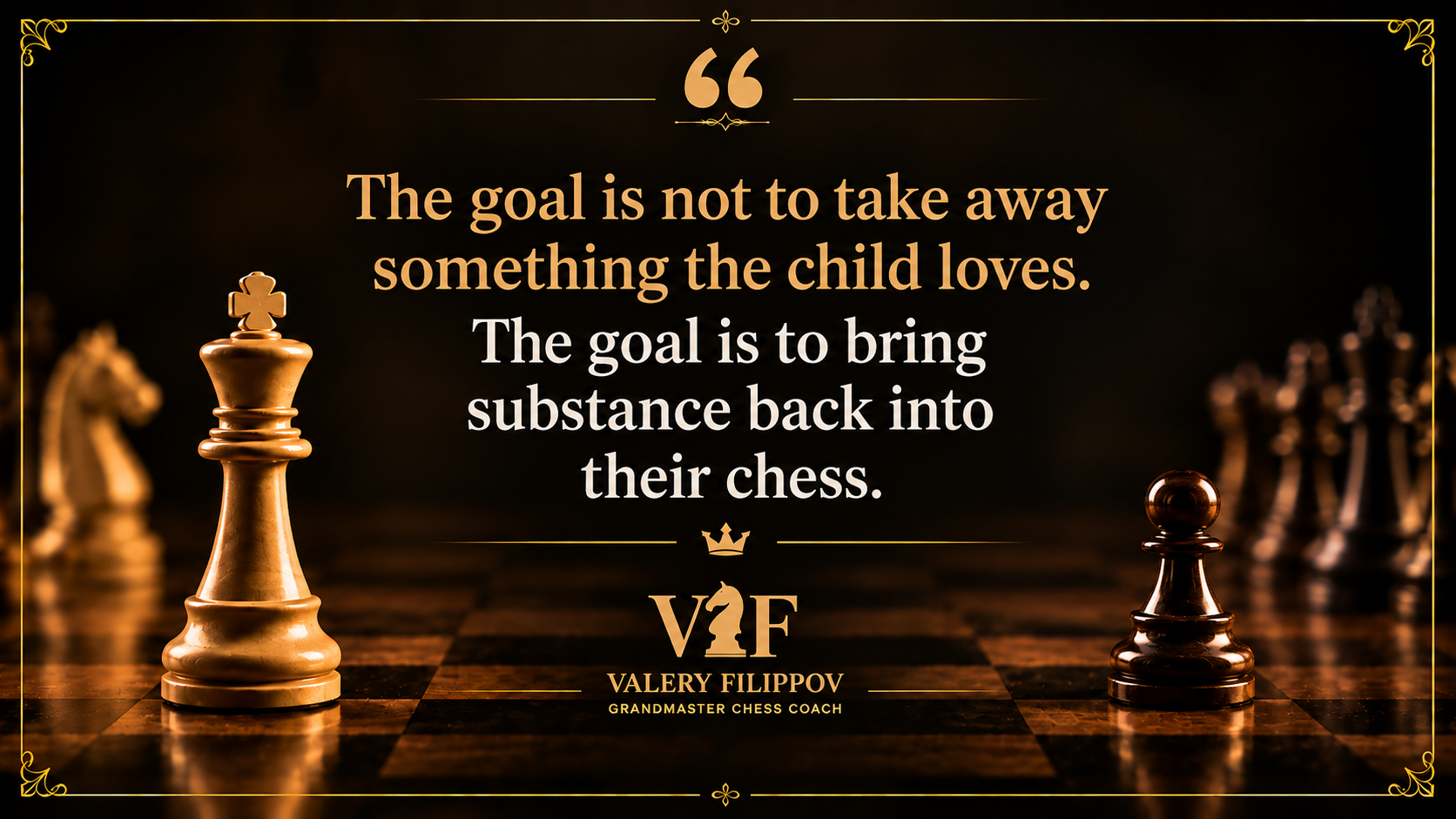
The goal is not to take away something the child loves. The goal is to bring substance back into their chess.
Online Chess Can Be an Excellent Addition to Coaching
From a coach’s point of view, the Internet has given us possibilities that simply did not exist before.
I can give a student a specific position, a set of puzzles, or a particular opening, and a few days later see how they apply those ideas in actual games.
It is especially useful when online games become material for future lessons. In my opinion, this is also something parents should keep in mind when they choose a chess coach for a beginner.
I find it much more interesting to analyze a student’s real mistake than to show them a tenth abstract position on the same topic.
If a child regularly misses counterattacks, it will appear in their games. If they attack too early, that will appear too. If they know an opening but have very little understanding of the resulting structures, a few games will usually reveal the problem quite quickly.
In this format, online chess becomes part of the training process rather than a separate form of entertainment.
This is the approach I consider the most productive.
Not Every Minute of Chess Needs to Become a Lesson
There is also an opposite extreme.
Some parents take their child’s development so seriously that every game is expected to provide educational value. Every game must be analyzed. Every mistake must be discussed. Every free hour becomes another training session.
I would avoid this.
A child has the right to sometimes just play chess.
Without trying to improve a rating. Without a coach. Without analysis. Without being asked what they learned today.
If chess becomes completely transformed into another school subject, interest can disappear surprisingly quickly.
I like it when there is a balance. There is serious work, there is tournament practice, and there is also space where a child simply enjoys playing.
Online chess is excellent for this.
We just should not confuse free play with the main training process.
Should Children Play Chess Online at All?
In my opinion, yes.
For most children, the advantages are too significant to ignore such a useful tool. The ability to find an opponent at almost any time, experience a huge variety of positions, solve puzzles, work with a coach, and save played games for later analysis makes online chess extremely convenient.
But I would never consider it a complete replacement for traditional chess.
The best option I see as a coach is a combination.
A child studies and analyzes. They play online. Sometimes they play on a real chessboard. If they enjoy competition, they gradually begin participating in over-the-board tournaments. Fast games exist alongside more serious ones. Rating remains an interesting indicator but does not become the entire purpose of playing.
And most importantly, the child remains interested.
I think parents sometimes focus too much on the question, “Is this activity useful?”
I would add another one: “What kind of relationship with chess is my child developing?”
If online chess teaches a child to think, gives them opportunities to play interesting opponents, helps them become more comfortable with mistakes, and makes them want to understand the game more deeply, I see enormous value in it.
But if chess gradually turns into an endless chase for rating points, a series of emotional blitz games, and frustration after every loss, it is probably time to change the approach.
The Internet itself is neither good nor bad here.
What matters is the kind of habits a child develops at the chessboard, even when that chessboard happens to be on a screen.
♟ Article prepared by Grandmaster and chess coach Valery Filippov ♟
📖 Continue Improving Your Chess:
▸ When Should Children Start Playing Chess
▸ Does My Child Have Talent for Chess?
▸ Should Parents Let Their Children Win at Chess?
FAQ
1. Should children care about their online chess rating?
A little, but not too much. Rating is useful for finding opponents of similar strength and following general progress. I would not use every rise or fall as evidence that a child is improving or getting worse. Chess progress is rarely that straightforward.
- Should a child analyze every online game?
No. Sometimes children should be allowed to simply enjoy chess. For training purposes, I would rather choose one interesting game and analyze it properly than quickly go through every game played that day. - Should children use a chess engine after their games?
They can, but I would not start with the engine. First, I prefer asking the child where they think the game went wrong and what they were trying to do. The engine becomes much more useful after the child has already tried to understand the position independently. - What should I do if my child becomes angry after losing online?
I would not immediately start explaining the mistakes in the game. Give the child some time first. Later, instead of focusing on the lost rating points, ask where they think the game started to go wrong. In my experience, this gradually makes losses feel more like something to understand and less like something that has to be immediately “won back.” - How long should a child play chess online each day?
I prefer looking at the quality of the games rather than setting an exact number of minutes. If a child is still thinking carefully and enjoying the games, there is little reason to stop after an arbitrary time limit. Once the moves become careless, another ten games are unlikely to help.