How to Prepare Your Child for Their First Chess Tournament
My name is Valery Filippov. Some arrive at the playing hall completely calm and treat the whole experience as an adventure. Others start getting nervous several days before the tournament. Sometimes, interestingly enough, the child is perfectly calm while the parents are much more worried.
In my opinion, the main task before a first tournament is not to urgently make the child a stronger chess player. It is impossible to seriously change their playing strength in a few days. It is much more important to prepare them for the situation itself: an unfamiliar playing hall, chess clocks, opponents, losses, waiting for the next round, and the feeling that the result of the game now actually means something.
And this is exactly where parents can either help enormously or accidentally spoil their child’s first impression of competitive chess. I have written separately about some of the most common mistakes parents make with their child’s chess.
Don’t Wait Until Your Child Is “Strong Enough”
I quite often hear roughly the same thought from parents: “Maybe it’s still too early for a tournament? Let’s wait until they get a little stronger.”
I don’t particularly like this approach.
Of course, a child should know the rules, understand the objective of the game, and be able to play a game independently. But waiting for some imaginary perfect level makes little sense to me. Tournament play is itself part of learning. In fact, some things are almost impossible to learn properly through lessons alone.
A child may solve puzzles very well at home, play with a coach, and feel completely comfortable online. But everything feels different over a real board. There is an unfamiliar opponent sitting across from you. The clock is running. Dozens of other games are being played around you. You cannot simply close the browser tab after a serious mistake and start another game ten seconds later. For parents wondering about the role of Internet chess in training, I have also written a separate guide on whether children should play chess online.
I would rather send a child to their first suitable tournament a little too early than too late. The important thing is choosing the right competition.
For a first experience, I generally prefer children’s tournaments or events where there are players of roughly comparable strength. If a complete beginner immediately enters a very serious tournament and suffers several heavy defeats in a row against much more experienced players, I don’t see much benefit in that.
The first tournament does not have to be easy. But it should give the child a chance to feel that they are actually competing, rather than simply sitting across from people who play much better chess. The question of when to begin is broader than tournaments alone, so parents may also find my article on when children should start playing chess useful.
Explain in Advance What a Tournament Actually Looks Like
Many tournament routines seem so obvious to an adult chess player that we don’t even think about them. For a child, everything may be new.
Where do I find my board? Which color am I playing? Who starts the clock?
In classical chess, FIDE rules generally require players to record their moves, with certain exceptions related, for example, to time pressure. In rapid chess, recording moves is generally not required. It is therefore worth checking the regulations of the particular tournament beforehand.
For an adult, these are small details.
Don’t Turn the Final Days Into a Training Camp
Another common mistake I see before tournaments is an attempt to suddenly increase the amount of chess.
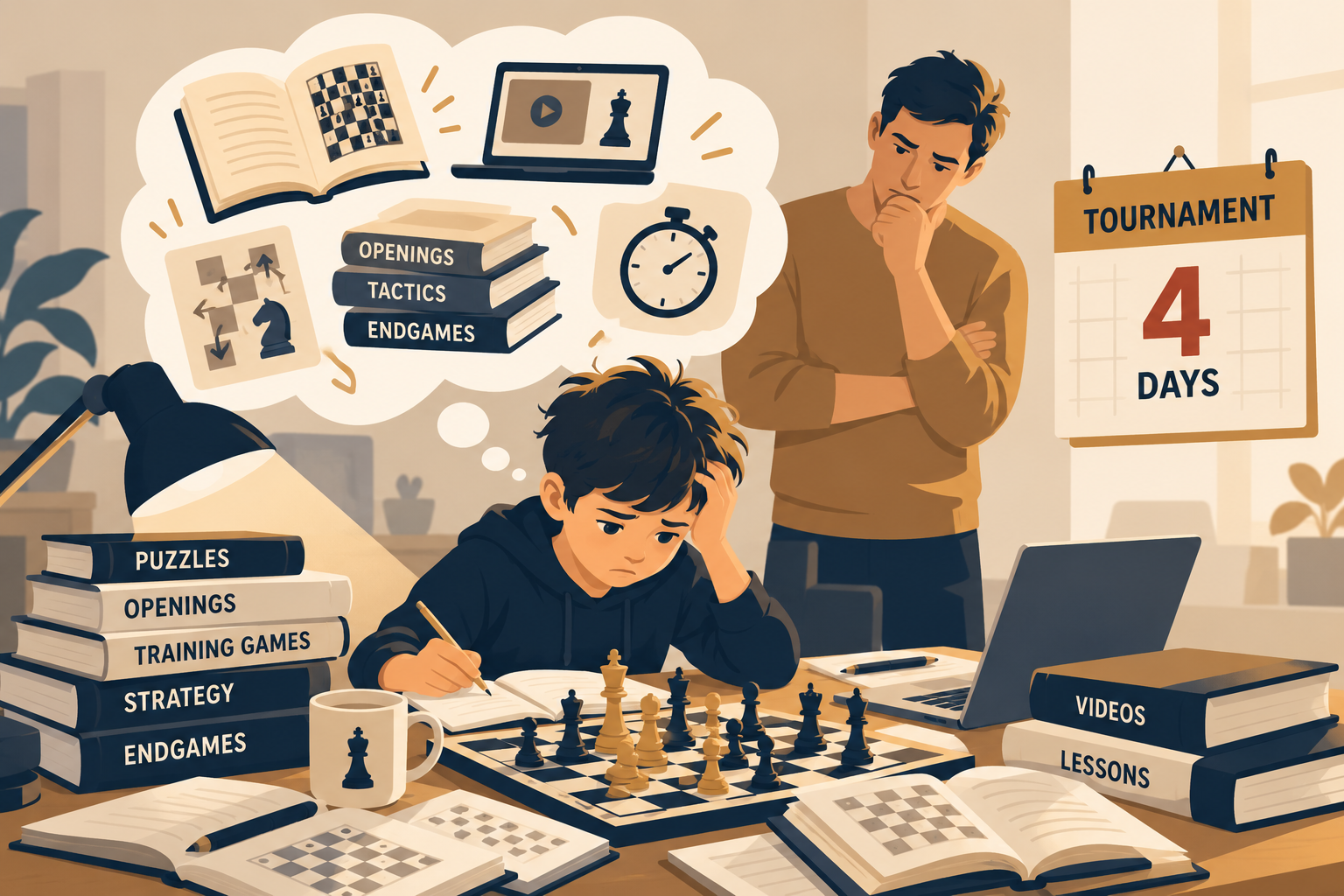
There are four days left before the competition, and suddenly everything begins: extra puzzles, reviewing every opening, training games, videos, lessons, endgames. Parents feel that every available hour can be used to make their child just a little stronger.
I am quite skeptical about this.
If it is the child’s first tournament, mental freshness is, in my opinion, far more important than another twenty positions solved. This is especially true for younger children.
During the final few days, I would focus mostly on familiar things. You can review the main opening ideas, solve a little straightforward tactics, and play a couple of training games with a clock. But I certainly would not try to rebuild the child’s opening repertoire in three days or overload them with a huge amount of new information.
Before a tournament, the feeling of “I know what I’m doing” is much more useful than the feeling of “I urgently need to remember another hundred things.” More generally, I think improvement comes from consistent work rather than last-minute preparation, which I discuss in more detail in my article on how to help your child improve faster at chess.
Teach Your Child to Use a Chess Clock
This may sound obvious, but I would definitely treat practicing with a clock as a separate part of tournament preparation.
A child who plays a lot online may understand chess perfectly well and still feel uncomfortable at a physical board. Online, the opponent’s move appears automatically, your time starts running automatically, and after you make a move, the software automatically switches the turn.
Over the board, none of this happens for you.
Before a first tournament, I therefore recommend playing at least several complete training games with a physical chess clock. Not five-minute blitz games, but something with a time control at least reasonably similar to the upcoming competition.
The child should become comfortable with a very simple sequence: think, make the move, press the clock.
It is also useful to explain the basic rules of behavior at the board and the touch-move rule. There is no need to turn a child into a miniature arbiter and make them memorize dozens of articles from the FIDE Laws of Chess. In my opinion, that will only create unnecessary tension.
One simple instruction is much more important: if something strange happens and you don’t know what to do, don’t argue with your opponent. Stop and call the arbiter.
Don’t Set a Result-Based Goal
“Try to score at least four points.”
“Just try to finish in the top ten.”
“You should win at least three games.”
I would avoid these kinds of goals before a first tournament.
The problem is not only the pressure they create.
Take two children. The first scores four points but plays very carelessly and wins several games only because their opponents make serious mistakes. The second scores two and a half points but thinks carefully, puts up strong resistance against better players, and plays the best chess of their life.
Which child had the better tournament?
For me, the answer is far from obvious.
That is why, for a first competition, I much prefer goals connected with the process. Don’t rush. Check the opponent’s threats. Use your time. Keep fighting in difficult positions.
The number of points can simply remain the result of what happened over the board.
Be Especially Careful About How You Talk About Losses
Sooner or later, your child will lose. It may happen in the very first tournament game of their life.
I think the parents’ reaction at that moment matters much more than they sometimes realize.
The mistakes are not going anywhere. You can analyze them in the evening or during the next lesson with the coach.
In general, I am not convinced by the idea that every lost game by a child has to become an immediate lesson. Sometimes a loss first needs to be simply experienced.
Parents Need to Prepare Too
At children’s tournaments, I sometimes see an interesting situation: the child is playing calmly while the parent is walking around outside the playing hall as if the World Championship were being decided inside.
Children notice this very well.
If a mother or father asks about the result after every round, studies the standings, calculates the possible final place, and reacts emotionally to every change, the tournament can very quickly become far more important than it needs to be.
In my opinion, parents should accept one thing before the tournament: once the game begins, there is almost nothing you can do to help.
Parents should not interfere with the game.
I think this is an excellent principle even beyond the formal rules.
The tournament game belongs to the child. They gradually need to learn how to make decisions without outside help and how to deal independently with the consequences of those decisions. For parents who are new to this world, I have put together a broader overview of everything parents need to know about chess.
Think About the Ordinary Practical Details
It is surprising how often tournament preparation is discussed only from the chess side.
If it is a long tournament, bring water and familiar food. I would not experiment on that particular day with huge amounts of sweets or energy drinks for teenagers. Normal food that the child is used to is almost always a more sensible option in my view.
Clothing should also be comfortable above all else. A playing hall may be hot or surprisingly cold, so several layers are often more practical than one heavy sweater.
All of this sounds rather boring compared with preparing the Sicilian Defense. But at a first tournament, a child’s comfort may be more useful than one more memorized opening variation.
Don’t Analyze Every Game Too Deeply Between Rounds
If there is a break between games, parents sometimes try to use it as productively as possible. The child has barely left the playing hall before a phone or chessboard appears and a detailed analysis begins.
I am not a big supporter of this approach.
You can quickly look at one important moment after a game, especially if the child wants to understand what happened. But I prefer to leave serious analysis until later.
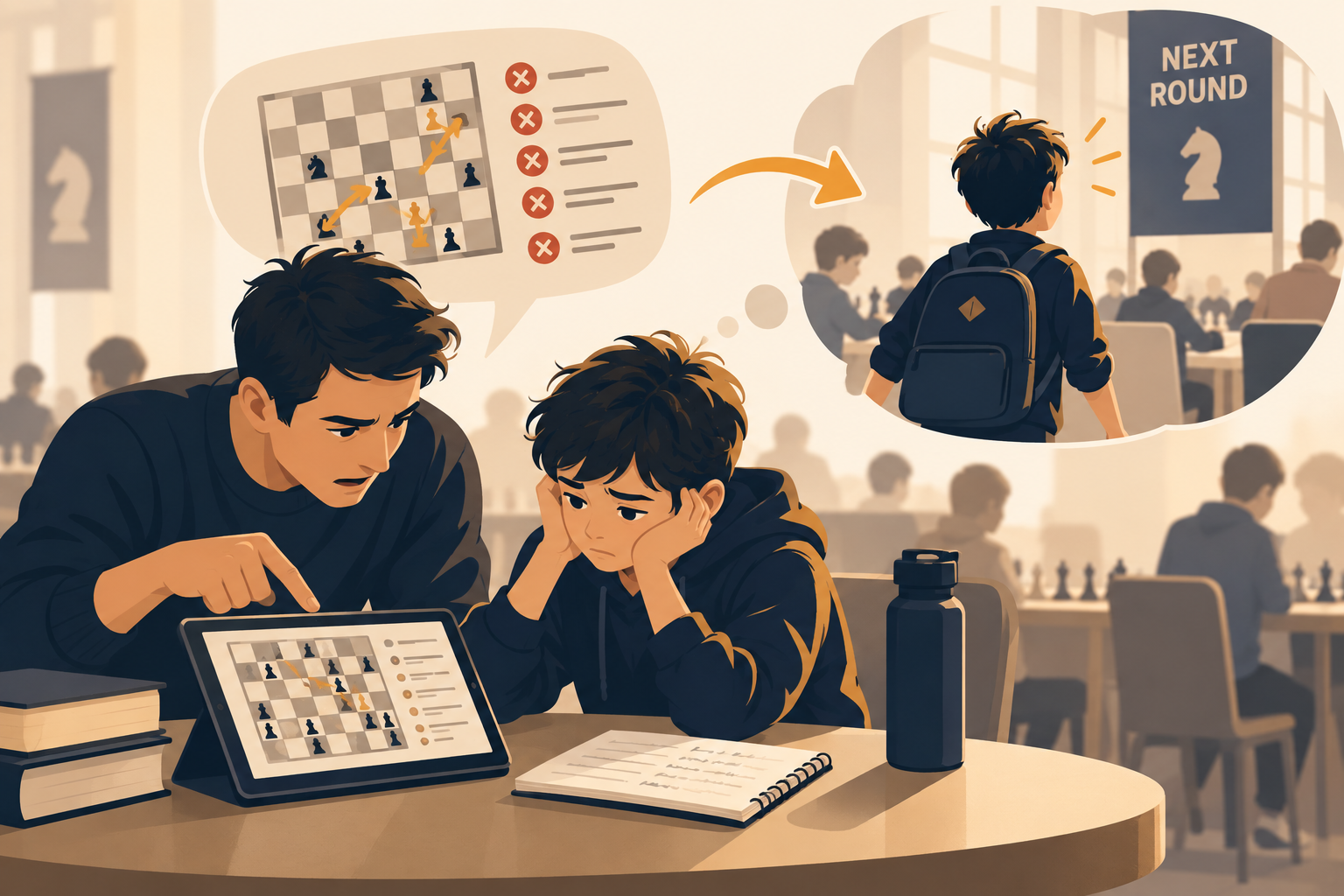
First, the child needs to recover. Second, if you explain ten different mistakes immediately before the next round, they may sit down at the board not with confidence, but with a long list of things they are afraid to do wrong.
After a bad game, I would rather shift the focus toward the next one.
A new game begins from a position in which your child once again has exactly as many pieces as the opponent. I have always liked this feature of chess tournaments.
Don’t Talk Too Much About the Opponent’s Rating
Before a game, parents often look at the opponent’s rating first.
“Oh, they’re rated 1500.”
Or the opposite:
“They’re only 1100. You should win.”
I find both statements completely unhelpful.
In the first case, the child may psychologically lose the game before the first move. In the second, winning becomes an obligation, and the child starts getting nervous if the game turns out to be difficult.
Ratings are not always an accurate reflection of playing strength, especially in children’s chess. Young players can improve very quickly, may have played only a few rated tournaments, and a beginner may not have a rating at all.
I would treat the opponent’s name and rating simply as information. There is a person sitting across from you, and you need to play a good game of chess against them. That is enough.
Don’t Start With the Standings After the Tournament
Imagine that the tournament is over. Your child has played five, seven, or nine games. Perhaps they won a medal. Perhaps they finished somewhere in the middle of the standings. Perhaps they lost almost every game.
What should happen next?
I would start by asking them about the tournament itself.
Did you enjoy playing? Which game do you remember most? Which opponent was the most interesting? Were you nervous during the first game? Would you like to play another tournament?
For me, at a first competition, these answers are much more interesting than the final place.
Later, you can calmly analyze the games and look for recurring problems. This is where a tournament becomes extremely useful for a coach. One real tournament game can sometimes reveal more than several ordinary lessons.
If a child constantly plays too quickly, you can see it. If they forget about developing their pieces, you can see it. If they stop fighting after the first mistake, you can see that too.
And after the tournament, you finally have concrete material for future work.
The First Tournament Doesn’t Have to Prove Anything
I think this is the main idea parents should remember.
The first tournament does not answer the question of whether your child is talented. It does not show whether they can become a strong chess player. And several losses certainly do not mean that chess is “not for them.” I have discussed this question separately in my article Does My Child Have Talent for Chess?
It is simply their first experience.
For some children, it goes wonderfully. Someone unexpectedly wins almost every game and goes home with a trophy. Another child scores one point, gets upset, and a year later is already playing serious tournaments without any fear at all.
I have seen enough chess players over the years to be very cautious about drawing conclusions from a single tournament.
That is why I consider the best possible result of a first competition to be something quite simple: a few days later, the child asks when the next tournament will be.
If that happens, the first step into competitive chess was probably taken in the right way.
♟ Article prepared by Grandmaster and chess coach Valery Filippov ♟
📖 Continue Improving Your Chess:
▸ Why Kids and Adults Improve at Chess Differently
▸ How to Analyze Chess Games
▸ Do You Really Need a Chess Coach as a Beginner?
FAQ
1. What should I do if my child loses the first game and gets upset?
Give them some time. You do not have to find a lesson in the loss immediately. Get some water, go outside for a few minutes, or simply sit together. The game can be analyzed later. In my experience, trying to explain every mistake while a child is still upset rarely achieves much.
2. Should I analyze my child’s games between rounds?
I would keep it to a minimum. If there was one obvious moment your child really wants to see, you can look at it briefly. A complete analysis is better saved for after the tournament. Between rounds, resting and mentally leaving the previous game behind is usually more useful.
3. Should my child practice more than usual before the tournament?
Probably not. A little extra practice is fine, but I would not suddenly double the workload. In the last few days, familiar positions, some tactics, and one or two games with a clock are usually enough. I would rather have a child arrive curious and rested than tired from four days of intensive preparation.
4. How many points should I expect from my child in their first tournament?
I would not set a number at all. Two children can score exactly the same number of points and have completely different tournaments. For the first event, I am much more interested in whether the child used their time, tried to think independently, kept playing after mistakes, and became more comfortable with tournament chess.
5. What should I tell my child before the first game?
Personally, I would keep it short. Something like “Take your time and enjoy the game” is enough. Giving five chess instructions immediately before the round can have the opposite effect. The child sits down and starts thinking about your checklist instead of the position.