Why Some Talented Children Lose Interest in Chess
At eight, they might sit down at the board on their own, look through games, and ask their parents to take them to a tournament. At twelve, someone has to persuade them just to open a chess program. For parents thinking about the right age to introduce the game, I have written separately about when children should start playing chess.
My name is Valery Filippov. Sometimes interests really do change naturally. That is perfectly normal. But quite often, it seems to me that a child loses interest not so much in chess itself, but in what their chess life has gradually become.
That is an important difference.
Talent Sometimes Creates Too Many Expectations
Strangely enough, a child’s ability can become an additional problem.
If a beginner plays at an ordinary level, nobody expects very much. They win a tournament, wonderful. They lose, no big deal. But if a child starts standing out noticeably at seven or eight, the word “talent” appears around them rather quickly. I have discussed this question in more detail in my article about how to understand whether a child has talent for chess.
At first, it sounds nice. Then expectations come with it.
If yesterday the child won a local tournament, today they are already expected to win a stronger one. If their rating quickly increased by 200 points, another similar jump starts to seem natural. A good result gradually stops being seen as an achievement and becomes the norm.
I consider this quite a dangerous situation.
Chess Quietly Turns From a Game Into Work
I am certainly not against serious training for children. If a child wants to improve, simply playing for fun is not enough. They need puzzles, analysis, openings, endgames, and independent work.
But I think it is very easy to cross a line here.
Imagine a child who once simply loved playing. Gradually, they have three lessons a week, homework, mandatory puzzles, an opening database, tournaments almost every weekend, and an analysis of every game they play.
Formally, everything is being done correctly. From the point of view of chess development, the program may look almost perfect. But there is one question: is there still any place in this system where the child simply plays because they want to?
That question seems much more important to me than the number of training hours.
When every game has to teach something, every mistake is analyzed, and casual play is considered a waste of time, chess begins to resemble another school subject. Except school at least ends during the day, while chess homework is waiting in the evening.
Even a very talented child can get tired of that. Online chess can be useful here too, but only if it remains part of a healthy balance. I have written a separate guide on whether children should play chess online.
Sometimes Parents Begin to Want Success More Than the Child Does
The problem begins a little later, when the child’s chess project gradually becomes a project for the entire family.
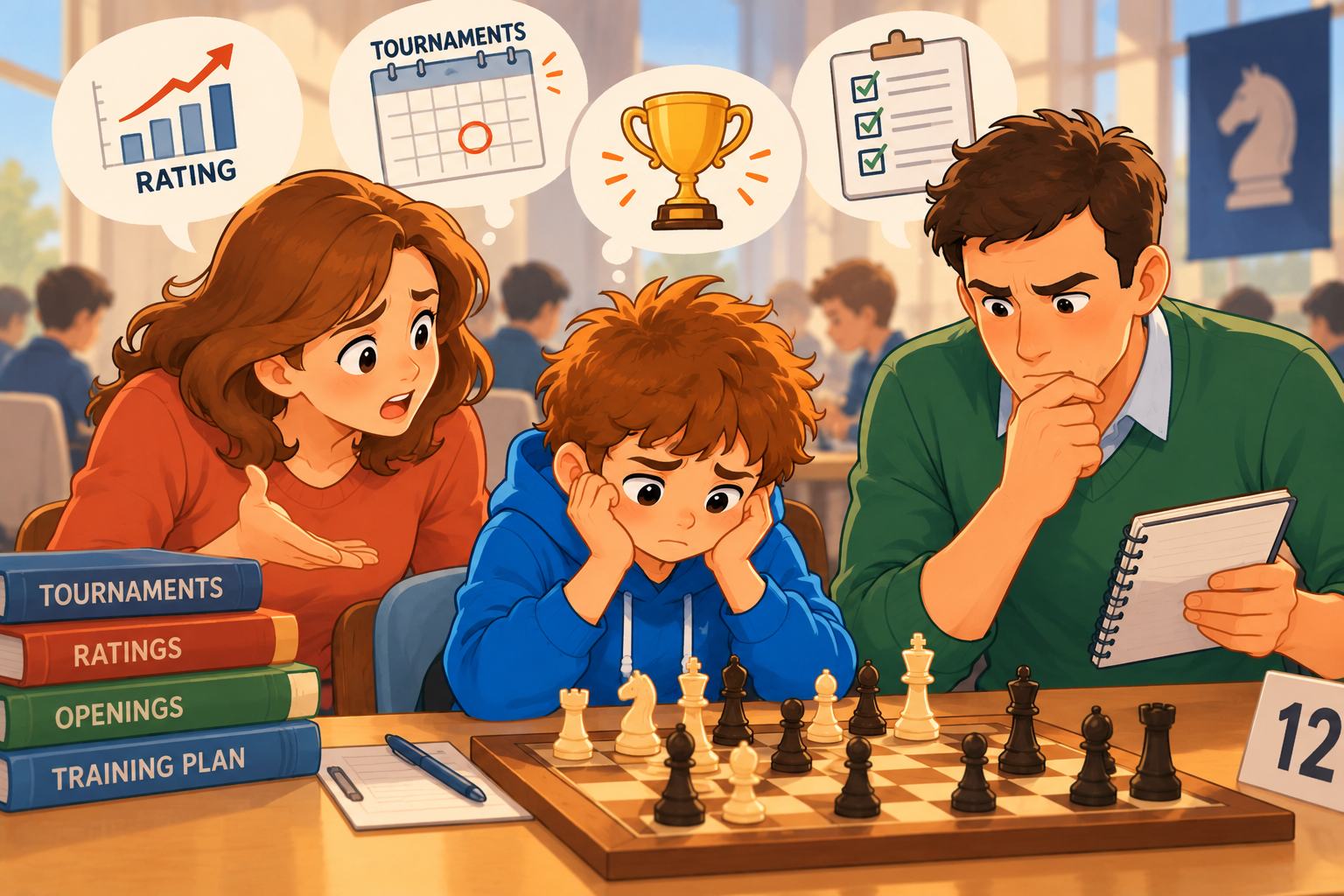
The parent knows the rating of every opponent. They follow their child’s position in the age-group rankings. They choose tournaments. They count points. After a game, they are the first to ask what happened. Sometimes the parent takes a loss noticeably harder than the player does.
I think children notice this very well.
They may continue training for a long time. They may even continue producing good results. But the reason behind it gradually changes. Before, they played because they wanted to play. Now they play because Mom will be upset, Dad has already paid for the tournament, the coach expects a result, or “you can’t quit after all these years.”
I consider this kind of motivation very fragile.
The problem of excessive pressure from adults has also been discussed in materials from chess organizations. World Chess, for example, has linked children losing interest to situations where ratings, results, and adult expectations begin to replace the enjoyment of the game itself.
Losing Becomes Too Expensive
Chess is quite cruel in one particular way. You can play a good game for three hours, make one serious mistake, and receive the same zero in the standings as someone who lost in twenty moves.
Sometimes even an adult chess player finds this difficult to accept. For a child, it can be even harder. I have written separately about what parents can do when their child hates losing at chess.
But in my opinion, it becomes especially difficult for talented children who became used to winning a lot during their first years.
Then the level of opposition gets stronger.
Now victories have to be fought for. Losing streaks appear. The rating may stay in the same place for several months. A child who used to lead their age group suddenly discovers that there are ten other talented children around them.
This is where the attitude of adults becomes especially important.
If every unsuccessful tournament is followed by an investigation into what went wrong, the child may gradually come to a simple conclusion: losing is too unpleasant. And it is no longer unpleasant only because of the game itself, but because of everything that will happen afterward.
Then caution appears. The child becomes less willing to play strong tournaments, worries about losing rating points, and reacts more painfully to mistakes.
And chess without the right to lose, in my opinion, stops being interesting very quickly.
A Good Coach Should Sometimes Change the Approach
I don’t think the same teaching style can work equally well for a child at seven, ten, and fourteen.
At seven, they may enjoy checkmate puzzles, speed competitions, and simple combinations.
If the training does not change along with the child, boredom appears.
This can look especially strange with talented children. Sometimes, precisely because a particular method produced quick results in the past, adults continue using it for years.
Puzzles worked? Then let’s give them even more puzzles. Two lessons a week helped? Let’s make it four.
I am not sure development always works that way.
I much prefer the idea of gradually giving a young chess player more independence. Let them sometimes choose which game they want to analyze. Let them suggest an opening they find interesting. Let them disagree with the coach about a position.
This is no longer simply about learning chess. It creates the feeling that chess belongs to them.
FIDE educational materials also emphasize student engagement and learning through play, while programs for children use not only individual lessons but also group, team, and practical formats.
Constant Comparisons With Other Children Rarely Help
In children’s chess, comparisons are very easy to make.
Here is another child born in the same year whose rating is 300 points higher. Another has already earned a title. A third has won the national championship.
Parents sometimes believe that examples like these are motivating: “Look, they train more, and that is why their results are better.”
I would be careful with that.
Children develop in completely different ways. One improves extremely quickly at nine and almost stops progressing at thirteen. Another looks like a completely ordinary player until twelve and then makes an enormous jump.
In general, I don’t particularly like the idea of turning children’s chess into an age-group race. Ultimately, there is no prize for having the highest rating among eleven-year-olds in April of a particular year.
Constant comparison can easily take away a child’s sense of their own progress. They no longer see that they have become a better player. They only see that somebody else is improving faster.
Too Many Tournaments Can Become Boring Too
Tournaments are necessary for chess development. I personally consider serious competitive practice extremely important. But that does not mean every free weekend has to be filled with a tournament.
Sometimes I look at a child’s schedule and think I would get tired of it myself.
School for five days. Preparation on Friday evening. Tournament on Saturday. Tournament on Sunday. Game analysis on Monday. A week later, everything starts again.
If the child genuinely wants to live like that, that is one situation. But if adults created this schedule entirely for the sake of faster rating growth, I would think twice about it.
Sometimes a tournament you skip is more useful than one you play. A child can meet friends, play another sport, go somewhere with the family, or simply spend a few days without seeing a chessboard.
I don’t think a child’s love of chess should be measured by how many hours of it they can tolerate. And when the time does come for a child’s first serious competition, I think it is worth approaching it carefully. I have a separate guide on how to prepare your child for their first chess tournament.
A Child Should Still Have a Life Outside Chess
I like it when children have other interests. Sports, music, friends, travel, ordinary school life. At first glance, all of this seems to take time away from chess. Perhaps it does. But at the same time, it helps prevent chess from becoming the child’s entire world.
When there is only one area that matters, every failure in that area becomes a huge event.
When chess is an important but not exclusive part of life, a bad tournament remains just a bad tournament.
Sometimes Losing Interest Isn’t a Problem at All
This is important to acknowledge as well.
A child can be talented and still decide one day that programming, tennis, music, or something completely different interests them more.
I don’t consider that a failure on the part of the parents or the coach.
The Main Goal Isn’t to Keep a Child in Chess at Any Cost
It is much more useful to create an environment in which the child still has the opportunity to want to continue. A good coach, a reasonable amount of training, tournaments without constant drama around the result, the right to sometimes feel tired, and the right to have other interests. Even small decisions at home can influence this atmosphere, including something as simple as whether parents should let their children win at chess.
I think this approach gives a child a much better chance of having a long life in chess.
FIDE’s children’s programs today also pay attention not only to teaching moves and competition, but to motivation, social engagement, confidence, and creating an environment in which children want to continue playing.
I have seen talented children who trained an incredible amount at a young age and stopped playing completely a few years later. I have also seen others whose development was much calmer, but chess remained part of their lives for years.
That is why, personally, I don’t think the main measure of successful chess education for a child is their rating or the number of trophies on the shelf.
Something else matters much more: several years later, the child still opens a chessboard not because someone told them to, but because they genuinely want to see what happens after the first move.
♟ Article prepared by Grandmaster and chess coach Valery Filippov ♟
📖 Continue Improving Your Chess:
▸ How to Choose the Right Chess Coach for Beginners
▸ How to Build a Chess Training Plan
▸ Chess Rating System Explained: FIDE, USCF, Chess.com & Lichess
FAQ
1. Is it normal for a child to suddenly want a break from chess?
Yes. I would not panic because a child wants a few weeks away from chess. Adults get tired of things they normally enjoy, and children do too. A short break can sometimes tell you more than another month of forced lessons.
2. Can too much chess training cause a child to lose motivation?
Absolutely. Three lessons a week, homework, online games, tournaments, puzzles, and opening preparation may look wonderful on a training plan. For some children, however, it simply becomes too much. More chess is not always better chess.
3. What should parents do when a talented child starts losing more often?
I would treat it as a normal part of becoming stronger. As the opposition improves, easy victories naturally disappear. A difficult period does not necessarily mean something has gone wrong. Sometimes it simply means the child is finally playing people who can punish their mistakes.
4. Should parents compare their child’s rating with other children?
I see very little benefit in doing this regularly. Children’s ratings can develop at completely different speeds. Being 200 points behind another ten-year-old today tells us surprisingly little about where either child will be three or five years from now.
5. What should a coach do if a child seems bored with lessons?
Change something. I don’t believe a training format should remain identical simply because it worked two years ago. The child may need different positions, more difficult opponents, a new opening, fewer exercises, more discussion, or simply more freedom to choose what interests them.