Why Memorizing Openings Won’t Make You a Better Chess Player
There is a situation I have seen many times with my students.
A player comes to a lesson and tells me that they want to work seriously on their openings. They have already bought a course, created a database, written down variations, and sometimes know the first fifteen moves much better than you would expect from someone at their rating.
We start looking at their games.
In one game, they get an excellent position out of the opening and lose a pawn four moves later. In another, they come out of theory with a slight advantage but have absolutely no idea which plan to choose. In a third, the opponent plays a strange move on move six, and suddenly all the preparation is over.
My name is Valery Filippov. I am a chess grandmaster, and I have nothing against studying openings. In fact, the stronger a chess player becomes, the more attention they usually have to give them.
But I think many amateur players misunderstand the purpose of opening preparation itself.
Learning an opening and learning how to play the position after the opening are, to me, two completely different things.
And this is where the problem begins.
Memorizing Moves Gives You a Very Pleasant Feeling of Progress
I completely understand why openings are so attractive.
They are convenient to study.
Today you knew a variation six moves deep. A week later, you know twelve moves. Yesterday you did not know what to play against 5…a6, and today you do. It is easy to measure, and because of that, you start to feel that your chess level is growing together with the number of variations in your memory.
Calculation is much less pleasant.
You can train calculation for a month and still make a mistake in a difficult position. You can study strategy without seeing an immediate result. You can analyze twenty endgames and then not get a single similar ending in your next tournament.
With openings, the result is visible immediately.
I know the move.
I don’t know the move.
Perhaps that is exactly why opening theory can become so addictive.
I think there is a psychological trap here. Memorization gives a player control over the part of the game that is, by its nature, the most predictable. As long as the opponent follows a known line, everything is wonderful. You are barely playing chess in the full sense of the word yet. You are reproducing decisions that have already been studied.
The real test begins a little later.
This is also why I prefer to look at opening study as only one part of a broader chess training plan, rather than allowing it to consume most of a player’s training time.
The Problem Appears With the First Unfamiliar Move
Let’s imagine that a student has learned the variation:
1.e4 c5
2.Nf3 d6
3.d4 cxd4
4.Nxd4 Nf6
5.Nc3 a6
And then knows another ten or fifteen moves of the main theory.
Excellent.
But what happens if the opponent plays something on move three that was barely covered in the course?
That is the moment I find especially interesting.
Some students suddenly start playing much weaker than they did a minute earlier. As long as the position was familiar, they moved their pieces quickly and confidently. The moment their memory runs out, uncertainty appears.
“I don’t know this variation.”
Fine. Then now let’s play chess.
What is the idea behind your opponent’s move?
What has changed in the position?
Where should your pieces go?
Which pawn break do you need?
Is there a weakness created by the unusual move?
If a player cannot answer any of these questions, I start to wonder whether they really knew the opening at all.
Perhaps they simply knew a sequence of moves.
Modern approaches to opening preparation often make exactly this distinction: it is more useful to connect variations with typical structures, piece placement, and plans than to store them as isolated sequences of moves.
A Good Memory Can Sometimes Hide Poor Understanding
In my opinion, this is an especially unpleasant situation.
A student can make a very good impression at the beginning of a game.
They play quickly.
They know the names of the variations.
They remember that a grandmaster played 11.Re1 here, while the computer prefers 11.h3.
But then I ask a simple question:
“Why does the rook go to e1?”
And there is a pause.
For me, that pause is much more important than knowing the move itself.
If you know that the rook should go to e1 but have absolutely no idea what its function is there, that knowledge is very fragile. Change the position slightly, and the same move may already be meaningless.
That is why, when working on openings, I like to ask students questions that cannot simply be answered from memory.
Which piece do we want to exchange?
Which exchange is unfavorable for us?
Where is the weak pawn?
What happens if the center opens?
Which endgame would suit us?
How does the attack usually develop?
It seems to me that if a player can answer these questions reasonably well, forgetting a few moves is not a great tragedy.
But if they remember the variation perfectly and do not understand the position, I would not call that good opening knowledge.
The Opening Does Not End Where Your Theory Ends
This seems obvious, but in practice many players train as if the game ends on the last move of their file.
Suppose you have studied a variation up to move fifteen.
A position with a slight advantage for White appears on the board.
Great.
What now?
This is where I often see the biggest weakness in opening preparation.
The player knows how to reach the position, but does not know what to do with it.
For me, good opening study should always extend a little into the middlegame. I want to see typical plans, several model games, characteristic tactical motifs, and preferably understand what kinds of endgames we may reach.
This is also where knowing how to make a plan in chess becomes much more valuable than simply remembering one more theoretical move.
Sometimes one well-analyzed game by a strong player gives a student more than another twenty branches in an opening tree.
They see the entire journey of the position.
Here development ends.
Here the fight for a particular square begins.
Here an exchange takes place.
Here a weak pawn appears.
And here, already in the endgame, it becomes clear why the rook was moved ten moves earlier.
Then the opening stops being a list of commands.
It becomes the beginning of a story.
Personally, I much prefer studying it this way.
The Lower the Rating, the More Cautious I Would Be With a Huge Opening Repertoire
I do not like rigid rules such as, “If you are below 1800, don’t study openings at all.”
In my opinion, that is the opposite extreme.
You need to know openings. If you regularly get a bad position after eight moves, it would be strange to pretend that this is not a problem.
But the amount of theory you need should correspond to the actual problems you have as a chess player.
If a player is rated 1300 and loses material to simple tactics in every second game, I am not sure that studying move twenty-three of a Najdorf variation is the best use of their time.
They may prepare perfectly for a position that will occur once every few years and continue losing completely ordinary positions every week.
To me, that seems like a poor investment of time.
Especially because at amateur level, opponents often deviate quite early from the lines a student has prepared. That is why practical advice for club players usually emphasizes keeping the repertoire manageable and learning the ideas, structures, and typical positions first.
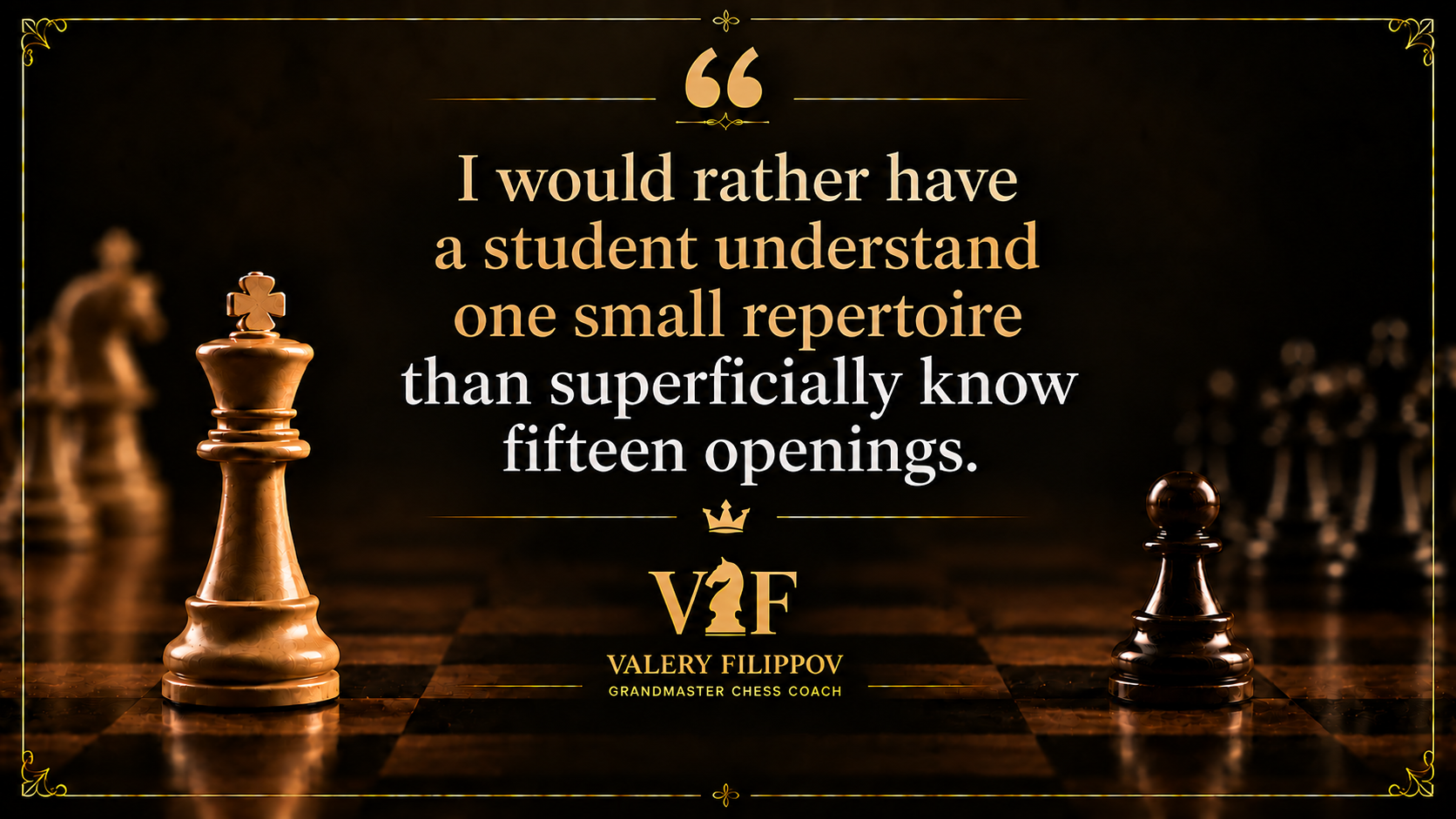
I would rather have a student understand a small repertoire reasonably well than superficially “know” fifteen openings.
Another Danger: You Start Blaming Everything on the Opening
After a loss, it is very convenient to turn on the computer and find the first moment where the game left the database.
“There. On move eight I should have played Be3, but I played h3.”
Problem found.
The following week, the student memorizes Be3.
But if after 8.h3 the position was still roughly fine, and on move twenty-two they missed an elementary tactic, what exactly have we fixed?
This is one of the habits I try to change.
Not every deviation from theory is a mistake.
Not every opening inaccuracy has anything to do with the result of the game.
And not every loss requires changing your repertoire.
I am much more interested in finding the moment after which the quality of the decisions really started to decline.
Sometimes it is the opening.
Sometimes it is calculation.
Sometimes it is a lack of understanding of the plan.
Sometimes the player simply makes a good opening move, then another good move, and then ruins an excellent position in ten seconds.
In a game like that, I would not blame the opening simply because it is the easiest place to find a specific computer recommendation.
In fact, focusing on the wrong problem after every loss is one of the recurring mistakes that can stop a player from improving at chess.
I Am Not Suggesting That You Stop Memorizing Openings
It is important not to take me too literally here.
Of course, some things need to be remembered.
There are concrete variations where the wrong move order matters. There are tactical lines where one mistake can immediately create serious problems. There are positions where knowing the theory precisely is useful.
The higher the player’s level, the more important concrete knowledge becomes.
It would be rather funny to claim that grandmasters prepare for tournaments by simply reviewing general principles of piece development.
Of course not.
At a high level, opening preparation can be extremely deep and specific.
But even there, a strong player does not simply remember moves. Ideally, they understand why they want that particular position, what alternatives the opponent has, and what to do once the prepared variation ends.
So I do not see memory and understanding as opposites.
I would rather say that memory should serve understanding, not replace it.
First, I want to know what is happening in the position.
After that, there is somewhere to attach the concrete variations.
How I Prefer to Study a New Opening
If a student is starting a new opening from scratch, I usually do not want to overload them with a huge amount of theory immediately.
First, I want the general picture.
What pawn structure usually appears?
Where do the pieces belong?
Which piece often becomes bad?
Which exchanges are typical?
Which pawn breaks determine the play?
Where does the king usually go?
What does the opponent want?
The last question is especially important.
I have noticed that many players study openings entirely from their own side.
“My plan is this. My piece goes here. I want to play f4.”
But for some reason, the opponent also gets to make moves.
If you understand only your own setup and do not know what the other side wants, the opponent’s first active decision can come as a surprise.
After getting the general picture, I would look at several good games.
Not twenty-five.
A few are enough to begin with, but preferably they should be analyzed properly.
Only after that would I gradually add concrete variations, especially the ones that actually appear in the student’s own games.
This way, the repertoire grows together with practical experience.
To me, that seems much more natural than trying to memorize an encyclopedia first and finally starting to play afterward.
Your Own Games Should Determine What You Study Next
Suppose you have played a new opening ten times.
In three games, your opponents chose the same variation, and every time you did not know what to do.
That is an excellent topic for preparation.
Analyze it.
Look at several games.
Understand the plan.
If there is a critical concrete line, memorize it.
Now this knowledge is connected to real experience.
You have already seen the position over the board. Perhaps you have even made the wrong decision in it. In my experience, new information is remembered much better this way.
This is how I prefer to build a repertoire gradually.
Not by trying to “learn every possible response for Black,” but by filling real gaps as they appear.
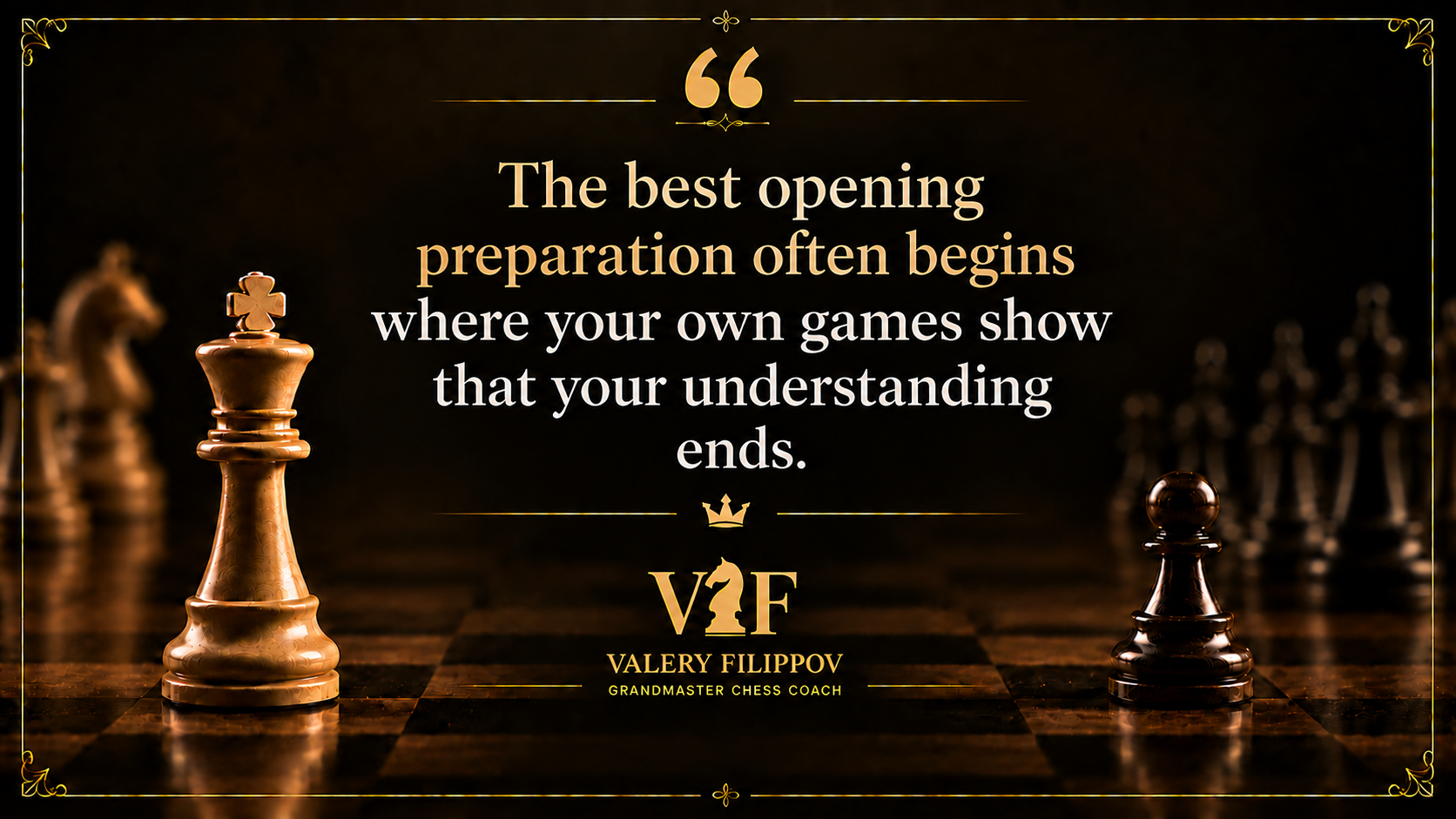
After a game, it is worth checking where exactly your preparation ended, but it is even more important to ask yourself whether that was really where the problems began. The approach in which your own games become material for the next stage of opening preparation is also used in modern practical recommendations for studying openings.
A Strong Opening Should Help You Make Decisions Independently
For me, this is probably the main criterion.
Good opening preparation should not make a chess player dependent on memory.
It should make them more independent.
If your opponent plays a familiar move, excellent, you know the answer.
If they play an unfamiliar move, that is fine too. You understand the position well enough to start thinking for yourself.
Perhaps you will not find the computer’s first choice.
That is okay.
You need a good chess move that fits the position.
I much prefer a student who forgets the theory on move twelve, spends five minutes thinking, and finds a reasonable solution to a student who reproduces fifteen moves perfectly and then, on move sixteen, has absolutely no idea what is going on.
The first player is already playing chess.
The second is still mostly remembering.
This ability to understand the purpose of your training and make decisions independently is also what I consider the biggest advantage adult chess students have.
Opening Theory Should Be a Tool, Not a Refuge
I think some chess players spend too much time on openings not because openings are their biggest weakness.
Openings are simply psychologically comfortable.
There is always another variation to find.
Another video.
Another novelty.
Another file.
And while doing that, you do not have to confront a much less pleasant fact: perhaps you calculate variations poorly. Perhaps you fail to notice your opponent’s ideas. Perhaps you do not understand endgames. Perhaps you make decisions too quickly.
Fixing these things is harder.
But they are often what determines a player’s real strength.
For adult players in particular, repeatedly putting effort into the wrong areas can eventually become one of the reasons they feel stuck and quit trying to improve.
So I would not ask, “How many moves of my opening do I know?”
I would ask a different question:
“When my memory runs out, how well can I actually play chess?”
For me, the answer to that question is much more important.
Memorizing openings can help you get a good position. Sometimes it saves time on the clock. Sometimes it allows you to avoid an unpleasant variation. At a certain level, it is difficult to keep improving without serious opening work at all.
But the number of memorized moves alone does not make someone a strong chess player.
What makes them stronger is what happens after the familiar moves are over.
You need to evaluate the position.
Understand the plan.
See the threat.
Calculate the variation.
Make a decision.
That is why I believe a good opening repertoire should not free you from the need to think.
It should lead you into positions where you know what to think about.
♟ Article prepared by Grandmaster and chess coach Valery Filippov ♟
📖 Continue Improving Your Chess:
▸ How to Reach a 1500 Rating on Chess.com as an Adult
▸ How to Choose the Right Chess Coach for Beginners
▸ How to Make a Plan in Chess: A Step-by-Step Guide