The Biggest Advantage Adult Students Have
When an adult starts taking chess seriously, for some reason the conversation very quickly turns to their disadvantages.
They started too late. They have a job. They have a family. They cannot study five hours a day. It is harder for them to memorize huge amounts of opening theory. They play fewer tournaments than a child who spends practically every weekend at a chess club. And, of course, somewhere nearby there is always the phrase: “If only I had started when I was eight…”
I have heard this kind of reasoning countless times.
My name is Valery Filippov. I am a chess grandmaster, and over the years I have worked with both children and adult chess players of very different levels. And it seems to me that the conversation about age in chess is often far too one-sided.
Yes, children have obvious advantages. I am certainly not going to argue that starting early matters, especially if we are talking about reaching a very high professional level. Research on chess expertise does indeed connect a high level of play with a large amount of long-term practice, and the age at which a player begins may also matter. But practice itself, and especially its quality, remains an extremely important factor.
The question of whether you can actually become a grandmaster after 30 is a separate one, and I think it is important to distinguish realistic limitations from the many myths surrounding age in chess.
However, an adult student does not come to chess empty-handed.
They have an advantage that, in my opinion, is very often underestimated.
An adult is much better able to understand why they are doing something.
And if you learn how to use this quality properly, it can seriously change the entire learning process.
Adults Don’t Have to Simply Trust the Coach
With a child, sometimes it is enough to say, “In this position, you should look at forcing moves first.”
Fine.
The child remembers it.
In the next position, we repeat it again. Then again. After some time, it becomes a habit.
With an adult student, I often prefer a different kind of conversation.
I do not simply want to tell them what to do. I want to explain why their previous way of thinking led to the mistake.
Suppose a player constantly starts calculating the first attractive move they see. They notice a check and immediately dive into the variation. Four moves later, it turns out that the combination does not work. We can say, “You should have looked at other candidate moves.”
Formally, that is completely correct.
But I think it is much more useful to examine the mechanism of the mistake itself.
Why did the check attract so much attention?
At what point did the player stop looking for alternatives?
Were they already psychologically convinced that they had found the solution?
What made them continue calculating that particular variation?
This is where an adult student can sometimes do something that I especially like as a coach. They begin to observe not only the chessboard, but also their own thinking.
For me, this is a very valuable moment.
Gradually, they begin to understand: “I didn’t just miss a move. I understand why I missed it.”
That is a completely different level of working on a mistake.
I Consider the Ability to Understand Your Own Mistakes a Huge Advantage
If an adult student tells me after a game, “I blundered a piece,” that information is almost not enough for me.
Yes, you blundered.
But why?
Very often, the answer is much more interesting than the mistake itself.
For example, the student was so focused on their own attack that they stopped checking the opponent’s threats. Or they spent too much time on the previous moves and started rushing. Or they decided the position was simple. Or they recognized a familiar tactical motif and automatically assumed that it worked.
Two identical mistakes on the board can have completely different causes.
That is why I am not particularly fond of the approach where every blunder is treated with another two hundred tactical puzzles.
Sometimes it helps.
And sometimes a person solves another two thousand puzzles and continues blundering in roughly the same way.
This is one of the reasons I believe learning how to analyze chess games properly is so important. The goal is not simply to locate the bad move, but to understand what produced it.
An adult student is often able to reconstruct their own state during the game in quite a lot of detail. What they saw, what they expected, what they were afraid of, which move they originally wanted to play, and why they rejected it. For a coach, this is excellent material.
Especially if the student does not try to make themselves look smarter after the game than they actually were at the board.
That, by the way, is another common problem. Once the computer is turned on, the position suddenly looks obvious.
“Well, yes, of course I should have played the knight here.”
No, not “of course.”
During the game, you did not see that move.
I am much more interested in the person who was sitting at the board than in the person who, twenty minutes later, is looking at the Stockfish evaluation.
And adult students who learn to honestly reconstruct their own thinking, in my opinion, gain a very powerful tool for independent improvement.
Adults Can Bring Skills From a Completely Different Part of Life Into Chess
This is another thing I often notice.
By the age of thirty, forty, or fifty, an adult has already learned how to do something fairly difficult.
It does not necessarily have anything to do with chess.
They may have built a business, become a doctor, programmer, engineer, teacher, or lawyer. Perhaps they have seriously studied music or played sports. Or maybe they have simply spent many years working in a field where they constantly have to make decisions and take responsibility for the consequences.
I do not believe that professional success automatically makes someone a strong chess player. Of course not.
But they already have experience with learning.
They know that a difficult skill cannot be mastered in three weeks. They know that sometimes you have to do boring work. They know that progress is not always linear. They know that you can spend several weeks without noticing much improvement and then suddenly realize that something has become much easier.
In my opinion, this is very useful life experience.
It is much easier for me to explain to such a student why we are not going to study something new in every lesson.
Sometimes we need to return to the same problem.
Sometimes we need to solve another ten similar positions.
Sometimes we need to open a game from a month ago and see whether the habit has actually changed.
An adult can usually understand the logic behind this process.
And once they accept it, working with them can be exceptionally interesting.
This is also one of the reasons I think kids and adults improve differently in chess. The destination may sometimes be similar, but the most effective way of getting there does not necessarily have to be the same.
The Most Motivated Adult Student Usually Knows Why They Want Chess
I consider this one of the main differences compared with children.
A child did not necessarily choose chess themselves.
Their parents may have brought them to a club. They may like the coach. A friend may go there. They may enjoy winning trophies. Or perhaps they simply enjoy spending time at the board.
There is nothing wrong with any of that.
But an adult who opens a chessboard after a day at work and sits down to study usually does so completely voluntarily.
Nobody is forcing them to analyze a rook endgame at 9 p.m.
It is their decision.
And that kind of internal motivation can be very powerful.
I have seen adult students who objectively had very little free time but used it much more effectively than people who had several times as much.
Thirty minutes today.
Forty minutes tomorrow.
A game on the weekend.
A lesson.
Analysis.
A few more positions.
At first glance, it does not look particularly impressive. But a year later, it turns out that the person has accumulated hundreds of hours of fairly meaningful work.
Research on chess practice generally gives us good reason to think that it is not simply the fact of playing that matters. In a classic study, serious individual chess study was particularly strongly associated with playing strength, although the researchers also considered tournament play and coaching. More recent research involving tens of thousands of online players has also found that different forms of practice can have different levels of learning efficiency.
This is very close to what I see in my own coaching experience.
An hour of chess can mean very different things.
Adults Usually Have Less Time, and Sometimes That Is Even Useful
It sounds strange, but I really do think so.
When someone has twenty hours of free time a week, it is very easy to spend fifteen of them on chess activities that create the feeling of work without changing very much.
Watch a video.
Then another one.
Play five blitz games.
Open an opening database.
Browse through some grandmaster games.
Solve a few puzzles.
Go back to blitz.
At the end of the day, you can honestly say, “I studied chess for four hours today.”
But what exactly did you do?
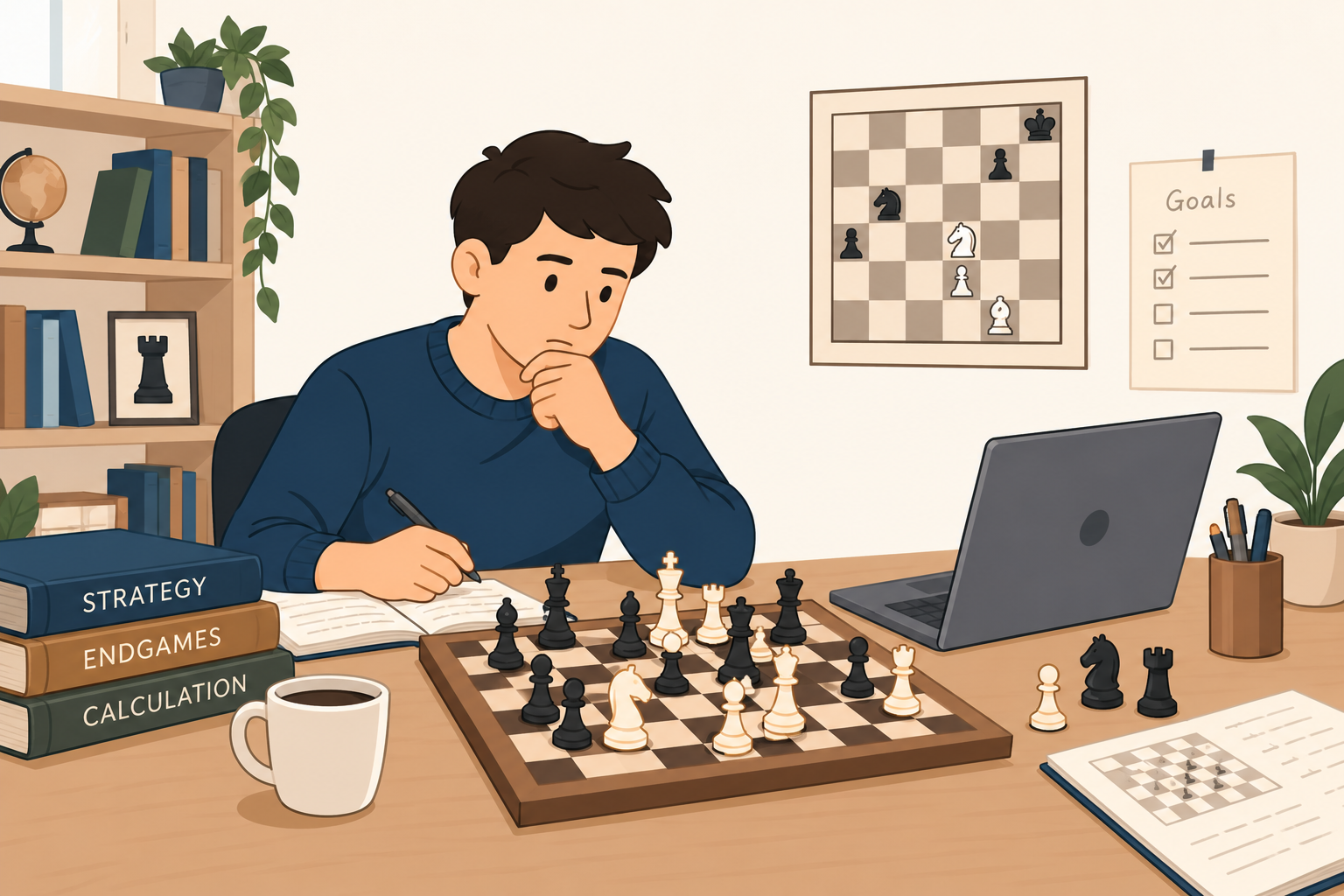
For adult players with limited time, I think the central question is not simply how much they study, but how to improve at chess as an adult without wasting the hours they actually have available.
An adult student often comes to me with a different reality.
“I have four hours a week. What should I do?”
I like this question.
Because it forces us to set priorities.
If we have four hours, we cannot do everything. So we need to understand what currently gives us the greatest return.
If the main problem is calculation, we calculate.
If the player gets perfectly acceptable positions from the opening but then has absolutely no idea what plans to follow, I see no reason to spend half of the available time on new theory.
If they regularly lose winning endgames, perhaps that is where part of the available time should go.
Limited time forces you to be more honest.
Of course, I am not saying that studying four hours is better than studying twenty. That would be a rather strange conclusion. A large amount of high-quality work remains a major advantage.
But I like four well-organized hours much more than twenty chaotic ones.
Adults Can Turn Learning Into a System
This is probably where we find the advantage that I consider the biggest one.
An adult student can do more than simply complete assignments. They can build a learning system around themselves.
Suppose we discover that they calculate complicated positions poorly.
We can agree that three times a week they will take several positions and solve them without moving the pieces. Not for speed. They write down the variations. After solving the position, they check the answer, but they do not stop at the question, “Was I right or wrong?”
Where did my calculation end?
Which response by my opponent did I miss?
Which candidate move did I fail to consider at all?
After a month, we already have material for analyzing the learning process itself.
Or take another example.
A player struggles with a particular type of endgame.
Instead of watching a two-hour video and checking the box marked “endgames studied,” we can divide the subject into parts. First, the fundamental positions. Then practical exercises. Then training games. A few weeks later, we return to the same positions without warning.
For me, this is what normal learning looks like.
It is not always exciting. But it creates feedback.
And an adult usually understands why this structure is necessary.
For players who struggle to organize all these pieces into one system, I have also described a more complete step-by-step approach to getting better at chess.
But Adults Often Destroy Their Own Biggest Advantage
There is another side to this.
The ability to analyze your own learning can easily turn into endless analysis of the learning process itself.
I have seen this many times.
A player wants to choose the perfect opening.
They read about the Caro-Kann.
Then they decide that the French Defense suits their style better.
A week later, they watch a course on the Sicilian.
Then they discover that the Najdorf requires too much theory.
They start studying the Kan.
A month later, they return to the Caro-Kann.
As a result, they have spent an enormous amount of intellectual energy and have barely become any stronger.
Adults are very good at making simple things beautifully complicated.
Which book should I choose?
Which course?
How many puzzles per day?
What puzzle rating?
Is it better to play 15+10 or 30+0?
Should I study strategy first and then endgames?
I am not saying these questions are meaningless. But at some point, you have to stop designing the perfect training system and start training.
This kind of misplaced effort is also behind many of the common mistakes that stop players from improving at chess. Sometimes the problem is not a lack of effort at all, but where that effort is going.
I think it is especially important for an adult student to recognize that line.
Analysis should help action, not replace it.
Another Problem Adults Have: Wanting to Understand Everything Completely
At first glance, this seems like a good quality.
A student asks, “Why is this move better?”
Excellent question.
We explain it.
A minute later comes another question: “But what if Black plays differently?”
Also good.
Then another.
And at some point, we discover that we have spent twenty minutes discussing a position that has almost no chance of ever appearing in a real game.
Sometimes adults find it difficult to accept that not every piece of chess knowledge needs to be taken to absolute completion.
You do not need to understand an opening as deeply as a grandmaster to play it perfectly well at the 1600 level.
You do not need to know every rook endgame before playing your next tournament.
You do not need an answer to every “what if?”
I think a good coach sometimes needs to stop the student here.
Not because the question is bad.
It is simply that the cost of answering it has become too high compared with its practical value.
An adult student is good at understanding cause and effect. That is a strength. But sometimes, for exactly that reason, they want to follow every cause-and-effect relationship all the way to the end.
One lifetime is not enough for that in chess.
I Don’t Try to Teach an Adult the Same Way I Teach a Child
In general, I find the idea that one method should work equally well for everyone rather strange.
With a child, I may build much more of the training around developing automatic skills, repetition, a playful format, and a large number of practical positions.
With an adult, I often want to discuss the principle itself.
Why are we choosing this move?
Why does this mistake keep repeating?
Why is this particular type of exercise useful right now?
What are we trying to change over the next two months?
I want the adult student to be a participant in the process, not simply someone who receives homework.
This is a large part of how I help adult chess players improve faster. I would rather adapt the training to the person in front of me than force every student through exactly the same program.
Of course, people are different. There are adults who have absolutely no interest in discussing methodology. They want a specific assignment and they want to complete it. That is perfectly fine too.
But if a person likes understanding the system, I try to use that quality.
I think it is a mistake to tell such a student, “Just do what I told you.”
If I can explain the logic behind the work, they will eventually be able to use that logic without me.
And for me, that is one of the main signs of good teaching.
It is also something I believe matters when deciding how to choose the right chess coach for a beginner. The relationship should gradually help the student think more independently, not make them permanently dependent on instructions.
Adults Particularly Benefit From Learning to Be Their Own Coach
I do not mean that a coach becomes unnecessary.
Some things are much easier to notice from the outside. Especially mistakes that the player has already become accustomed to thinking of as part of their style.
But over time, I want the student to start asking themselves roughly the same questions that I used to ask them.
Why did I lose this game?
Was this a one-time mistake or a recurring one?
Do I really lack opening knowledge, or am I trying to blame the opening for a problem that appeared on move twenty-five?
Why did I spend fifteen minutes on this move?
Why did I play instantly here?
What have I been training for the last three weeks, and has it appeared in my games?
When an adult starts asking themselves these questions independently, the quality of their work usually changes.
They are no longer simply consuming chess content.
They are managing their own learning.
For me, that is a much more serious skill than knowing one more twelve-move opening variation.
Age Still Matters, and I Wouldn’t Deny It
I do not want to go to the opposite extreme here.
Sometimes articles for adult chess players turn into motivational texts along the lines of: “Age means absolutely nothing.”
I disagree with that.
If someone starts playing chess as an adult and sets the goal of becoming one of the strongest professional players in the world, their starting age is a significant limitation. Research on chess expertise also shows relationships between playing strength, the duration of experience, and the age at which serious practice begins. At the same time, researchers disagree about how much of chess strength can actually be explained by practice alone. In other words, the picture is more complicated than a simple formula of “just put in the required number of hours.”
But most adult students I work with are not trying to become world champions.
They want to go from 1200 to 1600.
From 1600 to 1900.
Get a tournament rating.
Start playing classical tournaments with confidence.
Understand positions better.
Stop losing games because of the same mistakes.
And here, the idea that “I started too late” sometimes becomes a convenient explanation that prevents the player from seeing the real problems.
If someone hangs a piece in every second game, their main problem right now is not that they did not start chess at the age of seven.
If they play nothing but blitz and never analyze their games, age is not the first thing I would discuss either.
In fact, I think it is worth understanding why too much blitz chess can hurt improvement before blaming slow progress on age.
I am more interested in what we can change.
Adults Especially Need to Stop Comparing Themselves With Children
In my opinion, this is one of the most pointless habits.
An adult student comes to a tournament. Sitting across from them is a twelve-year-old with an 1850 rating.
And the internal disaster begins.
“They’re twelve, and they already play better than I do.”
So what?
That child may have six years of chess experience. They may have played hundreds of tournament games. Perhaps they train almost every day and work with a coach twice a week.
Why should a forty-year-old who has been seriously studying chess for a year and a half compare themselves with that child simply because they are physically older?
Chess age and the age in your passport are not the same thing.
I think it is much more useful to compare yourself today with yourself a year ago.
Which positions used to be difficult to understand?
Which mistakes have disappeared?
How has your calculation changed?
How has the quality of your games against stronger opponents changed?
At least that comparison gives you information you can actually use.
Awareness Does Not Replace Work
Despite everything I have said in favor of adult students, one thing needs to be made clear.
You can understand your own mistakes perfectly and still do nothing to correct them.
You can keep the perfect training spreadsheet and not train.
You can know the five best methods for calculating variations and continue making moves in ten seconds.
You can explain very accurately after every game why you lost, and then repeat exactly the same mistake a week later.
Awareness becomes an advantage only when it turns into action.
And this is where I would not romanticize adult learning.
Chess still requires repetition.
You need to solve positions.
You need to analyze games.
You need to play.
You need to return to your mistakes.
Sometimes you need to do fairly boring work.
Research on chess practice differs on how much of the variation in playing strength can be explained by different forms of training, but it gives us good reason not to reduce improvement to one attractive formula. Both the amount of experience and the nature of practice matter, and awareness alone does not automatically create expertise.
I think it is useful for an adult student to accept this.
Understanding allows you to make the work more precise.
But you still have to do the work.
Why I Like Working With Adult Students
This is probably why I have always enjoyed working with adults.
With them, chess can be discussed as more than simply a collection of right and wrong moves.
We can talk about the process.
Why a particular decision was made.
Why one training system works and another does not.
Why someone knows a concept but fails to recognize it at the board.
Why they play completely differently when they have five minutes left.
Why they start changing their opening after a loss even though the opening had nothing to do with the reason they lost.
I find these conversations interesting.
Especially when, after a few months, the student begins noticing things on their own that I previously had to point out to them.
That is what I consider real progress.
Not just another 100 rating points.
But a change in the quality of their own analysis.
The Biggest Advantage an Adult Student Has
If I had to choose only one advantage that adult students have, I would not choose intelligence, discipline, or even motivation.
I would choose the ability to consciously manage their own learning.
An adult can understand why they make a particular mistake. They can connect today’s problem with what happened in the previous five games. Together with a coach, they can choose a priority. They can organize limited time around a specific goal. And, what is especially important to me, over time they can become less dependent on constant instructions from a coach.
Of course, not every adult does this automatically.
This is something that also has to be learned.
But potentially, they already have this tool.
So when an adult student tells me, “I wish I had started chess as a child,” I understand them. Perhaps with a different start, their chess story really would have been completely different.
But I am much more interested in another question.
What can they do with the opportunities they have now?
They have life experience. They have the ability to analyze. They can consciously decide where to spend their time. They understand that a difficult skill is built over months and years, not after watching a single course.
And if all of that is directed properly, adulthood stops looking like nothing more than a list of limitations.
It begins to offer advantages of its own.
In my opinion, the most important one comes down to something very simple: an adult can do more than just learn chess.
They can learn how to learn chess.
♟ Article prepared by Grandmaster and chess coach Valery Filippov ♟
📖 Continue Improving Your Chess:
▸ How to Calculate in Chess Without Missing Tactics
▸ Why Adult Chess Players Quit Improving Too Early
▸ How to Break Through Your First Chess Plateau