Should My Child Take Private Chess Lessons or Join a Chess Club?
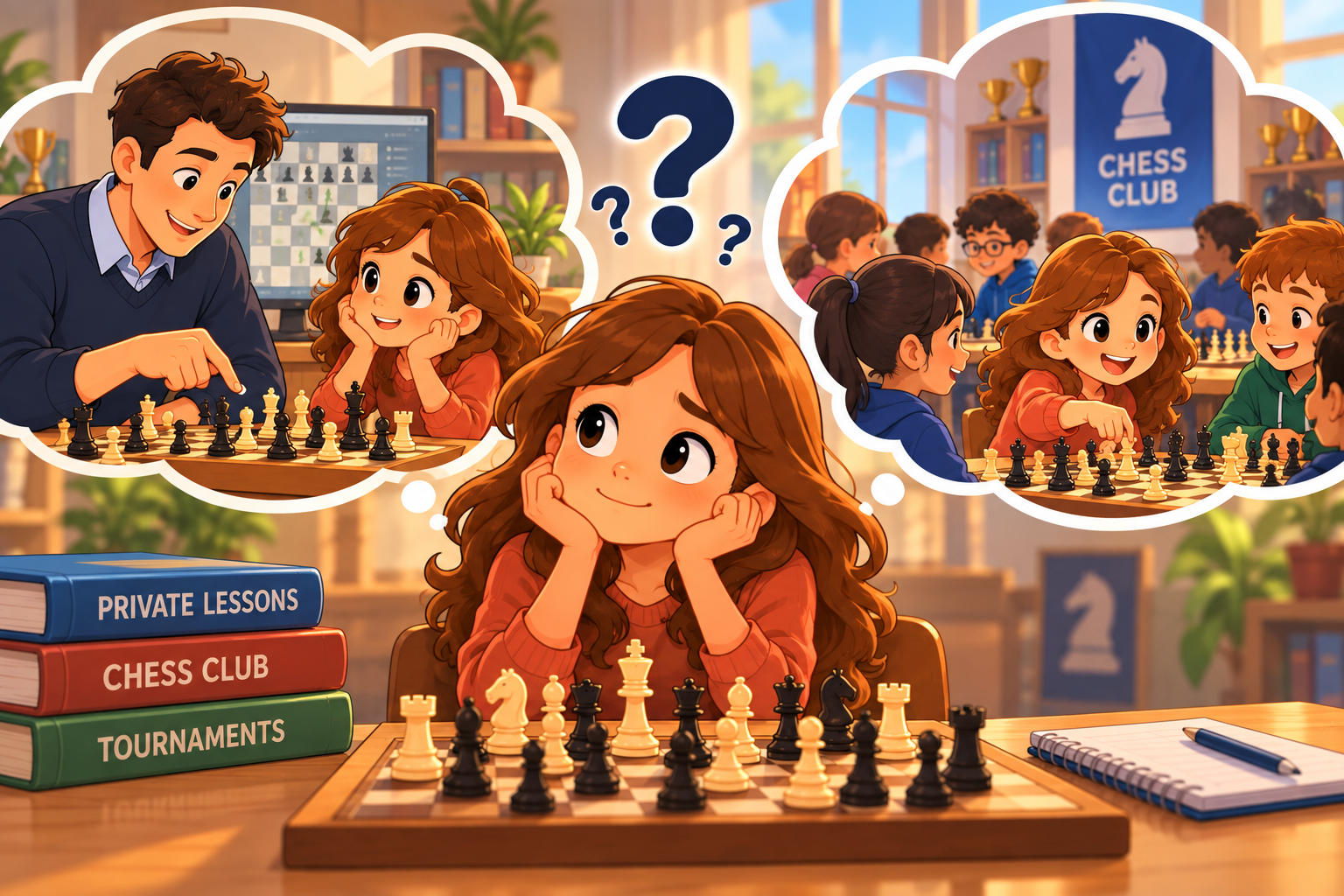
Parents quite often ask me what is better for their child: private lessons with a coach or a chess club. Usually, behind this question is a desire to find the more effective option. If the child is talented, parents do not want to waste time. If they are just starting out, parents want to organize their training correctly from the beginning.
My name is Valery Filippov. I am a chess Grandmaster and coach. In my opinion, the problem is that private lessons and chess clubs serve somewhat different purposes. So I would not really look at them as two competitors where we necessarily have to choose a winner.
A good coach can understand a child’s specific chess problems much faster. A good club provides something that is much harder to reproduce in an individual lesson: other children, real games, competition, communication, and the feeling that chess exists beyond the relationship between the student and the coach.
In an ideal situation, these two things complement each other. But not every family needs the ideal situation.
First, I Would Decide Why Your Child Needs Chess at All
I think parents sometimes skip this question.
One child plays chess simply because they enjoy the game. Another is already playing tournaments and wants to improve their rating. A third discovered chess two months ago, and the parents still have no idea whether this interest will last.
I would give different recommendations in all three cases.
If an eight-year-old child has just discovered chess and enjoys playing at home, I see no need to immediately build a professional training system around them. Sometimes a good club once or twice a week is a wonderful beginning.
If, however, the child is already playing competitions, regularly repeating the same mistakes, and genuinely wants to become stronger, the benefits of a private coach become much more noticeable. Of course, parents often wonder at this stage whether their child actually has talent for chess.
In general, I don’t particularly like the approach where the form of training is chosen before the goal is understood. First, it is worth answering the question, “What do we want from chess?” Only then should you decide who will teach the child and how.
The Main Advantage of a Private Coach Is Obvious to Me
In an individual lesson, all the time belongs to one student.
That sounds obvious, but in practice the difference is enormous.
Suppose a child calculates variations poorly, plays too quickly, and has problems with a particular type of endgame. As a coach, I don’t need to spend the next two months following a general program. I can take their tournament games, see exactly where the problems occur, and build several lessons around them.
If the problem changes three weeks later, the work changes too.
In a group, things work differently. Even a very good coach has to consider the average level of the students. The material may be too easy for one child and too difficult for another. A third may currently need to work on something completely different.
In my opinion, individual lessons become especially valuable once serious tournament practice begins. The games start to provide a fairly accurate picture. The coach is no longer working with an abstract “1400-rated child,” but with a specific player who has their own habits, strengths, and recurring mistakes.
This is where personalized work can really save a lot of time.
But a Chess Club Gives a Child Something I Cannot
I can give a good individual lesson. I can select positions, analyze games, assign homework, and prepare an opening.
But I cannot replace ten other children who come to the club in the evening to play chess.
And I consider that very important.
Chess can easily become quite a solitary activity. A child plays online, works with a coach through a computer, and solves puzzles alone. From a training perspective, everything may be organized perfectly, but gradually chess becomes just another subject. I have written separately about whether children should play chess online and how parents can approach it.
A club brings out a completely different side of the game.
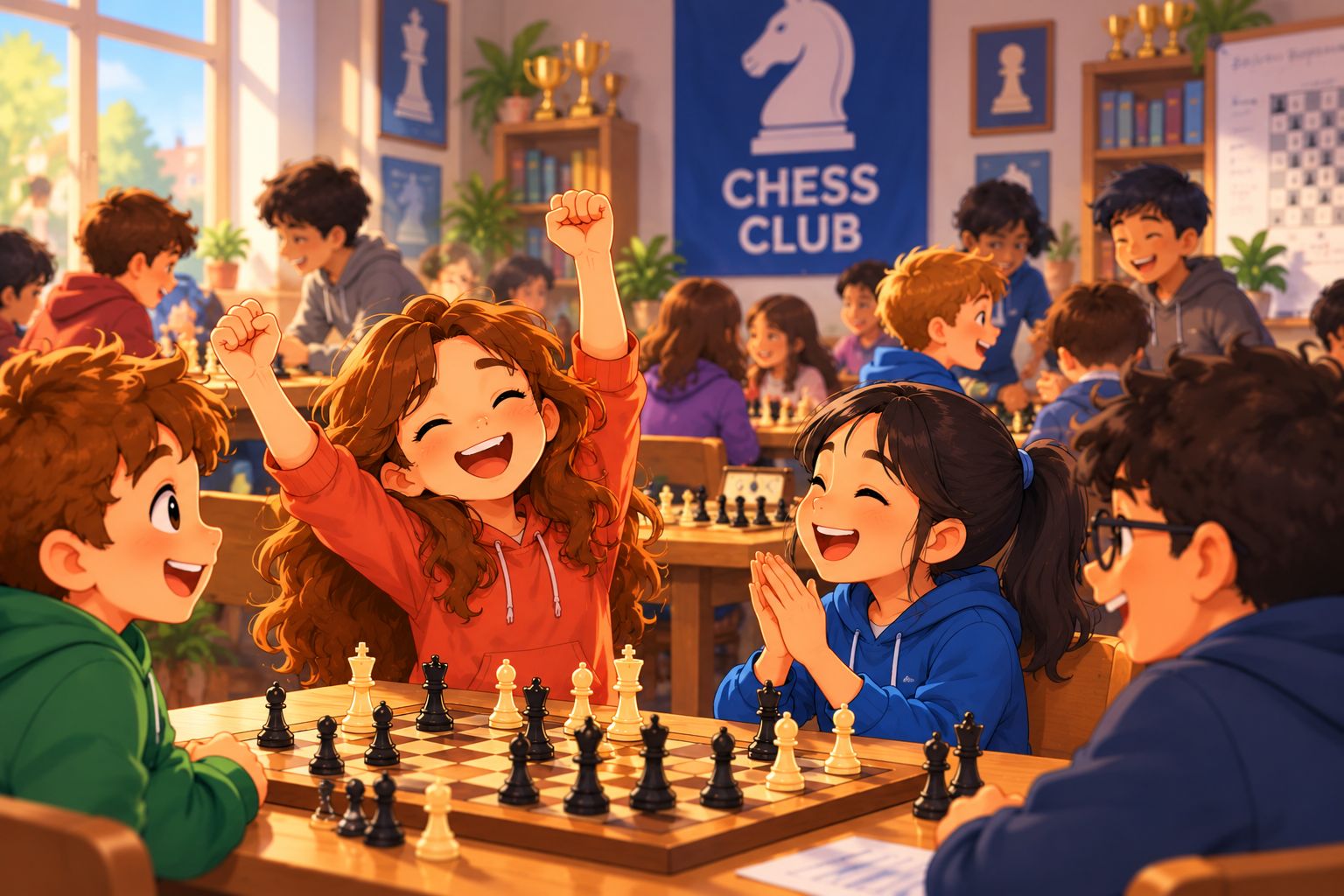
A child can play a game with a friend, immediately demand a rematch, watch stronger children play, or take part in a club tournament. Sometimes they come not because they want to study the isolated pawn today, but because their friends will be there.
I see nothing wrong with that. On the contrary, this social side can sometimes keep a child’s interest in chess alive better than a perfectly designed training program.
FIDE, in its chess education materials, also treats engagement, play, and shared activity as important parts of learning, rather than focusing only on the transfer of chess knowledge.
For a Beginner, a Club Often Seems Like a Logical First Step
If a child barely knows the rules, a high-level private coach is not always necessary.
That does not mean an individual lesson would be useless. Of course, a good teacher can establish the right foundations from the beginning. But another question is how seriously interested in chess the child actually is.
I would first give that interest a little room.
Let the child play. Let them meet other children. Let them win a few games and lose a few. After some time, it usually becomes clearer what is happening.
Do they look forward to the next session? Do they play at home without being reminded? Do they ask you to register them for a tournament? Do they start asking more difficult questions?
Then you can gradually add individual work.
It seems a little strange to me when a seven-year-old beginner immediately receives a schedule with several private lessons, mandatory homework, and serious opening preparation. Sometimes adults begin training the chess player before the child has had time to fall in love with chess itself.
For a Tournament Player, the Situation Is Different
When a child begins playing tournaments regularly, I see much more reason for individual lessons.
The reason is simple: there is now material for personalized work.
For example, over five tournaments a child loses several very similar games. They get a good position out of the opening, then start playing too quickly and miss a tactical shot. Or the opposite happens: they spend twenty minutes on obvious moves and reach the critical position with almost no time left.
In a club group, a problem like this can easily go unnoticed.
In an individual lesson, you can open those exact games and calmly work out why the situation keeps repeating. Sometimes the reason turns out to be completely different from what the parents expected.
In general, I think a good personal coach should not simply “give knowledge,” but gradually understand the individual student. How do they think? What are they afraid of at the board? Which positions make them uncomfortable? Why do they make certain mistakes again and again?
The higher the level becomes, the more important this individualization is to me.
Not Every Chess Club Is Equally Useful
The word “club” by itself guarantees nothing.
I have seen excellent clubs where children play many serious games, coaches genuinely follow their development, there are different groups according to level, and competitions are organized regularly. A child can improve very well in that environment.
But it can also be very different.
Twenty children of different levels are sitting in one room. Some are playing, some are talking, and someone has already finished the assignment and is bored. The coach physically cannot give enough attention to everyone.
Formally, the child spent two hours “studying chess.” How useful those two hours actually were is another question.
So I would choose not simply a club, but an environment. How many children are in the group? How close are they in level? Do they play against each other? Are there tournaments? Does the coach analyze their games? Can a stronger child move to another group?
For me, these questions are much more important than a beautiful club website or the number of trophies in a photograph.
A Private Coach Does Not Automatically Mean Quality Training Either
The same principle applies here.
The individual format guarantees nothing by itself. A child can study one-on-one and still spend months following a universal textbook that the teacher uses with every student.
In that case, much of the advantage of personalized training disappears.
I would expect individual work from an individual coach. They should know the child’s games, understand their main problems, and have at least a general idea of what they want to improve over the next few months.
At the same time, I don’t think every lesson has to be incredibly serious, especially with younger children. Sometimes playing a training game or analyzing a beautiful combination is more useful than spending another forty minutes following a plan written in advance.
I generally think a good children’s coach should be able to sense the moment when training starts becoming too heavy. This is especially important because even very capable young players can eventually lose interest in chess when training becomes dominated by pressure and expectations.
The Social Side of Chess Is Underrated
Parents often evaluate a lesson with a perfectly understandable question: what did my child learn today?
I would add another one: did they want to come back?
For children’s chess, this is not a small detail at all.
If a child finds two friends at the club whom they constantly play against, perhaps those friends will be the reason the child is still playing chess three years later.
A group environment also provides a natural comparison with other players. A child sees that someone knows openings better, someone solves puzzles faster, and someone they themselves have started beating.
I like this kind of competition much more when it develops naturally between children rather than when a parent shows them another ten-year-old’s rating and asks, “Why does he already have 1700?”
A good chess environment allows a child to feel part of a community. FIDE also identifies social inclusion, variety in chess activities, and accessibility as characteristics of quality educational chess programs.
Which Is More Effective for Faster Improvement?
If the question is asked exactly this way, and we compare a high-quality individual lesson with an ordinary group, I would expect faster chess improvement from personalized work.
Simply because the time is used more precisely.
But I would not conclude from this that a club is unnecessary.
A child can greatly improve their calculation and opening preparation over a year while still playing too few real games. You can have a strong student during lessons who feels uncertain in a real tournament environment.
I prefer a combination of training and practice.
The coach helps identify what needs work. The club and tournaments provide situations where those skills are tested. Then the games return to the coach, and the next cycle begins.
In my opinion, this is much more natural than studying endlessly without playing enough chess.
What If the Family Can Choose Only One?
This is where I would look primarily at the child.
For a beginner who wants to play and socialize, I would probably start with a good club. Especially if the groups are small and there are children of roughly the same age and level.
For a child who already plays tournaments seriously and wants to improve their results noticeably, I would more often lean toward an individual coach.
For a highly motivated young player with serious ambitions, I would try to combine both formats, even if the club is used mainly for practice and social interaction.
And if the child plays chess purely for enjoyment, I am not sure there is any need to aim for the most efficient possible training system at all. Sometimes one evening at a club with friends is exactly the format they need.
That is no less “real” chess.
Cost Matters Too
Individual lessons almost always cost a family more than group classes, and it would be strange to ignore that.
I don’t think parents should feel obligated to hire a private coach simply because their child shows ability.
A good club, independent study, online resources, and regular games can provide a great deal. If it later becomes clear that the child needs personalized help, private lessons can be added selectively.
Sometimes one individual lesson every two weeks combined with a club makes more sense than several private lessons every week.
The number of lessons itself does not impress me very much. I am more interested in what the child does between them and how well they can use what they have learned in actual games.
I Wouldn’t Choose Between a Club and a Coach Forever
I think parents sometimes treat this decision as too permanent.
But a child’s needs change.
At seven, a club may be perfect. At ten, their first serious coach appears. At twelve, they start playing many tournaments and add more specialized training. During another period, individual lessons may become less frequent.
There is nothing wrong with that.
Chess training does not have to look the same year after year. In fact, I would be more concerned if a child’s program never changed along with their age, level, and interests.
The Best Option Is the One That Makes the Child Want to Continue
If we put ratings, cost, and scheduling aside, I am left with a fairly simple criterion.
A child should become stronger, but preferably not at the cost of wanting to play.
A private coach can provide direction, correct specific problems, and noticeably accelerate progress. A club can provide practice, friends, competition, and a sense of belonging to a chess environment. These benefits really are different.
That is why I rarely tell parents simply, “Choose a coach” or “Join a club.”
First, I would look at the child’s age, level, personality, and goals. Then I would try one format. See how they respond. Add the second one if necessary. When tournament play becomes part of that process, I also think parents should know how to prepare a child for their first chess tournament and how to react when a child hates losing at chess.
With children, it is generally too easy to start optimizing chess. More lessons, a stronger coach, more tournaments, faster rating growth.
But sometimes the most useful sign that you chose the right format is much simpler: after the lesson, the child comes home, takes out the board, and wants to play one more game.
♟ Article prepared by Grandmaster and chess coach Valery Filippov ♟
📖 Continue Improving Your Chess:
▸ How to Help Your Child Improve Faster at Chess
▸ Everything Parents Need to Know About Chess
▸ How to Get Better at Chess: A Complete Step-by-Step Guide
FAQ
1. How often should a child have private chess lessons?
There is no schedule I would recommend to every child. One lesson a week can be perfectly sufficient for many players. Some serious tournament players may benefit from more. I would rather have one useful lesson followed by good independent work than three lessons the child barely has time to absorb.
2. How can I tell if a chess club is good for my child?
I would watch what actually happens during the sessions. Are children playing serious games? Are the groups reasonably close in level? Does the coach pay attention to individual players? Most importantly, does your child enjoy going there? A famous club name tells me much less than these things.
3. Is an expensive private chess coach worth it for a beginner?
Not always. A highly qualified coach may be excellent, but a seven-year-old who learned how the knight moves last week probably does not need sophisticated tournament preparation. I would first think about what the child actually needs at their current stage.
4. What if my child enjoys the chess club but is not improving very quickly?
I would not immediately take them out. If they love going to the club, that has value of its own. You can add occasional private lessons to work on specific chess problems without removing the part of chess that the child genuinely enjoys.
5. How do I know whether private lessons or a chess club are working?
I would look beyond rating alone. Is the child making better decisions during games? Are old mistakes becoming less frequent? Are they becoming more independent? And there is one question I consider especially important: after months of training, do they still want to play chess?