What Every Online Player Should Know Before Playing OTB
Over the past few years, I have been meeting more and more chess players who learned the game almost entirely online. They may have 1600, 1800, or even 2000 on Chess.com or Lichess, have played thousands of games, know modern opening variations, solve tactics quickly, and yet have never played in a regular over-the-board tournament.
My name is Valery Filippov. I am a chess Grandmaster and coach. And when a player like this asks me whether they are ready for their first OTB tournament, my answer is usually yes. But I almost always give them one warning: don’t expect it to be simply Chess.com with wooden pieces.
Chess remains the same game. The knight still moves in an L-shape, an extra pawn is still an extra pawn, and blundering your queen is equally unpleasant on a screen and over the board. But the actual process of playing changes much more than many people expect.
In my opinion, this is exactly what makes the first OTB game so interesting. It shows a chess player things they may never have thought about during several thousand online games.
Your Online Rating Promises Almost Nothing Over the Board
The first thing I would try to get rid of is the desire to convert your online rating into a FIDE or national rating in advance.
“I have 1900 on Chess.com. What would that be in FIDE?”
I get this question all the time.
Of course, there is some correlation. A player with 2200 online will usually play stronger chess than someone with 1200. But there is no exact formula here and, in my opinion, there cannot be one. I have explained the differences between the main systems in more detail in my article about the chess rating system.
The rating systems are different, the player pools are different, and the time controls are different. Even the same person can have noticeably different rapid, blitz, and bullet ratings on the same platform.
But there is another reason that I find more interesting. Online and OTB chess require slightly different practical skills.
A player may feel completely comfortable in 10+0 rapid, make decisions quickly, and use the familiar interface naturally. Then they arrive for a 90+30 classical game and suddenly discover that they have to sit at a real board for five hours and maintain concentration entirely on their own.
Another person, on the other hand, may not look particularly impressive online because they are not good at playing quickly. But over the board they are patient, careful, enjoy thinking for a long time, and do not get tired of a four-hour game.
So I would treat your online rating as approximate information about your playing strength, not as a promise of a particular result.
A Real Chessboard Really Does Look Different at First
This is one of those things that is difficult to explain until you experience it yourself.
On a screen, the entire position is contained within one visual field. The pieces are flat, always the same size, and the board is perfectly positioned. You can see practically the entire position in a fraction of a second.
On a real board, the pieces are three-dimensional. Some partially block others. The board may be large. You are looking at it from an angle rather than directly from above.
And suddenly a familiar position feels slightly different.
I have seen fairly strong online players miss extremely simple moves in their first live games. Not because they did not understand the tactics. They literally saw the board less clearly. This is one reason why I consider proper tactical training in chess more useful than simply solving thousands of positions as quickly as possible.
This happens particularly often with long diagonals, long rook moves, and pieces on the opposite side of the board.
I don’t consider this a serious problem. The brain adapts fairly quickly. But I definitely would not recommend sitting down at a physical chessboard for the first time in several years during the first round of a tournament.
A week or two before the event, play several normal games with real pieces. Preferably with a clock.
Even if your opponent is a friend who plays considerably weaker than you, it will still be useful.
Online, You Cannot Accidentally Make an Illegal Move
This seems like a small detail until you sit down at a real board.
An online platform will not allow you to put a bishop on the wrong square. It will not let you leave your king in check. Castling through an attacked square simply will not happen.
The software is constantly doing part of the work for you.
Over the board, that protective mechanism is gone.
Under FIDE rules, the player moves the pieces themselves, and the physical action matters. A move must also be made with one hand.
I think it is useful to get used to one simple idea in advance: now you are the interface.
You have to move the piece correctly, press the clock, and keep track of what is happening on the board. It becomes automatic quite quickly, but the first few games can feel surprisingly mechanical.
That is why I would not limit preparation to openings. Sometimes twenty minutes of practice with a real board and clock before your first tournament is more useful than reviewing one more Najdorf variation.
Touch-Move Is Not Natural at All for an Online Player
Online, you can click on a piece, change your mind, and choose another one. On some platforms, you can even drag pieces around the screen until you release the mouse button.
Over the board, touching a piece is treated differently.
Under FIDE rules, if a player deliberately touches one of their own pieces, they must move the first such piece that can legally move. If they deliberately touch an opponent’s piece that can be captured, they must capture it. If you simply want to adjust a piece, you should announce your intention beforehand, for example by saying “j’adoube” or “I adjust.”
For an experienced tournament player, this is so normal that they do not even think about it.
For someone coming from online chess, I would turn it into a separate habit: first decide what you want to play, and only then touch the piece.
Don’t keep your hand over the board while physically going through possible moves.
In my opinion, this is actually useful for the quality of your chess. It creates a small boundary between thought and action. Until you touch the piece, you can still check your decision.
You Will Have to Press the Clock Yourself Too
Online, after you make a move, your opponent’s time starts automatically.
Over the board, you have to complete your move and switch the clock yourself.
It sounds elementary. And after a few games, it really does become elementary.
But in their first tournament, online players regularly forget to press the clock. Sometimes only a few seconds pass, sometimes much longer before they notice that their opponent is thinking on their time.
There is another detail: under FIDE rules, each move must be made with one hand, and the same hand is used to press the clock.
I would play at least a few practice games beforehand using a very simple sequence:
think, make the move, press the clock.
It should become automatic.
This is especially important before rapid and blitz tournaments, where an extra five seconds can already matter.
In Classical Chess, You Will Have to Record the Game
For many purely online players, this is the most unfamiliar part of all.
On a website, you do not have to write anything down. The platform automatically saves every move and the time on the clock. After the game, you click the analysis button and get a complete PGN.
In classical OTB chess, a paper scoresheet usually appears.
Under FIDE rules, during the game players are generally required to record their own moves and their opponent’s moves in algebraic notation on the scoresheet provided by the organizers, or use an approved electronic scoresheet. The rules also include exceptions, particularly in situations where a player has very little time remaining.
I recommend learning to record a game before the tournament.
Not simply knowing what Nf3 or Qxd5 means, but actually playing a complete practice game and writing it down.
At first, the process interferes with your thinking a little. You make a move, press the clock, write it down, your opponent replies, and then you have to record their move too. After a while, it becomes background activity.
And I see a positive side to this. A scoresheet forces you to slow down slightly. For some online players, that can actually be useful.
Don’t Bring Your Online Decision-Making Speed Into Classical Chess
This is perhaps one of the biggest problems.
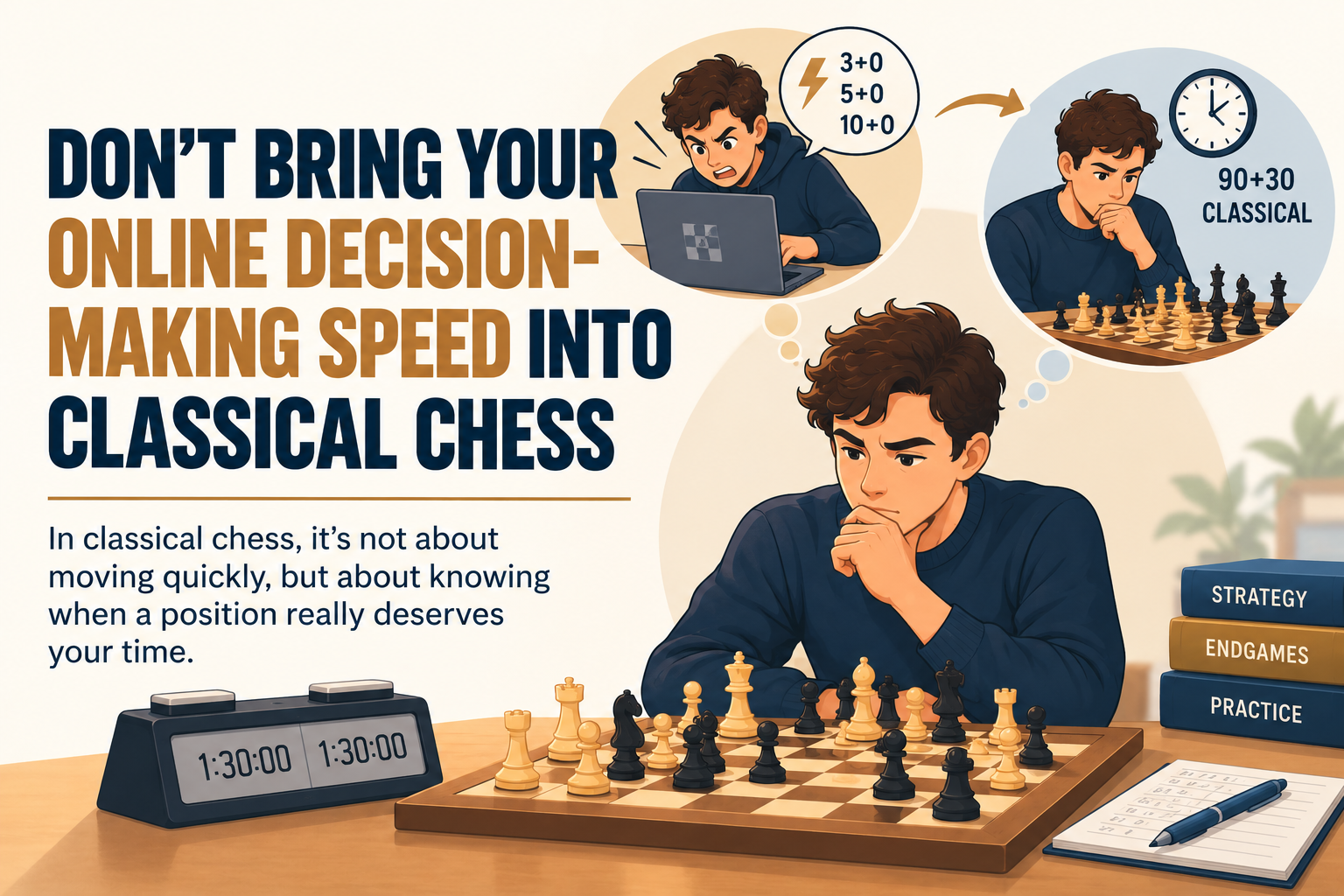
A player has played 20,000 games at 3+0, 5+0, and 10+0. They have developed an excellent ability to find reasonable moves quickly. This is also one of the reasons I have written separately about why blitz chess can be bad for improvement.
But classical chess demands something different.
If you have an hour and a half for the game, there is very little point in finishing with an hour and ten minutes still on your clock after missing a combination on move 24.
I see this very often in players who grew up online.
They don’t feel that they are allowed to think for five or ten minutes about one position. After forty seconds, an internal feeling appears: “Well, I need to make a move already.”
No, you don’t.
If the position is critical, think.
In my opinion, one of the most important skills in classical chess is not only calculating variations, but understanding when it is actually worth spending time.
Sometimes an obvious developing move deserves thirty seconds. Sometimes one decision on move 25 determines the entire game and deserves fifteen minutes.
Fast online time controls barely develop this sense of time at all.
But Don’t Go to the Opposite Extreme Either
After hearing the previous advice, some players make the opposite mistake.
They decide that because this is classical chess, absolutely everything has to be analyzed.
On move six, someone begins a twenty-minute investigation of a position they have seen dozens of times. By move 30, they have five minutes left.
I don’t think a good classical game necessarily means playing slowly.
It means using your time intelligently.
Simple decisions can be made quickly. Critical positions require you to stop.
This is much more difficult than it sounds, and usually comes only with tournament experience.
There Are No More Premoves
It sounds funny, but online habits really do sometimes transfer to the board.
FIDE’s online regulations explicitly allow premoves if the playing platform supports the feature. A move is entered in advance and executed automatically after the opponent’s move if it remains legal.
In ordinary chess, of course, nothing like this exists.
But the real problem is not the premove itself. The problem is the style of thinking it can sometimes create.
A player sees an almost obvious reply from the opponent and internally makes their next move already. The opponent plays something different, but the hand still reaches for the piece.
I would pay particular attention to this in simple positions. Every opponent’s move deserves at least a quick check: what changed?
Sometimes the “obvious” move contains a threat you were not expecting.
Your Opponent Is Now Sitting Right in Front of You
And that changes the psychology of the game.
Online, you have a username and an avatar in front of you. You may have no idea about the person’s age, gender, or nationality. After the game, you click New Game, and a few seconds later another opponent appears.
Over the board, there is a real person sitting in front of you.
They may be much younger than you. They may be much older. They may look incredibly confident. They may arrive wearing their chess club uniform and carrying a stack of scoresheets from previous rounds.
Sometimes that alone is enough for an online player to assign their opponent a strength they may not actually have.
This works particularly amusingly with children.
An adult online player rated 1900 comes to a tournament and is paired with a twelve-year-old child. Online, they would calmly play against an account like that. Over the board, a thought appears: “If this kid is playing in a tournament like this, they must be some incredible talent.”
And then the adult starts playing not against the position, but against their own imagination of the opponent.
I consider this one of the most useless things you can do in tournament chess.
There are 16 pieces in front of you. Your opponent has 16 as well. Start with the position.
Your Opponent’s Rating Feels More Powerful Over the Board
Online, you can play five games in a row against people stronger than you and barely pay attention to it.
OTB, you see the pairings in advance. Then you find your opponent’s name. Then the rating.
“They have 2127. I have 1780.”
And you can spend the next half hour thinking about something other than chess.
I would try to minimize the importance of this information.
A rating is useful as a statistical description. But it does not make moves.
A strong opponent can make a mistake. A weaker one can play a brilliant game.
I have seen countless games where someone gets a winning position against a much higher-rated player and then starts thinking: “There is no way I can actually be winning here.”
You can.
Trust the board a little more than the number next to the name.
Mistakes Feel Heavier Over the Board
Blundering a piece online is unpleasant. But ten seconds later, you can start another game.
A classical tournament is different.
You traveled to the playing hall. You waited for the round to begin. You prepared. You played for two hours. You got an excellent position.
And then one move ruined everything.
There is no next game ten seconds later. Sometimes the next round is tomorrow.
That is why a loss feels much heavier emotionally.
I would accept this in advance as part of the experience. Not every tournament game will be good. Sometimes you will lose to someone weaker than you. Sometimes you will miss an elementary tactic. Sometimes you will ruin a position the engine evaluates as +5.
Nothing extraordinary happened.
If you treat every loss OTB as an exam of your “real chess strength,” tournament chess can become unpleasant very quickly. For parents bringing a young online player into live competition, I have also written a separate guide on how to prepare your child for their first chess tournament.
Don’t Analyze the Previous Game During the Next Round
After a loss, the brain likes returning to the mistake.
“Why did I move the rook?”
“There was such a simple tactical shot.”
“How could I not see that?”
And twenty minutes later, the next game begins.
In my opinion, this requires a fairly strict internal switch. The previous game is over. The analysis can happen later.
Your new opponent does not have to pay for the mistake you made in the previous round.
And I especially would not recommend opening an engine between rounds and spending ten minutes looking at how terrible your move was. Stockfish is not going anywhere. In the evening, it will happily tell you about all your mistakes.
During a tournament, it is sometimes more useful to eat something, go outside, and forget about chess completely for twenty minutes.
Your Phone Is No Longer Just a Phone at an OTB Tournament
For an online player, a smartphone is a natural part of chess life. Chess.com, Lichess, Stockfish, opening databases, messages, and tournament information are all there.
During a live game, electronic devices are treated very differently.
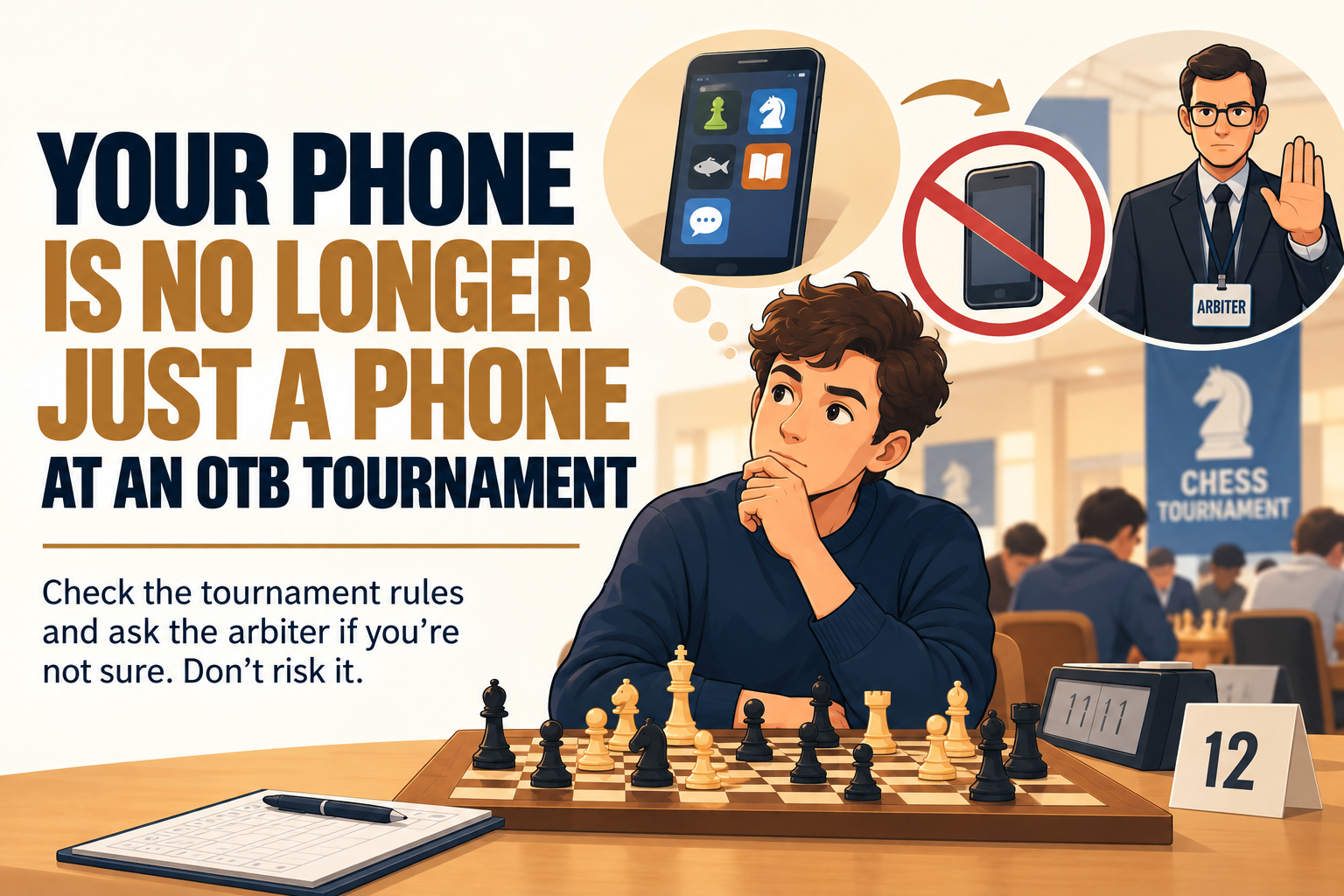
FIDE rules prohibit players from having an electronic device in the playing venue unless it has been specifically permitted by the arbiter. The regulations of a particular tournament may allow a completely switched-off device to be stored in a bag in a designated place approved by the arbiter.
So before your first tournament, I would definitely read the regulations for that specific event.
Don’t rely on the fact that “my friend kept his phone in his backpack at another tournament.”
The rules of a particular event may be different.
And I would not experiment here at all. If you don’t know where to put your phone, ask the arbiter before the game starts.
That is much more pleasant than discovering the rule after a problem has already occurred.
The Arbiter Is Not There Only for Professionals
For some reason, beginners are sometimes afraid to call the arbiter.
Something strange happens. The opponent claims one thing, you think something else. The clock is running. And the player tries to remember a rule from an article they read three months ago.
I think this is completely unnecessary.
If there is a problem, stop the clock when the rules allow you to do so and call the arbiter. Don’t spend ten minutes arguing with your opponent.
That is exactly why the arbiter is in the playing hall.
Your job is to play chess, not conduct a legal investigation at the board.
It is useful to know the basic rules before a tournament, but I definitely would not try to memorize the entire FIDE rulebook.
A Draw Feels Different Over the Board
Online, the Offer Draw button is almost emotionally neutral.
In person, you are making the offer to someone sitting directly across from you.
For some reason, this makes some beginners uncomfortable.
They offer a draw in a completely lost position simply because they want the game to end. Or, on the contrary, they are afraid to offer one in a completely equal endgame.
I would treat a draw offer as a normal chess decision.
If the position gives you reasonable grounds to offer a draw, offer it. If your opponent declines, the game continues.
There is no need to take the refusal personally.
And I would especially advise against offering a draw every five moves. That can become annoying for your opponent, and FIDE rules explicitly prohibit unreasonable repeated draw offers as a form of distraction.
Physical Endurance Matters More Than You Might Expect
Four or five hours at the board is tiring in a different way from several hours of chess at home.
At home, you can get up, open the refrigerator, change chairs, or look at your phone between games.
At a tournament, you have to maintain concentration inside one long game.
By the third or fourth hour, the quality of your decisions may decline not because the position has become more difficult, but simply because you are tired.
So I would not underestimate completely ordinary things.
Get enough sleep. Eat before the game. Bring water if the organizers allow it. Don’t arrive at the playing hall two minutes before the round after running across the city for an hour.
There is a reason strong chess players take these things seriously.
A brain that calculates variations for four hours gets tired too.
The Silence of a Tournament Hall Can Be as Distracting as Noise
It sounds paradoxical.
Many online players are used to playing at home. There may be music, YouTube, conversations, or notifications in the background.
Then they enter a hall where a hundred chess players are sitting and almost nobody is speaking.
You hear clocks, coughing, footsteps, chairs moving.
Some people love this atmosphere. Others find it surprisingly stressful.
Then the opponent who keeps standing up starts to annoy you. Or the person at the next board is shaking their leg. Or someone places the pieces too loudly.
I would not try to achieve perfect conditions.
The tournament hall never belongs entirely to you. The ability to bring your attention back to your own board is also part of practical chess skill.
Don’t Prepare the Opening as If You Were Playing a World Championship Match
Another first-tournament trap appears when the pairings are published.
An online player sees the opponent’s name, finds their games, opens a database, and starts building an enormous preparation.
Sometimes this is useful. But at amateur level, I would not overestimate this kind of work.
Your opponent may play another variation. They may change their opening. They may do something on move two that was nowhere in your preparation.
And then twenty prepared lines disappear, but you still have to play chess.
Before a first OTB tournament, I much prefer knowing your own repertoire well to trying to predict every move of every opponent.
Preparation should give you confidence, not create the feeling that the game has already gone wrong because your opponent played 4.h3 instead of the expected 4.Nf3. More generally, I think players benefit much more from understanding how to build a chess training plan than from trying to prepare everything at once before a single event.
Don’t Look at the Computer Immediately After Every Game
This is a habit that online chess has made almost automatic.
The game ends. You click Analysis.
A second later, you already know that 18…Re8 was +0.4, 18…Nd5 gave +1.7, and on move 27 you missed a win.
Over the board, I would sometimes do it differently.
First, try to analyze the game yourself or with your opponent. Where did you start feeling uncomfortable? What were you calculating? Which move surprised you?
Only then turn on the engine. I have described this process in much more detail in my guide on how to analyze chess games.
I think this gap between the game and Stockfish is especially valuable. You still remember your own thoughts, but the computer has not yet told you the “correct answer.”
If you see the evaluation immediately, it becomes very easy to explain the position with hindsight.
Your First OTB Game Will Not Show Your Real Strength
And your first tournament probably won’t either.
You will be getting used to the board, the clock, the scoresheet, the playing hall, the opponents, and a completely different length of game.
Perhaps you will play below your normal level.
Or perhaps you will discover that classical chess suits you much better than fast online games.
I would not draw major conclusions from either outcome.
Give yourself a few tournaments.
Online chess develops a huge number of skills and gives us the opportunity to play more games than previous generations of chess players could ever have imagined. But OTB adds a different kind of depth to the game. There is the physical presence of the opponent, responsibility for every move, long periods of concentration, and the feeling that a single game genuinely occupies part of your day.
I still like that much more than any online game.
The Most Important Difference Is Not in the Rules
Before your first tournament, you can learn touch-move, practice pressing the clock, learn how to keep score, and read the tournament regulations. All of that is useful.
But the main change, in my opinion, happens in your attitude toward the game itself.
Online, there is always more chess.
Lost? A new game starts ten seconds later.
Don’t like the position? Play another one.
Tired? Close the tab.
Over the board, a game has weight. You travel to the playing hall for it. You sit down across from a specific person. You think for two, three, four hours. You record every move. Sometimes you remember individual moments from that game for years.
That is exactly why I would not be afraid of moving from online chess to OTB.
On the contrary, if you have played thousands of games online and genuinely love chess, it seems almost strange to me never to try the game in the form in which it existed for centuries. This is something I often see with adult students as well, and it is one of the practical issues I discuss when explaining how I help adult chess players improve faster.
You don’t need to wait until your rating is high enough. You don’t need to learn your openings perfectly first. And you certainly don’t need to be afraid of looking like a beginner because you forgot to press the clock or didn’t immediately understand where to put your scoresheet. The same principle applies to training in general: before spending money simply because you feel inexperienced, it is worth asking whether you really need a chess coach as a beginner.
Every tournament player once sat down at a real chessboard for the first time.
After a few games, the pieces will stop feeling unfamiliar, recording the moves will stop getting in the way, and the clock will become an automatic part of your hand movement. And then what remains is the reason you started playing in the first place.The position in front of you, the opponent across the board, and the need to decide for yourself what move to make next.
♟ Article prepared by Grandmaster and chess coach Valery Filippov ♟
 Continue Improving Your Chess:
 Continue Improving Your Chess:
▸ How to Stop Blundering in Chess: A Practical System to Eliminate Simple Mistakes
▸ How to Reach a 1500 Rating on Chess.com as an Adult
▸ How to Get Better at Chess: A Complete Step-by-Step Guide