The First 3 Things I Fix When Working With a New Student
When a new student comes to me, I almost never start with the question, “Which opening do you want to study?”
In my opinion, this is one of the most overrated questions in chess training. Of course, openings are important. Sometimes they really do require urgent work. But after many years of coaching, I have noticed that most chess players do not lose points because they failed to remember a computer recommendation on move eight.
Usually, the problem is much closer.
A player thinks incorrectly at the board. They do not notice the opponent’s threat. They start calculating a variation before identifying candidate moves. They make a move too quickly. Or, on the contrary, they spend ten minutes in a position where the decision is fairly simple, and then play the critical stage of the game with almost no time left.
My name is Valery Filippov. I am a chess grandmaster, and I have been working with chess players of different levels for many years. Among my students, there have been both beginners and fairly strong tournament players. And the more I teach, the less I want to start working with a new student using some kind of pre-prepared program.
First, I need to understand how this particular chess player makes decisions.
That is why the first lessons are, to some extent, a form of diagnosis for me. I look at games, ask questions, give positions to calculate, and gradually try to find the habits that interfere with the player’s chess the most.
And although every student is different, there are three things I return to especially often.
1. First, I Fix the Decision-Making Process Itself
In my opinion, this is the most important part.
Quite often, a student comes to me with a rating of 1200, 1600, or even 1900 and says something like, “I need to improve my tactics,” or “My openings are bad.”
Sometimes they are right. But much more often, I see a different picture.
The player simply does not have a stable thinking process at the board.
They look at the position, notice an attractive move, and almost immediately begin calculating it. If the variation looks good, they play the move. Then it turns out that there was a much stronger candidate move that they never considered at all.
I consider this habit much more dangerous than not knowing a specific opening variation.
An opening mistake can often be fixed fairly quickly. We look at the game, find the problem, and study the necessary position. But a poor decision-making process will follow the player everywhere. It will appear in the Sicilian Defense, the Queen’s Gambit, an endgame, and even in a simple tactical position.
That is why, during the first lessons, I often ask the student not simply to find the best move, but to explain what they are thinking.
What did you notice first?
Which moves are you considering?
What does your opponent want to do?
Why do you like this candidate move?
What will change after the exchange?
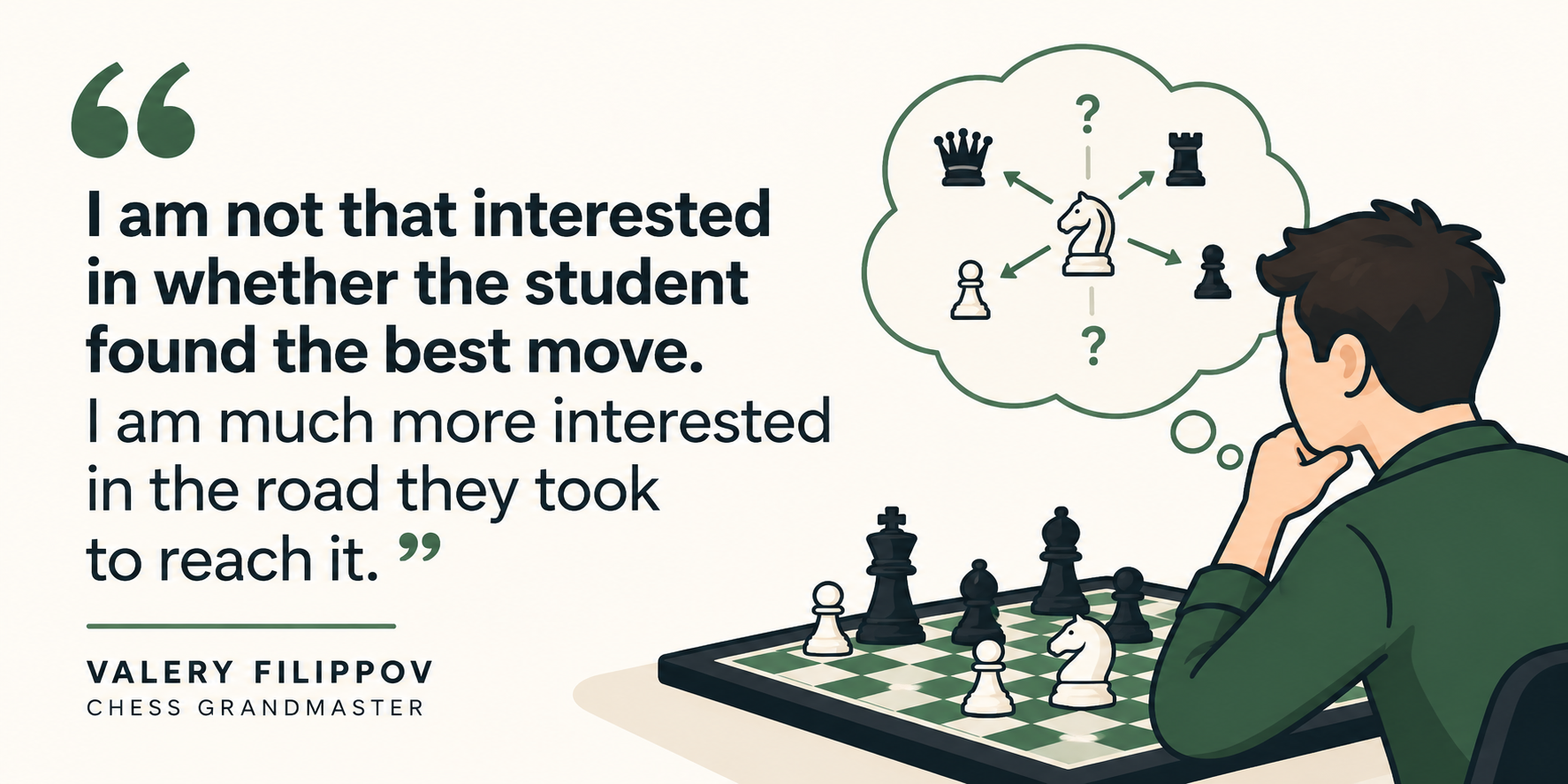
I am not that interested in whether the student guessed the best move. I am much more interested in hearing the road they took to reach it.
Sometimes a student gives the correct answer, but I do not like their reasoning at all. And the opposite can also happen. They may make a mistake at the end of a difficult variation, but before that, their thinking was very good. From a coach’s point of view, I actually prefer the second situation. A calculation mistake can be corrected. It is much worse when the correct move was found almost by accident.
This is also why I consider a structured approach to calculating in chess without missing tactics much more useful than simply trying to calculate deeper.
One of the most common problems here is that a chess player falls in love with the first good move too quickly.
They see a check and start calculating the check. They see an opportunity to attack the queen and immediately begin examining it. They see a beautiful sacrifice, and for the next five minutes, nothing exists except that sacrifice and the hope that the combination works.
I notice this especially often among players who play a lot of fast chess online.
They develop a good ability to recognize familiar ideas quickly, and this is certainly a useful skill. But sometimes, together with that skill, they develop an unpleasant habit of treating their first impression as the final decision.
In blitz, this can work.
In a serious game, I do not like this approach at all.
I want the student, at least at critical moments, to be able to stop and look at the position a little more broadly. This does not mean turning into a machine and making a list of seven candidate moves on every turn. That is another extreme. But the habit of asking yourself, “Is there anything stronger here?” can already change a huge number of games.
So the first thing I try to build is a more reliable decision-making process.
Not a list of twenty rules that the student will forget a week later, but a few questions that gradually become a natural part of their thinking.
2. Then I Look for Repeated Mistakes, Not the Most Beautiful Ones
After several games, I usually begin to see a much more interesting picture.
Almost every chess player has their favorite mistakes.
Some players regularly start attacking too early. Some really dislike retreating and prefer questionable activity to calm defense. Some automatically exchange pieces when they are under pressure. Another player, on the contrary, avoids exchanges even when those exchanges would clearly benefit them.
These repetitions are what interest me most.
Imagine that a student sends me ten games. In one of them, on move 27, they missed a beautiful combination involving a rook sacrifice. Of course, we can analyze it. It is interesting, impressive, and looks good during a lesson.
But if in seven games out of ten they missed simple ideas from their opponent, I would rather spend our time on that.
I think a coach sometimes has to resist the temptation to show the student the most beautiful material.
Beautiful chess material easily creates the feeling of a productive lesson. We looked at an impressive combination, found a strong move, and the student was surprised. But will that change their next tournament game?
Not always.
If, instead, we discover a specific recurring habit and begin correcting it, the effect may look much less impressive, but it can be far more useful.
This is one reason I believe learning how to analyze your own chess games is so important. A single mistake may be accidental, but the same type of mistake appearing again and again usually tells us something much more useful.
For example, I quite often see players who immediately start thinking about their own plan after every move by the opponent.
The opponent plays Rf8.
“Okay, how should I continue my attack?”
But I would first like to hear a different question:
“Why did they play Rf8?”
To me, this is one of the fundamental differences between a weaker player and a stronger practical player. A strong chess player does not necessarily calculate everything ten moves ahead. But they are much more likely to notice that something in the position has changed and try to understand the meaning of the opponent’s last move.
The same problem often appears when a player does not really know how to make a plan in chess and starts choosing moves without connecting them to the demands of the position.
Another common example involves exchanges.
Some students see an opportunity to exchange pieces and treat it almost as a neutral action. “I can exchange my bishop for the knight.”
Fine. But why?
What will remain after the exchange?
Which piece will become stronger?
Which pawn will become weaker?
Who benefits from getting closer to the endgame?
I would much rather teach a player to ask these questions than show them twenty correct exchanges in a single lesson.
That is why, after looking at the first few games, I usually try to identify two or three recurring problems. Not ten and not fifteen.
If you tell a student everything they are doing wrong at once, you may end up with a very accurate analysis and fairly poor teaching.
A person needs the opportunity to actually change a habit.
And I would rather correct one serious problem that appears in every second game than five rare mistakes, each of which looks more interesting.
This is also why I think many players who are trying to improve at chess spend too much energy fixing isolated mistakes instead of looking for the patterns behind them.
3. The Third Thing I Fix Is the Player’s Relationship With Time
This problem is so common that sometimes I can roughly imagine a player’s level simply by looking at how they use their time during a game.
I do not believe there is some ideal number of minutes that should be spent on each move. Chess is far too varied for that. Sometimes a strong move really should be played in ten seconds. Sometimes it is useful to spend fifteen minutes on the next decision.
The problem begins when the amount of time spent has no connection to the difficulty of the position.
A student may spend seven minutes choosing between two natural moves in a quiet position, and then, a few moves later, spend thirty seconds on a decision that completely changes the character of the game.
For me, that is a warning sign.
Even worse is when someone plays almost the entire first half of the game at the same speed they are used to playing online. This happens especially often with chess players who are moving from a lot of rapid and blitz chess into classical tournaments for the first time.
There are two hours on the clock, and after twenty moves they still have one hour and forty-five minutes left.
Sounds wonderful.
Except the position is already lost.
In situations like this, I usually say that the clock is not there so you can take the remaining time home with you.
If the tournament gives you two hours for a game, it is probably a good idea to use that resource.
But there is also the opposite problem. Some players hear the advice “think longer” and start turning every move into a philosophical problem.
I do not like that either.
The goal is not to spend more time. The goal is to learn when time is actually necessary.
I try to teach students to recognize critical moments.
Has the pawn structure changed?
Has direct contact between the pieces appeared?
Is there an opportunity for a forcing variation?
Do you need to choose between several fundamentally different plans?
Did your opponent make an unexpected move?
This is probably the moment to stop and think.
But if you simply need to make an obvious developing move in a familiar position, spending ten minutes calculating may just be a waste of a resource.
I think good time management is closely connected to the quality of a player’s thinking. A player who understands which decisions are important usually begins to use the clock more sensibly as well. That is why I rarely treat time management as a completely separate subject. To me, it is more of a reflection of how well the player understands what is happening on the board.
The same thinking process is closely connected with learning how to stop blundering in chess, because many avoidable mistakes happen when a player makes a decision before giving the position the attention it deserves.
Why I Don’t Start by Completely Rebuilding a Student’s Openings
I think openings deserve a separate mention here because many new students expect exactly that.
A player comes to a grandmaster and, quite logically, thinks: now we are going to build a serious opening repertoire.
Sometimes that really is necessary. If I see that a student regularly gets bad positions after ten moves, of course it would be strange to ignore it.
But I usually do not rush to completely rebuild a student’s openings during the first lessons.
First, I want to understand what kind of positions actually suit them.
One student feels perfectly comfortable in open positions but suffers in slow structures. Another loves space and attacking chess. A third says they want to play aggressively, but their games show that they make much better decisions in quiet positions.
I think it is a mistake to give the same repertoire to every chess player of the same rating.
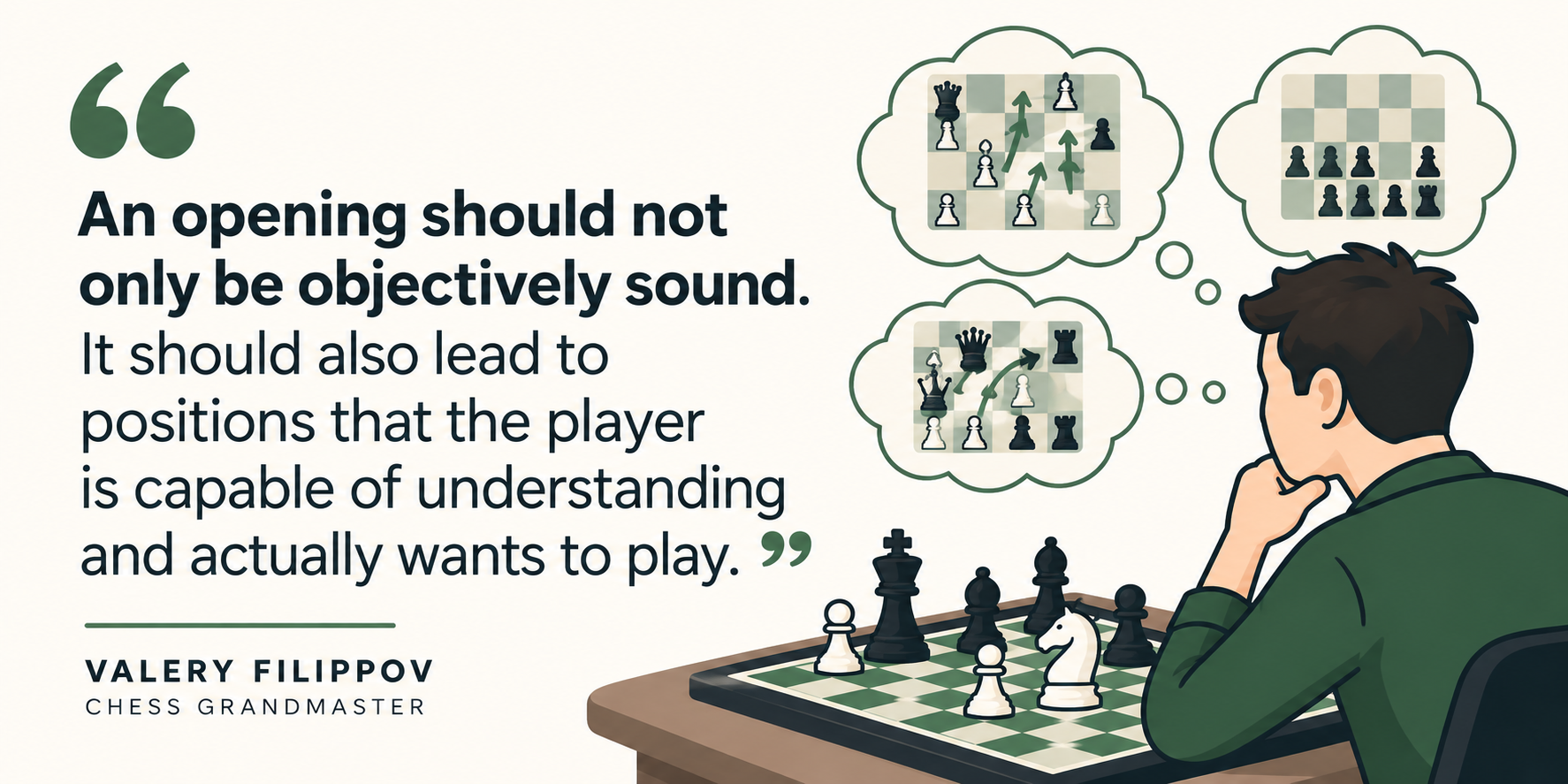
An opening should not only be objectively sound. It should also lead to positions that the player is capable of understanding and actually wants to play.
To know that, I first need to get to know the chess player.
The First Lessons Are More About Diagnosis Than Treatment
Sometimes a new student expects that after the very first hour, they will receive a huge list of materials, a new opening system, and a six-month training program.
I understand that desire. When someone decides to take chess seriously, they want to start immediately.
But I prefer to wait a little.
I need to look at several games. Preferably not only wins and not only the most beautiful games. Lost games often tell me much more about a chess player.
I need to see how the person solves positions without hints. I need to hear their reasoning. I need to understand what happens when they do not know what to do.
Only after that does it make sense to build a serious plan.
In general, I am fairly cautious about universal training programs. A plan like “first month tactics, second month openings, third month endgames” looks neat, but real chess players are not quite that neat.
One person really does urgently need tactics. Another player with exactly the same rating needs to stop destroying their own position with unnecessary pawn moves. A third solves puzzles very well but cannot calculate variations in a real game at all, because in a puzzle they already know that there must be a combination somewhere.
A rating number does not tell you everything.
This individual approach is also one of the things I think a beginner should consider when deciding how to choose a chess coach. A training plan should respond to the player in front of the coach, rather than simply follow the same template for everyone.
What I Want to See After the First Few Weeks
I do not expect a student to suddenly gain 200 rating points after three lessons.
In fact, I would be concerned if the entire evaluation of our work were based only on short-term rating changes. Chess results are far too unstable for that.
I am much more interested in seeing small changes in the student’s games.
The student has started noticing the opponent’s ideas more often.
Before an important decision, they consider several candidates.
They no longer automatically play the first attractive move they see.
They have started to understand which positions require a serious investment of time.
After the game, they can explain where the problems began.
For me, these are very good signs.
The rating will probably react later.
This is particularly important for adults, because I have seen many players quit trying to improve at chess simply because visible results did not arrive as quickly as they expected.
I also believe that one of the main responsibilities of a coach is not to constantly tell the student the correct moves. If, after a year of lessons, a chess player is still completely dependent on the coach’s explanations, I would find it difficult to call that an ideal result.
Good coaching should gradually make the student more independent.
The Three Things I Prefer to Start With
If I had to describe my approach to a new student very briefly, I would say that I first look at the decision-making process, then search for recurring mistakes, and after that pay special attention to how the player uses their time.
Of course, the order can change. A particular chess player may have a problem that is simply impossible to ignore. In chess training, I generally do not like the word “always.”
But in my opinion, these three areas give me the best first impression of a player.
It is important for me to understand not only what they know.
It is much more important to understand what they do when they do not know the answer.
That is the moment when, in my opinion, a chess player’s real level begins to show.
You can memorize twenty moves of opening theory. You can solve a thousand tactical puzzles. You can watch dozens of hours of chess videos.
But during a game, there will be no course, no computer, and no coach sitting next to you.
There will only be the position, the clock, and the need to make a decision.
And that is why, when I begin working with a new student, the first thing I try to improve is the quality of those decisions. Everything else, openings, endgames, strategy, and specific variations, becomes much easier to build on top of that foundation.
♟ Article prepared by Grandmaster and chess coach Valery Filippov ♟
📖 Continue Improving Your Chess:
▸ Can You Become a Grandmaster After 30? Facts vs. Myths
▸ How to Improve at Chess as an Adult
▸ Why Blitz Chess Is Hurting Your Improvement